
An equity-linked note (ELN) is a short-to-medium-term financial instrument issued by banks and other institutions.
A bank borrows your money and agrees to pay you back on a set date, but instead of paying you regular interest along the way, your return depends on how a stock, a basket of stocks, or a market index performs over the term.
With an equity-linked note, the bank splits your money between a bond that repays your principal and equity options that generate your upside. If the underlying rises, you collect a share of that gain. If it falls, what you get back depends entirely on the protection written into your terms, and plenty of these notes carry very little.
As with all forms of investments, ELNs carry some risks. Take the time to understand what and where they come from to achieve better results.
Below, our team of investment fraud lawyers will walk you through what these notes are, how the participation rates, caps, and barriers actually determine your payout, and which risks can cost you your principal, so you can make the best investment decisions moving forward.
What is an Equity-Linked Note?
An equity-linked note, or ELN investment, is a debt instrument whose payout depends on the performance of a stock, a basket of stocks, or a market index rather than a fixed interest rate.
Banks and other financial institutions issue these notes with a set maturity date, and you collect your return on that date. When the note tracks an index, you may see it called an equity index-linked note.
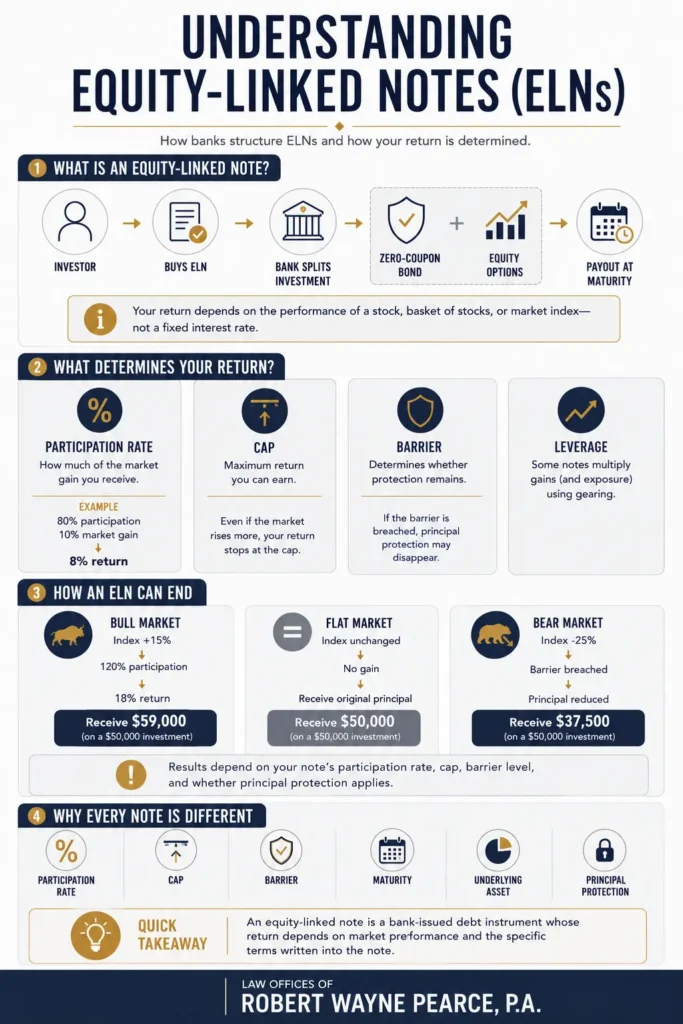
Most ELNs split into two pieces, with one portion that is often a zero-coupon bond sold below face value, and an equity option portion tied to the underlying. That second piece decides whether you earn anything above what you put in.
If a broker sold you one of these as a safer alternative to stocks and you later discovered how much you had at risk, we understand how unsettling that is.
How do Equity-Linked Notes Work?
When a bank issues an equity-linked note, it spends part of your money on the bond component and the rest on equity options. If the issuer buys a zero-coupon bond large enough to repay your full principal at maturity, the note is called principal-protected, and you recover your original investment even when the underlying falls.
Check the note’s terms to see whether principal protection applies. Plenty of issuers skip it. Instead, they offer a participation rate, which determines how much of the underlying’s gain passes through to the investor.
Say the participation rate is 80% and the index rises 10% over the term. The investor receives the original principal plus 8%, and the bank that sold the note keeps the remaining 2%.
Of course, there is a tradeoff, and it falls on your principal. When the underlying loses value, and your note carries no protection, that decline comes straight out of your investment.
Participation Rates, Caps, and Leverage
The participation rate sets your share of the gain from the underlying stock or market index, and the cost of structuring and managing the note usually pulls that rate below 100%.
At a 75% participation rate, a 5% gain in the underlying earns you only 3.75%. A cap works in the opposite direction by putting a ceiling on your return, so once the underlying climbs past that level, additional gains stop reaching you.
There is one more term you should look for. Some notes apply leverage, sometimes called gearing, which multiplies your exposure to the underlying’s movement.
If your note has 150% upside gearing, a 10% gain in the underlying becomes a 15% return. Some notes also calculate returns using the average index level on several observation dates and not a single closing value. But if the index jumps near the end of the term, the late gain may not be fully reflected in your return.
Equity-Linked Note Example
Let’s walk one note through three markets so you can see how this plays out. Consider a $50,000 note with a two-year term, linked to the S&P 500, carrying a 120% participation rate, a 20% cap, and protection that holds only if the index closes at or above 85% of its starting level.
Bull Market
The index gains 15% over the two years. Your 120% participation rate turns that into an 18% return, which comes in under the cap, so you receive $59,000 at maturity.
Had the index gained 25% instead, the cap would have limited your return to 20%, and the issuer would have kept the extra performance.
Bear Market
The index drops 25% and breaks the 85% barrier, so protection no longer applies and your principal absorbs the decline. You receive $37,500 back on a $50,000 investment.
That same barrier did nothing for you in the good scenario, and here it is what costs you. Partial protection is not a guarantee, and the worst case usually appears deep in the offering documents. You may be feeling that nobody walked you through this outcome before you signed.
Flat Market
The index finishes where it started, and the underlying equity remains unchanged over the investment period. So, there is no gain to convert, and you receive your $50,000 back.
Your statement may show no loss, but you also missed two years of dividends and the chance to earn a return.
What Are the Benefits of Equity-Linked Notes?
A broker likely sold you on the four points below, and each holds up under the right conditions.
Higher Return Potential
Linking returns to equities lets an ELN pay more than a conventional bond of similar length. That upside comes from the equity option component rather than from any coupon, which means it rises with your participation rate and shrinks under a cap.
Principal Protection
Principal protection means the issuer commits to returning your initial investment at maturity, funded by the zero-coupon bond inside the structure. Notes built this way are sold as principal-protected notes.
Pull your own paperwork and identify which version you own. Protection can be full, partial, or conditional on a barrier level, and each one gives you a different exposure.
Short Maturities
Many ELNs run short, from a few months out to a few years. Shorter terms let you put proceeds back to work sooner, though issuers design nearly all of these notes for you to hold to maturity rather than trade.
Flexibility
An ELN can be tailored to a specific stock, basket, or index, with the issuer adjusting participation, caps, barriers, and term to fit a stated risk profile. That same flexibility explains why two notes carrying nearly identical names behave nothing alike.
What Are the Risks of Equity-Linked Notes?
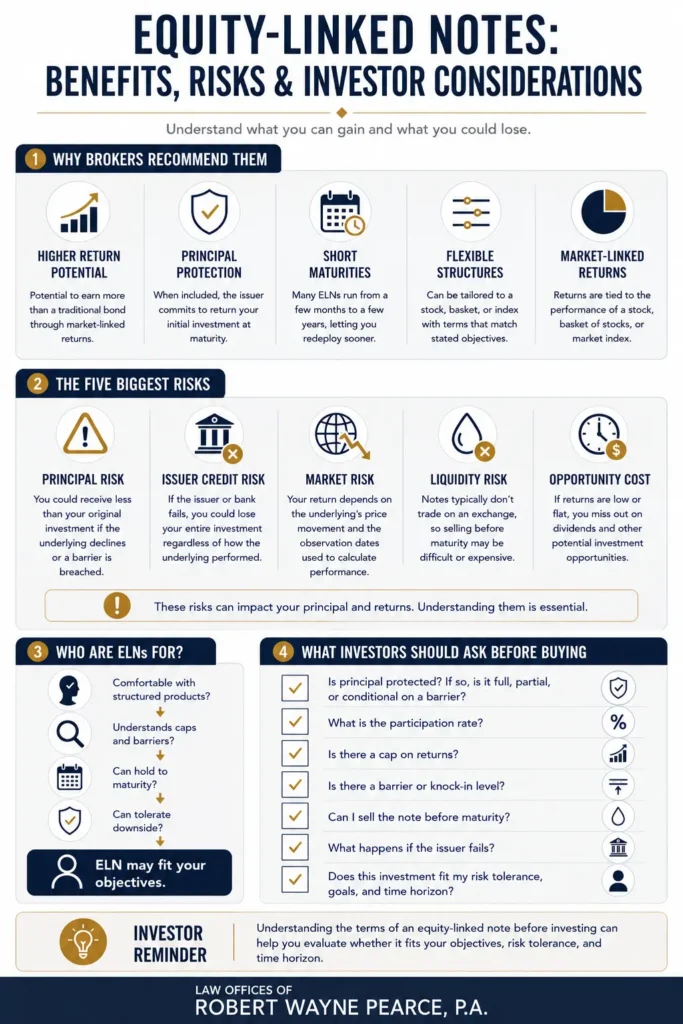
The five main risks of equity-linked notes are principal risk, issuer credit risk, market risk, liquidity risk, and opportunity cost:
Principal Risk
Principal risk is the chance you recover less than you put in. Notes without protection pass the underlying’s decline straight through to you, and a knock-in barrier cancels your protection entirely the moment the underlying touches that level.
Issuer Credit Risk
You only get paid back if the bank that issued your note is still standing. If the issuer fails, you can lose the entire investment no matter how well the underlying performed, as investors learned when Silicon Valley Bank collapsed in 2023.
Here at the Law Offices of Robert Wayne Pearce, P.A., we handle structured product cases and fight to recover what our clients are owed.
Market Risk
Market risk is your return’s exposure to the underlying’s price movement, and volatility around a valuation date can swing your outcome sharply.
The observation schedule deserves the same attention you gave the barrier. Only the reading on those set dates counts toward your payout, not the path the index took to reach them.
Liquidity Risk
Liquidity risk is what you face if you need to sell your note before it matures, since you may not receive its full value. Most equity-linked notes don’t trade on an exchange, so the issuer or one of its affiliates may be your only buyer.
Opportunity Cost
Opportunity cost is the return you gave up while your money sat in the note. If the note returns only the principal, you also do not receive dividends or earn returns from other investments.
Who Are Equity-Linked Notes For?
An ELN fits an investor who understands the terms, accepts the caps, and can absorb the downside without damage to their financial plan.
Your broker owes you a recommendation that actually fits your situation. FINRA groups equity-linked notes with other structured notes, including autocallable notes and reverse convertible notes, and has told firms to apply the same account scrutiny to these products that they apply to options trading. That obligation does not disappear because a product is complicated.
If you lost money on an equity-linked note that never fit your objectives, your risk tolerance, or your time horizon, you may have an unsuitable investment recommendation claim.
Contact the Law Offices of Robert Wayne Pearce P.A. if You’ve Been a Victim of Investment Fraud
If a broker sold you an equity-linked note without explaining the barrier, the cap, or the chance you could lose your principal, you may have been the victim of investment fraud. We understand how difficult it is to look at a statement and realize the product was never built for someone in your situation.
Here at the Law Offices of Robert Wayne Pearce, P.A., our attorneys have spent 45 years representing investors and have recovered more than $185 million in damages on their behalf. Our team recovers structured note losses through FINRA arbitration.
Contact our law offices at (866) 860-7447 for a free consultation, and we will review how this note was sold to you and what you can recover.