
Reverse convertible securities are short-term structured investments that combine a debt instrument with an embedded put option tied to an underlying asset. They usually offer above-market coupon payments, but investors may experience large principal losses if the core assets fall below a specified knock-in barrier.
These securities can provide higher income than traditional fixed-income investments, but they also carry significant market, liquidity, credit, and principal loss risks.
If you are considering investing in reverse convertible securities or believe you have suffered losses because of investment fraud or broker misconduct, the investment fraud attorneys at Robert Wayne Pearce, P.A. will walk you through how these securities work, the risks involved, warning signs of broker misconduct, and your potential options for recovering investment losses.
What Are Reverse Convertible Securities?
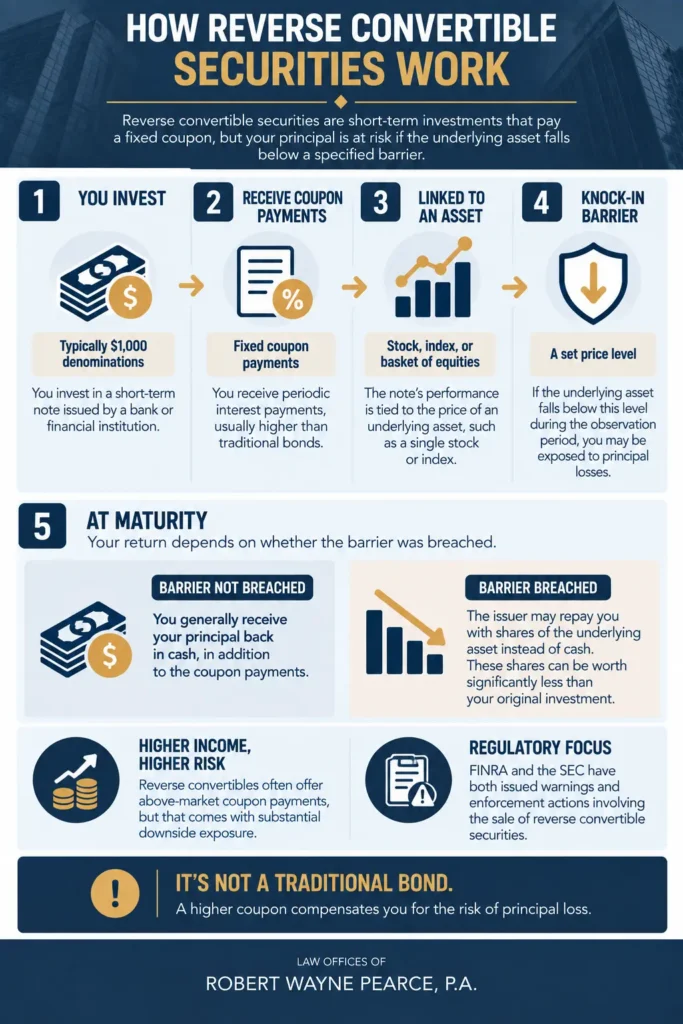
Reverse convertible securities are high-yield, short-term structured products that pair a debt instrument with an embedded put option linked to a reference asset.
They are typically linked to individual stocks, stock indexes, or baskets of equities and are commonly sold in $1,000 denominations.
Investors receive a fixed coupon through periodic interest payments until the maturity date, but many reverse convertibles include a knock-in barrier that can allow the issuer to repay principal through the conversion and delivery of depreciated shares rather than cash.
Brokers often market reverse convertible notes as income-producing investments because they generally offer coupon rates above those available on conventional bonds and other fixed-income securities. But the higher coupon compensates the investor for accepting substantial downside exposure to the underlying security. For that, they should always evaluate the coupon together with the risk of principal loss instead of treating the interest rate as a standalone benefit.
FINRA Regulatory Notice 10-09 warned brokerage firms about the complex risks associated with reverse convertibles and the obligations involved in recommending them to retail investors.
The SEC has also brought enforcement actions involving the sale of these products, including an action in which UBS agreed to pay more than $15 million over supervisory and training failures related to reverse convertible notes.
How Do Reverse Convertible Securities Work?
Reverse convertible securities pay investors a fixed coupon in exchange for exposing their principal to the performance of an underlying stock, index, or other reference asset. Economically, part of the transaction resembles the investor selling a put option to the issuer, which helps explain why the note can offer a higher coupon than an ordinary bond.
Many reverse convertibles have a knock-in barrier, which sets a price level that can expose the investor to principal losses. But that only happens if the linked asset falls below the barrier during the specified observation period.
Once the barrier is breached and the conversion conditions are met at maturity, the issuer may repay the investor with shares of the linked stock rather than returning the original principal in cash. In effect, an investment that began as a fixed-income security can leave the investor holding an equity position way less than the amount originally invested.
The scale of the market also demonstrates why these products have attracted regulatory attention. UBS alone sold approximately $10.7 billion in reverse convertible securities across roughly 44,000 customer accounts during the period addressed by the SEC’s enforcement action.
What Are the Risks of Reverse Convertible Securities?
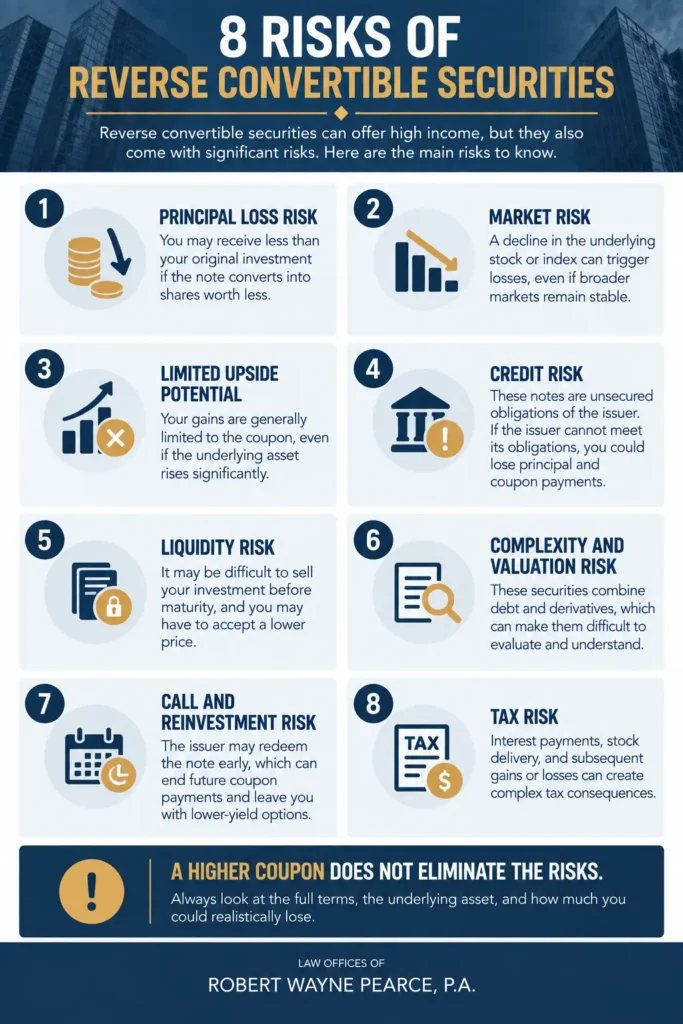
The main risks of reverse convertible securities are principal loss risk, market risk, limited upside potential, credit risk, liquidity risk, complexity and valuation risk, call and reinvestment risk, and tax risk.
Principal Loss Risk
One biggest concern is the possibility of losing part of the principal. The amount returned at maturity may be less than what the investor initially paid, depending on the note’s terms and how the investment is settled. This can leave the investor with a loss even after receiving the scheduled coupon payments.
When a barrier is breached and conversion occurs, the investor may receive shares worth considerably less than the original principal. For example, an investor who commits $100,000 to a reverse convertible could receive stock worth substantially less than $100,000 at maturity if the underlying shares have fallen sharply.
Market Risk
Market risk arises from changes in the value of the stock, index, or other asset linked to the reverse convertible. A huge decline in that reference asset can trigger conversion and expose the investor to principal losses even when the broader financial markets remain relatively stable.
This risk may be greater when the reverse convertible is based on a single stock. Earnings disappointments, regulatory issues, product failures, management problems, and other company-specific events can send the stock price lower and potentially push it below the note’s barrier.
Limited Upside Potential
Reverse convertibles generally limit an investor’s upside to the coupon payments specified by the note. If the underlying stock increases substantially in value, the investor ordinarily does not participate in that capital appreciation in the same manner as a shareholder.
For example, if the linked stock rises by 30%, the reverse convertible investor may still receive only the predetermined coupon and repayment provided under the note’s terms. The investor has accepted exposure to the stock’s downside without receiving equivalent participation in its upside.
Credit Risk
Reverse convertible securities are generally unsecured obligations of the issuing bank or financial institution. Investors therefore face credit risk in addition to the market risk associated with the underlying security.
If the issuer becomes unable to meet its obligations, an investor could lose principal and expected coupon payments regardless of how the underlying stock performs. The financial crisis demonstrated that the credit quality of major financial institutions can deteriorate rapidly during periods of severe market stress.
Liquidity Risk
Selling the investment before maturity may be difficult because there may be little or no active secondary market for a particular note. An investor who needs access to their money before maturity may have trouble finding a buyer at a reasonable price.
Even where an issuer or broker-dealer is willing to repurchase the security, the offered price may be substantially below its theoretical value or the investor’s original purchase price. Market movements, interest rates, volatility, issuer credit quality, and the remaining time to maturity can all affect the price.
Complexity and Valuation Risk
Reverse convertible securities combine debt instruments with embedded derivatives, which makes them considerably more difficult to evaluate than ordinary stocks or bonds. Understanding their fair value may require analysis of option pricing, volatility, barrier levels, interest rates, issuer credit risk, and other variables.
The relationship between the coupon, barrier, underlying asset, and conversion provisions may not be clear to an ordinary retail investor. If a broker does not adequately explain how these features interact, the investor may misunderstand both the probability and potential size of a loss.
Call and Reinvestment Risk
Some reverse convertible securities permit the issuer to redeem or call the note before its scheduled maturity date. When that occurs, the investor receives their money back earlier than expected and loses the future coupon payments they anticipated receiving.
Issuers generally exercise contractual call rights when doing so is economically advantageous under the terms of the security. This can leave the investor having to reinvest the returned principal when comparable investments offer lower yields.
Tax Risk
Reverse convertible securities can create complicated tax consequences because the investment combines interest payments, derivative exposure, and potentially the delivery of stock at maturity. The tax treatment may differ from what an investor expects from a conventional bond or equity investment.
If shares are delivered at maturity, the transaction can create additional tax and cost-basis considerations that the investor must properly report. Subsequent gains or losses on the shares can create further reporting obligations.
What Are Signs That Your Stockbroker Has Committed Fraud?
The signs that your broker has committed fraud with your reverse convertible notes are:
Your Broker Misrepresented the Investment as Safe
Misrepresentation may occur when a broker presents a reverse convertible as a safe or bond-like investment without adequately explaining the embedded equity risk and possibility of substantial principal loss. Brokers and brokerage firms have obligations concerning fair dealing, suitability, and disclosure when recommending complex securities.
Comparing a reverse convertible to a certificate of deposit or conventional bond can create a misleading impression if the broker fails to explain the material differences. A CD does not ordinarily expose its principal to the decline of an unrelated stock through an embedded put option.
Marketing discussions that focus heavily on an attractive coupon while minimizing the possibility of conversion and principal loss can similarly leave an investor with an incomplete understanding of the product. An investor who was told their money was safe may reasonably be concerned when they later learn that a decline in the underlying stock could significantly reduce their principal.
Regulators have previously taken action involving unsuitable sales of reverse convertible securities, including FINRA’s case concerning H&R Block Financial Advisors and sales to customers including a retired couple.
Your Broker Failed to Explain the Risk of Losing Principal
A broker recommending a reverse convertible should clearly explain the circumstances under which the investor can lose principal. This includes explaining the applicable knock-in barrier, conversion provisions, underlying security, and consequences if the relevant conditions are triggered.
Some investors do not fully understand this feature until the underlying stock has already breached the barrier and their investment is facing conversion. At that point, the difference between a high-income note and a principal-protected bond becomes clear.
FINRA has emphasized the need for firms selling complex products to understand the securities they recommend and determine whether those recommendations are appropriate for particular customers. The SEC’s UBS enforcement action also addressed inadequate training and supervision involving reverse convertible notes.
Your Broker Failed to Disclose Important Risks or Fees
A broker’s recommendation should account for material information that could affect an investor’s decision, including liquidity limitations, issuer credit risk, embedded costs, commissions, and the possibility of principal loss.
Structured products can generate compensation that differs from the costs associated with ordinary stocks and bonds. Where commissions or other economic incentives are significant, investors should receive sufficient information to understand the costs associated with the recommendation.
Undisclosed costs can reduce an investor’s effective return and make an apparently attractive coupon less compelling after accounting for risk.
The Law Offices of Robert Wayne Pearce examines compensation and transaction history when evaluating whether a recommendation may have been influenced by incentives that conflicted with the investor’s interests.
Regulatory cases involving reverse convertibles have included allegations concerning brokers who earned substantial compensation from recommending these securities, including a Wells Fargo broker reported to have earned more than $1 million from the transactions at issue.
The Investment Was Unsuitable for Your Risk Tolerance or Financial Situation
A recommendation may be unsuitable when a reverse convertible does not correspond with the investor’s objectives, financial circumstances, risk tolerance, liquidity needs, or investment time horizon. Depending on when the recommendation occurred and the circumstances involved, FINRA suitability requirements and Regulation Best Interest may be relevant to the broker’s conduct.
Retired investors and people who depend on their investment portfolios for income can be particularly attracted to the higher coupons offered by reverse convertibles. However, an investor’s desire for income does not necessarily mean they can withstand a substantial loss of principal.
A proper assessment should consider whether the investor could financially tolerate the downside associated with the underlying security. If significant principal loss would jeopardize retirement income, living expenses, or other financial objectives, that fact may be highly relevant to whether the recommendation was appropriate.
FINRA has brought enforcement actions involving unsuitable reverse convertible recommendations, including a $2 million sanction against Wells Fargo Investments relating to sales to 21 customers.
Your Portfolio Was Overconcentrated in Reverse Convertible Securities
Overconcentration occurs when too much of an investor’s portfolio is exposed to reverse convertibles or related risks. Even where an individual investment might otherwise be appropriate, repeatedly placing substantial portions of a customer’s assets into similar structured products can create excessive portfolio-level exposure.
Owning several different reverse convertibles does not necessarily provide meaningful diversification. Different notes may share similar barrier structures, issuer credit exposure, equity-market sensitivity, and principal-loss characteristics.
Repeated recommendations can therefore magnify the consequences of a market decline. They can also raise questions about whether the recommendations were driven by the customer’s investment needs or by the compensation generated from repeated structured-product transactions.
FINRA’s early enforcement actions involving reverse convertibles addressed concentration concerns, including its action involving H&R Block Financial Advisors.
Contact the Law Offices of Robert Wayne Pearce if You’ve Been the Victim of Investment Fraud
The Law Offices of Robert Wayne Pearce represents investors who have suffered losses involving reverse convertible securities and other structured products. The firm investigates claims involving investment fraud, misrepresentation, unsuitable recommendations, failure to disclose material risks, overconcentration, and broker negligence.
Attorney Robert Wayne Pearce has more than 40 years of experience handling securities arbitration and litigation matters.
The firm handles securities claims on a contingency-fee basis, so clients do not pay an upfront attorney’s fee to retain the firm. This arrangement allows investors to have a potential claim evaluated without first committing substantial funds to legal fees.