
FINRA Rule 5310 states that “In any transaction for or with a customer or a customer of another broker-dealer, a member and persons associated with a member shall use reasonable diligence…”. From there, the rule goes on to describe how the broker-dealer must obtain the best price possible under prevailing market conditions.
In other words, they must execute the trade so the price is as favorable to you as possible.
When you place an order with a broker-dealer, you trust that firm to seek the most favorable execution reasonably available under the circumstances. FINRA 5310 codifies this as a legal duty rather than a courtesy. It governs how firms route customer orders, evaluate execution quality, and document compliance with their best execution obligations.
If a broker put their own profits ahead of your execution, you may have received a worse price. Below, we explain how the rule works, the warning signs of a best execution violation, and when speaking with a FINRA arbitration lawyer may help you recover your losses.
What is FINRA Rule 5310?

FINRA Rule 5310 requires broker-dealers to exercise reasonable diligence to get the most favorable terms possible under prevailing market conditions. The duty applies to any transaction handled for or with a customer, whether the firm acts as your agent or trades directly with you as principal.
The rule reaches far beyond ordinary stocks. The rule applies to a wide range of securities, including stocks, options, bonds, and foreign securities handled by FINRA member firms. Firms cannot pick and choose which trades deserve careful handling.
This standard grew out of the older NASD “Best Execution and Interpositioning” rule and carries forward those best execution obligations into FINRA’s consolidated rulebook. If you’ve trusted a firm to seek the best available execution requirement for your orders, decades of securities regulation stand behind that expectation, and the Financial Industry Regulatory Authority (FINRA) can enforce it.
Key Components of Rule 5310
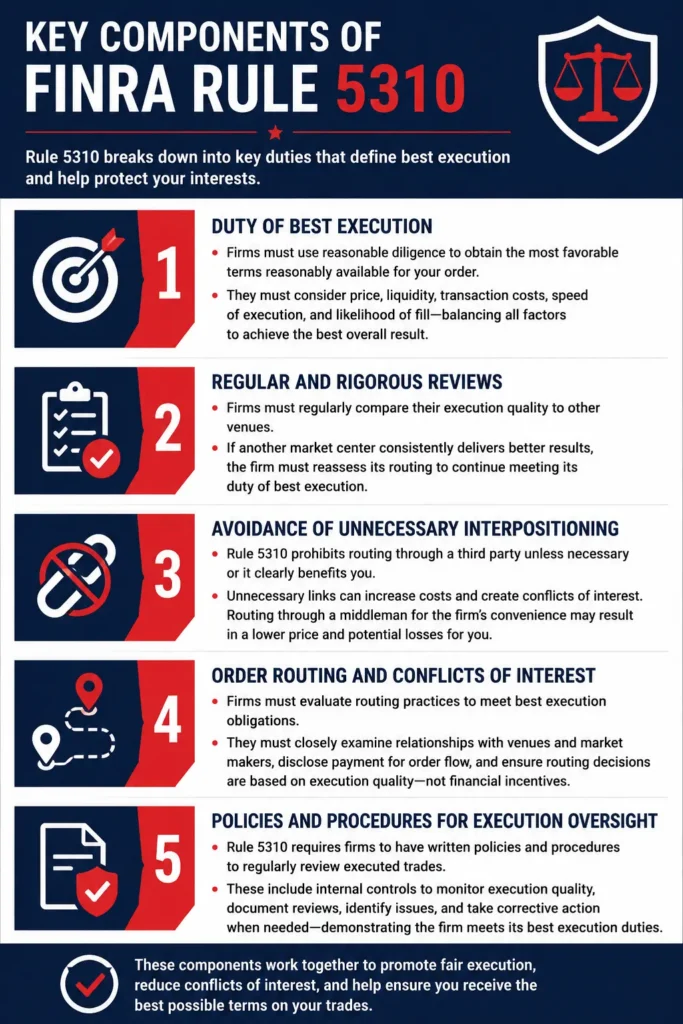
Rule 5310 breaks down into a handful of duties that together define what best execution looks like in practice. Each one targets a different way a firm could shortchange you, and understanding them helps you see where a broker may have fallen short.
Duty of Best Execution
The duty of best execution rule requires a firm to exercise reasonable diligence to ascertain the most favorable terms reasonably available for your order. If you’re trying to buy a stock, for example, it’ll look for the lowest price under such market conditions. On the other hand, if you’re looking to sell, it’ll also look for the highest one.
To meet this duty, the firm has to weigh several things at once. It considers the price, the liquidity available, the transaction costs, the speed of execution, and the likelihood that your order fills at all. A firm that fixates on one factor while ignoring the rest is unlikely to meet the obligation of due diligence.
Regular and Rigorous Reviews
Firms should compare their results against what other venues could have delivered. If another market center consistently delivers better execution quality, the firm should reassess where it routes customer orders to ensure it is still meeting its duty of best execution.
Avoidance of Unnecessary Interpositioning
Interpositioning means placing a third party between the firm and the execution venue, which Rule 5310 may prohibit unless it’s necessary or the extra party clearly provides a benefit to you.
The rule forbids this because the unnecessary link in your chain can add to the total cost of the transaction. Furthermore, it opens the door to conflicts of interest that may work against your account. There are instances where firms route through a middleman for their own convenience, rather than your advantage.
Doing it this way may cut the price you should have received, which may lead to stock market losses.
Order Routing and Conflicts of Interest
Routing firms evaluate their order routing practices to confirm they meet their best execution obligations.
That means examining relationships with execution venues and market makers with a careful eye. Firms must disclose payment for order flow arrangements and make sure routing arrangements turn on execution quality rather than the financial incentives a venue offers them. When those incentives steer your order, the conflict of interest may result in your loss.
Policies and Procedures for Execution Oversight
Rule 5310 requires written policies and procedures from firms on how to regularly review the trades being executed.
These supervisory procedures typically include internal controls to monitor execution quality, document periodic reviews, identify potential problems, and take corrective action when needed. Together, they help firms demonstrate that they are meeting their best execution obligations.
Purpose of FINRA Rule 5310

FINRA Rule 5310 exists to protect you. Its central purpose is to protect investors by requiring firms to use reasonable diligence every time they execute a trade.
There are several reasons for this.
The rule helps you get the most favorable terms available, encourages firms to regularly review how orders are executed, and reduces potential conflicts of interest in routing decisions. Together, these aims build confidence that the market treats ordinary investors fairly.
Aside from that, this rule also pushes firms to keep improving. It expects them to continuously evaluate and refine their execution methods, because a market that never stands still demands practices that evolve with it. When a firm ignores that expectation, the investors who trusted it are the ones who pay.
What Does Reasonable Diligence Require?
Reasonable diligence means the firm made a genuine effort to find the best market for your order at the moment it arrived. It does not demand a perfect outcome, but it does require the firm to make reasonable effort to get the best execution possible.
FINRA names five factors that shape this duty: the character of the market for the subject security, the size and type of transaction, the number of markets checked, the accessibility of the quotation, and the terms of your order. A firm that ignores these factors and never works to find the best market is not exercising the diligence the rule requires. Each factor forces the firm to think about your specific order rather than treating it as one more entry in a queue.
A firm also cannot excuse a poor result by pointing to a busy desk, understaffing, or slow systems. You should never absorb the cost of a firm’s operational problems, and regulators expect firms to be ready to handle your order promptly even on a hectic day.
What is Interpositioning?
Interpositioning happens when a firm inserts a third party between itself and the best available market. Rule 5310 permits this only when the added party is necessary or has given clear benefits to you.
The rule shares its title with interpositioning for a reason. FINRA treats an unnecessary middleman as unnecessary to your execution quality, because each extra hand in the trade can quietly shave value off your price.
Sometimes, there are legitimate reasons for this. A firm may route through a broker’s broker, meaning an intermediary that keeps the firm’s identity hidden, so that a large order does not move the price against you before it fills. Used this way, the middleman protects you rather than the firm.
The problem arises when a firm adds a third party out of habit, convenience, or because of its own business interest rather than to improve your execution. When that extra step adds cost or delay without helping you, it may fall short of the firm’s best execution obligations and leave you with a less favorable result.
How Do Firms Review Execution Quality?
Rule 5310 requires member firms to either conduct an order-by-order review of your orders or perform “regular and rigorous” reviews of execution quality at least quarterly. A firm must make every effort to execute a marketable customer order fully and promptly, and its best execution analysis has to show that effort.
These execution quality reviews run on a security-by-security, type-of-order basis. That means the firm has to look separately at market orders, marketable limit orders, and non-marketable limit orders rather than lumping them together and calling it a day. A review that glosses over these categories does not meet the standard the rule sets.
During each review, the firm compares its current order routing against competing markets. If another venue consistently offers better results, the firm must change its routing or document a sound reason for keeping it in place.
The review also weighs concrete measures of quality, including price improvement, likelihood of execution, speed, size, transaction costs, and any payment for order flow arrangements. When a firm skips this analysis, it loses the ability to show that your orders received the execution you were owed.
How Does Payment for Order Flow Affect Best Execution?
Payment for order flow is legal, but it carries an obvious tension. It creates a conflict of interest that a firm cannot allow to influence where your orders go.
The Securities and Exchange Commission (SEC) defines payment for order flow broadly. It includes not only cash but also rebates, credits, and other in-kind inducements a firm receives for directing orders, and the risk grows sharper when a firm routes to affiliated broker-dealers.
FINRA has been direct on this point. Benefits from these arrangements may not distort a firm’s analysis of which market offers you the best terms, and a firm that lets them do so breaches its duty.
Disclosure does not solve the problem either. Reporting these arrangements under SEC Rules 606 and 607 of Regulation NMS does not satisfy or reduce the underlying best execution duty, so a firm cannot bury a bad routing practice inside a compliant-looking disclosure.
FINRA Rule 5310 Enforcement Cases and Fines
FINRA has brought major enforcement actions against firms that failed to meet their best execution obligations, and the penalties show how seriously it treats the duty. Some well known FINRA Rule 5310 enforcement cases include:
- FINRA fined Deutsche Bank Securities $2 million in 2022 after finding that it routed orders to its own internal system without checking whether other venues offered better prices.
- FINRA fined Virtu Americas $175,000 in 2024 for failing to conduct the regular and rigorous reviews required by the rule and for weak documentation of its routing decisions.
. - Robinhood also paid roughly $70 million in a 2021 FINRA settlement tied in part to order routing and execution failures. This event proves that no-commission brokers are held to the same standard as everyone else.
What Can Investors Do About a Best Execution Failure?
An investor harmed by poor execution may have a claim when a firm’s routing or review practices fell short of Rule 5310. If your orders were mishandled, don’t worry; you have a path to hold the firm accountable, and you may be able to recover what the failure cost you.
If you’re unsure whether the firm had a shortcoming, there are certain patterns you can look for. These warning signs include:
- Consistently poor fills
- A heavy reliance on affiliated venues, without evidence of best execution reviews
- and no evidence that the firm ever compared competing markets before sending your trades
A securities attorney can request the firm’s order routing data and Rule 606 reports to assess whether it ignored better prices available to you. That documentation often reveals whether the firm truly reviewed execution quality or simply claimed it did.
Most of these disputes move through FINRA arbitration rather than the court system. This is the forum where investors typically bring best execution claims and pursue recovery from the firms that handled their orders.
Contact Robert Wayne Pearce About a Best Execution Claim
If you suspect a broker-dealer failed in their duty to seek the best execution on your orders, the Law Offices of Robert Wayne Pearce, P.A., can review your account and tell you where you stand. We represent investors nationwide in FINRA arbitration and securities disputes, and we know how to read the routing records that reveal what really happened.
Here at the Law Offices of Robert Wayne Pearce, P.A., we focus on investment loss cases and fight to recover everything our clients are owed. We draw on more than 45 years of experience and over $185 million recovered for investors, so you do not have to sort out a complicated execution failure on your own.
Contact us at (866) 860-7447 for a consultation with an investment fraud lawyer to see if a broker’s best execution failure cost you money. We will review what happened and explain your options clearly.