
Discretionary and non-discretionary investment accounts are different in who has the authority to make trades.
With a discretionary account, your broker or advisor trades without your approval, while a non-discretionary account requires your broker to seek client approval before a trade is made.
When investors first set up an account with a brokerage firm, their account may be set up with either discretionary or non-discretionary trading authority.
Unfortunately, many investors are simply unaware of the status of their account or what it means. This is usually because investment brokers fail to properly explain each type of account.
However, knowing what kind of investment account you have is important. The claims available to a victim of investment fraud or broker misconduct depend on the status of your account.
This guide details discretionary accounts and non-discretionary accounts. We’ll cover the benefits and drawbacks of each, how to choose between them, and what broker misconduct can look like in either type of account. we explain how discretionary and non-discretionary accounts work.
Discretionary vs. Non-Discretionary Accounts

As mentioned, a discretionary account is an investment account in which an investment advisor has the power to make individual trades without requiring client approval.
In comparison, a non-discretionary account means the client has complete control over whether or not to execute a trade.
What is a Discretionary Account?
For discretionary accounts, also called managed accounts, your broker or financial advisor has the freedom to make trades without contacting you first.
However, this discretionary authority does not mean that the broker has independent authority to do whatever they want; investors may still place limits or give instructions regarding the kinds of trades the broker is allowed to make.
What is a Non-Discretionary Account?
For non-discretionary accounts, on the other hand, your broker must contact you before conducting any trade.
Non-discretionary accounts are better for investors who want to take a more active role in their investments. Brokers for this account still make investment recommendations, but they can’t act on those recommendations before obtaining the client’s explicit approval.
Acting in Your Best Interest
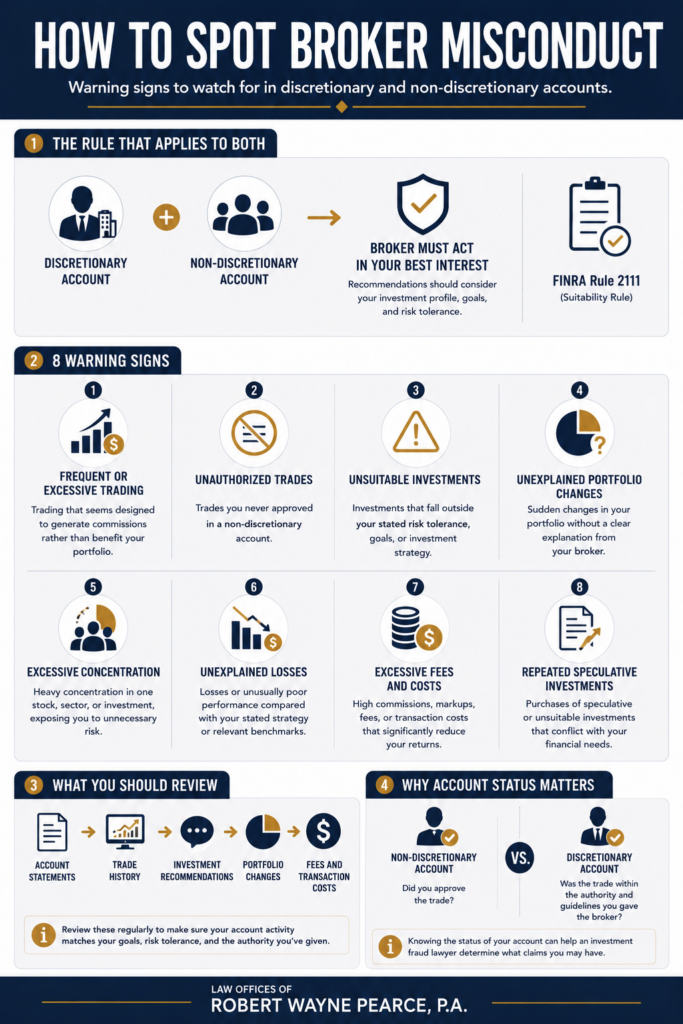
Keep in mind that regardless of the type of account you have, your broker is duty-bound to make trades in your best interest.
Brokers and financial advisers are required to make trades that are suitable for your goals and risk tolerances. FINRA Rule 2111 (or the Suitability Rule) requires them to consider a customer’s investment profile when making a recommendation.
A broker’s failure to do so exposes them to potential liability for unauthorized trading or breach of fiduciary duty. Knowing the status of your account helps an investment fraud lawyer determine what claims you may have.
Discretionary vs Non-Discretionary: Which Type of Account Should I Choose?
Choose a discretionary account when you want a professional to manage your trades without getting your approval for each transaction. But if you want to make your own trading decisions and review and approve each trade yourself, a non-discretionary account may be a better fit.
The reason for this is that each account gives you a different level of involvement in managing your investments. Consider how much control you want and how closely you want to be involved in your broker’s decisions.
Benefits of a Discretionary Account
Discretionary accounts give brokers more freedom to manage investments without waiting for the investor’s approval. It’s a good option for passive investors who prefer to leave day-to-day trading decisions to a professional.
With that flexibility, brokers can make timely decisions when market conditions change or new investment opportunities arise.
Consider the following example. You have an account with a broker who manages dozens of accounts besides yours. One day, your broker finds an investment opportunity that is perfect for all the accounts they manage.
If your account is discretionary, the broker makes the trade immediately without contacting you, which allows them to secure the best possible price. If your account is non-discretionary, however, your broker must get your permission before making the trade.
This may not make much of a difference if you are the first investor the broker contacts. But because the broker manages dozens of other accounts, you run the risk of losing out on the best price for the investment.
It also applies to day-to-day investment management. For example, if you’ve instructed your broker that you want to maintain a balance of 35% stocks to 65% bonds in your portfolio, a discretionary broker can make adjustments to maintain this balance without your consent.
Disadvantages of a Discretionary Account
Like other managed investment accounts, discretionary accounts also have some drawbacks.
One of them is the higher minimum investment that some brokerage firms require to open an account.
It’s up to the firm, but investors may need to meet a higher minimum investment (about low-to-mid six figures) before they can use a discretionary account. For very few individual investors, that minimum may be difficult to meet.
Discretionary accounts are also usually more expensive because they require a manager to handle risk and trading. Fees for discretionary accounts can be anywhere from 1% to 2% per year depending on the brokerage firm.
Benefits of a Non-Discretionary Account
While discretionary accounts excel at flexibility, non-discretionary accounts provide more control to their investors. Handing over a huge portion of your financial assets and investment funds to a brokerage firm is a big decision.
Some investors may be uncomfortable doing so and may not fully trust their broker to make all the right decisions. In those situations, non-discretionary accounts provide a compromise.
Non-discretionary accounts will be a more attractive choice to investors who want more direct control over their investments.
Because their broker must get permission before making a trade, investors will have the final say in all investment decisions. As a result, the investors have the opportunity to assess their broker’s advice before moving forward.
Disadvantages of a Non-Discretionary Account
The biggest disadvantage of a non-discretionary account is your broker’s inability to react quickly when an investment opportunity arises. As in the example above, a broker managing dozens of non-discretionary accounts must get consent from investors before executing trades in their respective accounts.
If your name is in the middle of that list, the price you pay will depend on how many clients your broker contacted before getting to you. Even if your name is first on the list, non-discretionary accounts may fall victim to the phone tag problem; you may not see or respond to the broker’s request for your permission until after the opportunity has passed.
How to Spot Broker Misconduct in Your Accounts
The most common signs of broker misconduct are:
- Frequent or excessive trading: Trading that seems designed to generate commissions rather than benefit your portfolio.
- Unauthorized trades: Trades you never approved in a non-discretionary account.
- Unsuitable investments: Investments that fall outside your stated risk tolerance, goals, or investment strategy.
- Unexplained portfolio changes: Sudden changes in your portfolio without a clear explanation from your broker.
- Excessive concentration: Heavy concentration in one stock, sector, or investment, exposing you to unnecessary risk.
- Unexplained losses: Losses or unusually poor performance compared with your stated strategy or relevant benchmarks.
- Excessive fees and costs: High commissions, markups, fees, or transaction costs that significantly reduce your returns.
- Repeated speculative investments: Purchases of speculative or unsuitable investments that conflict with your financial needs.
Hire an Investment Fraud Attorney
At The Law Offices of Robert Wayne Pearce, P.A., we have over 45 years of experience helping investors recover their money from bad investments.
If you are the victim of investment fraud or if your broker has failed to invest your money according to your needs, we can help. Contact us today or give us a call at 833-300-6983 for a free consultation.