

Form U5 stands for the Uniform Termination Notice for Securities Industry Registration, and it’s the document that legally ends your registration with a firm.
If you are a registered representative facing a termination, understanding how Form U5 works is very much needed because the wording on that form becomes part of your permanent professional record.
Most advisors don’t find out what’s at stake until the form is already filed. At the Law Offices of Robert Wayne Pearce, P.A., we represent brokers and financial advisors in FINRA disputes nationwide, including Form U5 defamation and abuse claims.
If you believe your former firm misstated the reason for your departure, contact us before the U5 gets finalized.
What Is Form U5?
Form U5 is the document a brokerage firm or investment adviser files with FINRA to officially end a financial professional’s registration and sever their association with the firm.
Member firms file it with the Financial Industry Regulatory Authority to report that a registered person’s association with the firm has ended, and it becomes part of that person’s record visible to other regulatory bodies.
The form captures the termination date and the reason for the termination, along with the termination and disclosure questions and any disclosure events tied to the departure.
Filing the form also updates branch office address information and the termination and residential information, including the individual’s residential addresses on record. Regulators, current firms, and prospective employers can all see what it contains, which is why its accuracy matters so much.
Form U5 is the counterpart to Form U4, the document filed when you register with a firm. The same framework applies to investment adviser firms and their investment adviser representatives under related self-regulatory organization rules. Together they bookend your time at each firm, and the U5 is the one that records how that chapter ended.
Who Files Form U5 and When
The member firm, not the individual, files Form U5. When your association with a firm ends for any reason, the firm is responsible for the filing process and for reporting your departure. The initial submission records the individual’s employment end date.
The 30-Day Filing Deadline
Firms must file Form U5 within 30 days of the termination. This deadline applies regardless of why the association ended, whether you resigned, were let go, or moved to another firm.
The timing matters because several deadlines start running the moment that filing hits the system. You won’t see what your former employer wrote until the U5 actually posts. So follow up early. Don’t wait around hoping it lands in your favor. Both you and the firm have a stake in getting the record right.
Types of U5 Filings
Form U5 is not a single fixed document. Firms file different versions depending on the situation, and knowing which one applies to you clarifies what is happening with your record.
Full Termination
A full Form U5 ends every one of your registrations with the firm. If you leave entirely, this is the version that gets filed.
Partial U5 Filing
You can lose registration in one jurisdiction while staying active in others. Partial U5 filing skips the reason-for-termination and disclosure questions entirely, and it only updates your residential address, not your branch office information.
Can a Firm Change Your U5 After Filing It?
Yes. An amendment form updates the disclosure, the termination date, or the reason for termination after the original submission, sometimes once an internal investigation reaches its final disposition.
Your former employer can revise the language on your record months or years after you’ve left, which can reopen issues you thought were settled.
Reasons for Termination on Form U5
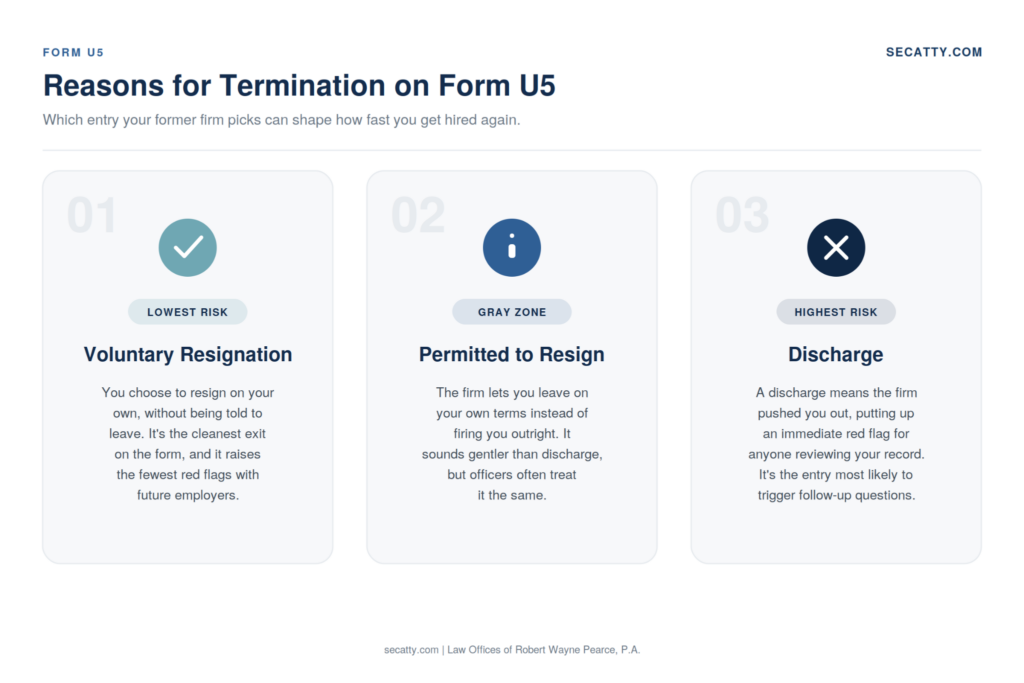
Form U5 requires the firm to state why your association ended. In practice, almost every dispute comes down to three common reasons. We’ll cover each one below.
Voluntary Resignation
In voluntary resignation, you choose to resign on your own without the firm telling you to do so. It’s the cleanest exit on the form, and it raises the fewest red flags with future employers.
Permitted to Resign
The firm lets you leave on your own terms instead of firing you outright. It sounds gentler than discharge, but plenty of compliance officers treat it the same way when they’re screening candidates, so don’t assume it protects you the way a true voluntary resignation does.
Discharge
A discharge means the firm pushed you out, and it puts up an immediate red flag for anyone reviewing your record. This is the entry most likely to trigger follow-up questions from a future employer, and the one worth fighting hardest if the explanation attached to it isn’t accurate.
How U5 Language Affects Your Career
The language on your Form U5 can open or close doors for years. Potential employers and prospective employers, including any broker-dealer considering you, routinely review it before hiring, and unfavorable wording can damage your professional reputation and future career prospects before you ever get an interview.
For example, a U5 that describes a termination tied to a customer complaint or a compliance issue signals risk to any firm considering you. Even when the underlying facts are minor, the entry alone can shrink your future opportunities in the industry.
Your U5 stays on your record, and that language resurfaces every time you apply somewhere new. An inaccurate or unfair entry can cost you opportunities for years after the original event, and any customer complaint noted on the form only makes it worse.
U5 Defamation: When the Language Is False or Misleading
When a firm puts false or misleading statements on your Form U5, you may have a claim for defamation. This is one of the most important protections available to advisors who believe their U5 unfairly damaged their reputation.
Defamation in this context means the firm published a false statement of fact that harmed your professional standing. FINRA rules and broader industry rules give you a path to challenge it, and seeking legal counsel early helps you work through the legal process effectively.
A U5 that misstates the reason for your departure, or includes accusations the firm cannot support, can cross the line from a fair record into actionable defamation.
These claims carry real weight because of where the statements appear. A U5 goes to regulators and prospective employers. A false entry is not a private grievance. It is a damaging statement broadcast to the people who decide your future in the industry.
Many advisors pursue these claims through the arbitration process before a FINRA arbitration panel, where they can seek both expungement of the false language and damages for the harm it caused. Form U5 termination disputes often turn on mitigating circumstances.
The Two-Year Jurisdiction Window
FINRA retains jurisdiction over you for two years after your Form U5 is filed. This window has important consequences for how long you remain exposed to regulatory action tied to your time at the firm.
During this period, FINRA retains jurisdiction over you for at least two years after your registration ends, and that window doesn’t close just because you’ve moved on. During that time, you may have to respond to FINRA requests for information about your activities while you were registered with the firm.
Disputing Inaccuracies on Form U5
If your Form U5 contains inaccurate or unfair information, you do not have to simply accept it. Several paths exist for challenging the language and protecting your record.
Expungement and FINRA Arbitration
Expungement is the process of removing inaccurate information from your record, and it generally requires an arbitration award or court order directing the change. You typically pursue it through FINRA’s dispute resolution forum.
The process is demanding, and the standards are strict, which is why preparation matters. You will need to show that the information is false, misleading, or otherwise meets the grounds for removal. Relevant guidance and experienced attorneys who know how entitled system users access these records often make the difference between a cleared record and a lasting mark.
Adding Your Side to BrokerCheck
If expungement is not available, you can submit a statement that appears alongside the disclosure on BrokerCheck. This lets you give context that anyone reviewing your record will see.
A well-written statement won’t erase the entry, but it can soften its impact. Explaining your side in clear, professional language gives prospective employers more than just the firm’s version of events.
Many advisors pair this step with a formal BrokerCheck dispute request too, since that process exists separately for challenging factual inaccuracies.
Why Legal Counsel Matters
These disputes are difficult to handle alone, and the stakes for your career are high. Experienced legal counsel can assess whether you have grounds for defamation, expungement, or another challenge, and can build the case that gives you the best chance of success.
Expungement standards, arbitration procedures, and defamation elements each carry technical requirements that are easy to miss on your own. One missed deadline or skipped procedural step can cost you a remedy you were otherwise entitled to. Lawyers who handle these cases regularly know how to position yours.
How an Attorney Can Help
An experienced securities attorney can review your Form U5, identify false or misleading language, and advise you on the strongest path to correcting it. Whether that means pursuing defamation, seeking expungement, or both, a lawyer can map out your options.
Acting quickly protects your interests, particularly given the deadlines and jurisdictional windows that apply. If your U5 contains language that is damaging your career, a consultation can clarify what you are facing and what can be done about it, before the entry costs you another opportunity.