
A Ponzi scheme is investment fraud that pays existing investors with money collected from new investors instead of profits from real business activity.
In a Ponzi Scheme, the fraudster pays out fake returns to early investors using money from new investors without making any real profit. It is named after Charles Ponzi, who ran a famous Ponzi scam in the 1920s.
If you have been offered an investment promising consistent double-digit returns with no apparent downside, you have already encountered the standard pitch. The structure behind it does not change.
In this guide, our investment fraud lawyer team will walk you through how Ponzi schemes work, how Ponzi scheme promoters operate, famous cases, and the red flags that can help you spot one. We’ll even give advice on how you could get your money back, depending on the circumstances.
What is a Ponzi Scheme?
A Ponzi scheme is investment fraud that pays existing investors with money collected from new investors instead of profits from real business activity.
Unlike mutual funds and other legitimate investments, no trading, lending, or operating business generates the returns. Every payout pulls from the same pool of incoming deposits.
The promoter typically promises high returns with little or no risk, describes the strategy as proprietary or too complex to explain in detail, and points to early investors’ returns as proof that the investment works. Those early returns are real payments, but they come from other investors’ deposits, not from market performance.
The scheme collapses when new deposits are no longer enough to cover what the promoter owes existing investors. And that can happen when fewer people put money into the scheme or when existing investors cash out all at once.
How Do Ponzi Schemes Work
Ponzi schemes move through five stages. Each one depends on the stage before it, and the entire structure fails the moment any single stage breaks down.
Here’s how a Ponzi scheme typically works:
- The pitch: The investment opportunity is framed as exclusive, with projected returns above what legitimate markets produce. The strategy is described in terms complex enough to discourage follow-up questions.
- Early payouts: Initial investors receive payments in full and on schedule. No trading or business activity generated the money, but the payments make it easier for the promoter to convince new investors to transfer money into the scheme.
- Recruitment: Paid investors bring in friends, family, and colleagues. Their endorsement is sincere because they believe their returns are real.
- New money funds old payouts: Every distribution to previous investors comes from incoming deposits. The promoter skims a portion for personal use while maintaining the appearance of a functioning operation.
- Collapse: The scheme fails when incoming deposits no longer cover outgoing obligations. This is why collapses frequently coincide with market downturns, when investors across all accounts pull money at the same time.

Signs of a Ponzi Scheme
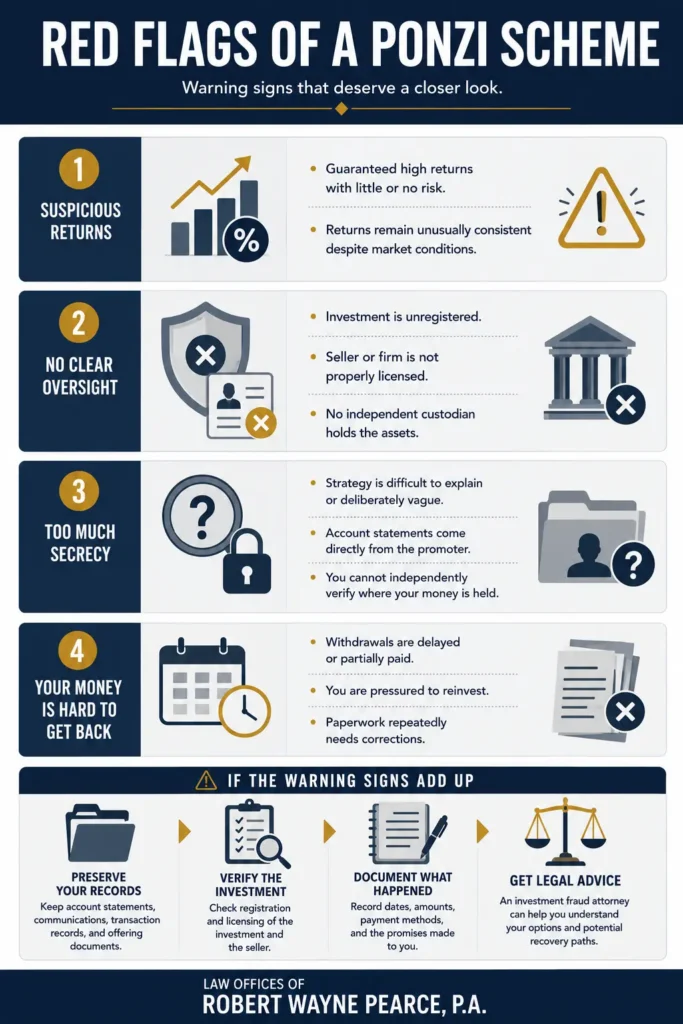
The clearest signs of a Ponzi scheme are returns that never vary, withdrawals getting harder over time, and no independent custodian. We will elaborate more on each of these signs below:
- Returns that never vary: Legitimate investments fluctuate with the market. A return that lands at the same figure every quarter regardless of conditions indicates fabricated statements.
- No independent custodian: A third-party custodian should hold your assets and report on them separately from the manager. If the promoter is your only source of balance information, no outside party has confirmed the money exists.
- Statements come from the promoter: Account documents should arrive from the custodian or clearing firm. Promoter-issued statements can show any number the operator chooses.
- Withdrawals get harder over time: Processing delays, partial payments, pressure to reinvest, and paperwork that keeps requiring corrections all point to a shrinking pool of available funds.
Red Flags You Are Dealing With a Ponzi Scheme
The SEC (Securities and Exchange Commission) has published a consistent set of red flags that appear in many Ponzi schemes regardless of the product or technology involved. They are as follows:
- Guaranteed high returns with little or no risk: No investment can guarantee high returns without exposing investors to some level of risk. In general, the potential for greater returns comes with greater risk.
- Overly consistent returns: Returns from investments subject to market conditions fluctuate over time. A track record that never dips means the numbers are manufactured.
- Unregistered investments: Registration gives investors access to information about a company’s management, products, services, and finances. Its absence removes every standard safeguard.
- Unlicensed sellers: Most Ponzi schemes involve unlicensed individuals or unregistered firms. You can check whether investment professionals are registered through FINRA BrokerCheck or on Investor.gov.
- Secretive or complex strategies: A manager who will not explain the approach and its risks in plain terms is avoiding scrutiny, not protecting a competitive edge.
- Missing paperwork and difficulty withdrawing: Incomplete documentation paired with delayed withdrawals are late-stage signals that the operation is running out of incoming deposits.
Ponzi Scheme vs Pyramid Scheme
The Ponzi scheme and a pyramid scheme take the money in different ways. A Ponzi scheme usually keeps the source of the payouts hidden from investors. In a pyramid scheme, participants are told that recruiting new members is how they earn money.
If you invest in a Ponzi scheme, you believe you hold a position in a trading account, lending pool, or business venture. The operator issues statements showing exactly that, which is why early investors recommend the opportunity in good faith. They do not know how their returns are funded.
Pyramid scheme members pay a fee to join and are promised payments for recruiting new participants, with the organizers taking all or a large percentage of each fee. Participants know from the beginning that recruiting others is how they earn money, even if they do not fully understand the risks involved.
Both require a continuous supply of new participants and collapse when that supply thins. These two schemes also make people who joined last absorb nearly the entire loss.
Famous Ponzi Schemes
The two largest schemes in US history show how long the structure can run when the operator carries institutional credibility.
Bernie Madoff
Bernie Madoff ran the largest Ponzi scheme on record and reached $64.8 billion in claimed value across two decades. His firm operated as a legitimate market maker before the fraud began, giving the investment arm credibility that no outside promoter could manufacture.
He described the strategy as a split-strike conversion, a method involving blue-chip stocks and options. The account records were built from historical trading data covering activity that never occurred.
When the 2008 financial crisis produced withdrawal requests he could not cover, the operation collapsed within weeks. He received a 150-year sentence and died in prison in 2021.
Allen Stanford
You may not have heard of Allen Stanford, but his scheme defrauded investors of roughly $7 billion, making it the second-largest in US history.
Stanford issued certificates of deposit through his offshore bank in Antigua. The CDs promised fixed rates well above what US banks offered, backed by a portfolio he described as conservative and diversified.
But the investments were not what Stanford had represented them to be. Because of that, he received a 110-year sentence in 2012, and receivership recoveries have returned only a fraction of investor losses over the years since.
You may not have heard of Allen Stanford, but his scheme defrauded investors of roughly $7 billion, making it the second-largest in US history.
FINRA Arbitration for Victims of Ponzi Schemes
You can file a FINRA arbitration claim when a registered broker sold you the investment, even if the brokerage firm never approved the product.
Selling an unapproved investment is often referred to as selling away, a practice where a broker offers securities or investments outside the firm’s approved product list.
FINRA Rule 3280 restricts these transactions unless the broker follows the required notice and approval procedures. A firm that fails to detect or stop selling away can be held liable for the resulting investor losses in FINRA arbitration, even though the investment never appeared on the firm’s books.
The brokerage firm may also be held responsible for the losses. While the promoter may have little left to recover by the time the scheme collapses, the brokerage firm may have other resources available to satisfy a claim.
It’s important to know that there are two limits that apply. FINRA arbitration generally requires a FINRA member firm or associated person subject to FINRA’s arbitration rules. And Rule 12206 makes a claim ineligible once six years have passed from the event giving rise to it, with the panel resolving eligibility questions.
Firms may argue that the clock starts on the purchase date, but the rule refers to the ‘occurrence or event giving rise to the claim.’
In Howsam v. Dean Witter Reynolds, the Supreme Court held that questions about the application of the arbitration time limit are generally for the arbitration panel to decide, not the court.
Contact an Investment Fraud Lawyer Today
Losing money to a Ponzi scheme can leave you unsure of where to turn or whether you can recover your investment. If you believe you have been the victim of investment fraud, taking action early may help protect your legal options.
With more than 45 years of experience handling securities, commodities, and investment fraud matters, Robert Pearce has represented investors in complex disputes involving fraudulent investment schemes.
His experience in both arbitration and courtroom litigation allows him to assess potential claims and pursue available recovery options.
If you believe you have been caught in a Ponzi scheme, contact the team today to discuss your situation and learn what legal options may be available to you.