
The main difference between a Ponzi scheme and a pyramid scheme is where the money comes from.
A Ponzi scheme pays passive investors out of funds collected from newer investors, while a pyramid scheme pays participants for recruiting other people into the operation. Both eventually collapse, and both can leave honest investors with devastating losses.
If you have been a victim of one of these schemes, you deserve to know the truth about how they work. The team at the Law Offices of Robert Wayne Pearce, P.A. is here to help you recognize the warning signs before it is too late. We want you to know that if you have been a victim of either a Ponzi scheme or a pyramid scheme, you may have a path to recovering your losses.
Read on to learn how these schemes operate, how to tell them apart, and what steps you can take to fight back.
Key Differences Between Ponzi Schemes and Pyramid Schemes
Ponzi schemes and pyramid schemes both rely on a steady flow of new money to survive, but they take that money in very different ways. The simplest way to tell them apart is to ask where the returns come from.
A Ponzi scheme pays passive investors out of new investors’ funds, while a pyramid scheme pays participants for recruiting other people into the operation.
Here are the main differences that you need to know:
Ponzi Scheme:
- Investors hand over an initial investment and then wait for the promised returns, never doing any work to earn them.
- The operator pays existing investors with new investors’ money while pocketing a large share of the funds for personal use.
Pyramid Scheme:
- Investors pay an entry fee and earn money by recruiting new participants into the business rather than by selling any real product.
- The profits flow upward to the small number of people at the top, which leaves the vast majority of other investors losing what they put in.

What Is a Ponzi Scheme?
A Ponzi scheme is a type of financial fraud in which the operator pays existing investors using money collected from new investors rather than from any real profit. The returns look legitimate on paper, but no genuine earnings exist behind them, which means the whole operation depends entirely on a constant stream of new deposits.
The scheme takes its name from Charles Ponzi, who ran a notorious fraud in the 1920s that promised investors enormous returns on international postal coupons with what sounded like little or no risk. His early backers were paid, which built trust and pulled in more victims, but the money was never invested in anything real.
A Ponzi scheme generally falls apart the moment there isn’t enough money coming in from new investors to cover what the operator owes the existing pool. Many of our clients come to us only after the collapse, when the account statements they trusted for years turn out to be fiction.
The Securities and Exchange Commission and the Commodity Futures Trading Commission treat these operations as illegal investment vehicle scams, and the people behind them can be held liable for what they took. So if you believe you’re a victim of this scheme, contact a Ponzi scheme attorney immediately.
Real-World Ponzi Scheme Examples
Bernie Madoff ran the most infamous Ponzi scheme in history, a fraud that stretched nearly two decades and cost investors an estimated $65 billion in reported balances, with around $20 billion in actual principal lost. More recent cryptocurrency cases follow the same blueprint on a smaller scale: operators promise steady returns, make no real investments, and keep the investors’ money, with some crypto schemes draining hundreds of millions before they collapse.
What Is a Pyramid Scheme?
Pyramid schemes involve new members paying an entry fee and earning money almost entirely by recruiting new members rather than by selling products of real value. Each participant is promised a cut of what the people below them pay in, so the pressure is always on bringing in the next wave of investors.
The math guarantees failure. As the number of investors increases, the pool of people left to recruit keeps shrinking until further recruiting becomes impossible, and the scheme collapses on the vast majority who joined late.
What makes these operations hard to spot is how convincingly they pose as multi-level marketing or direct sales companies, often pushing expensive starter kits onto recruits while real product sales stay near zero.
That missing piece is the giveaway, which is why the Federal Trade Commission and the Better Business Bureau both treat little to no genuine product sales as the clearest sign you are looking at a pyramid rather than a legitimate business.
Real-World Pyramid Scheme Examples
BurnLounge marketed itself as an online music store, but its real draw was the easy money it promised for recruiting other sellers rather than for selling music, and the FTC ultimately won a roughly $17 million judgment against it.
Other schemes charge a steep entry fee and dangle a tempting business opportunity that only ever pays the small number of people sitting at the top.
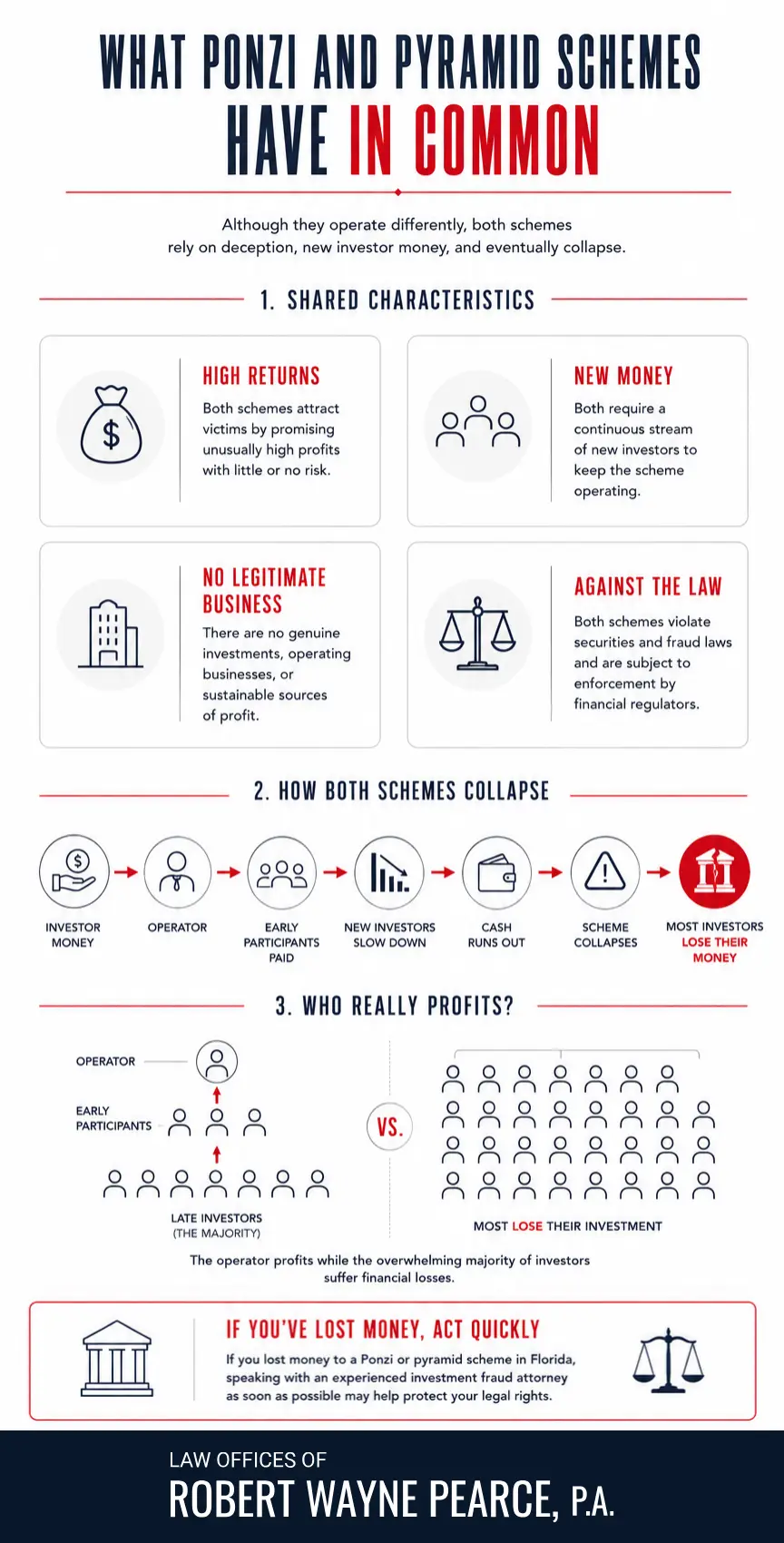
What Ponzi and Pyramid Schemes Have in Common
Both Ponzi and pyramid schemes lure people with the same irresistible pitch: more money, high returns, and little or no risk, all designed to pull in as many investors as quickly as possible. Underneath that pitch, both depend on a constant flow of new investors to transfer money upward to the earlier investors who got in first.
There are no mutual funds being managed, no businesses being built, and none of the invested funds going anywhere real.
Both are illegal and fall squarely under the enforcement jurisdiction of regulatory agencies. In each case, the operator walks away with a profit while the investors absorb the losses, and the entire structure collapses the moment new money stops arriving. This is firmly against regulations.
One interesting fact is that Florida is a hotbed for Ponzi and pyramid scheme fraud due to its massive retirement population, with over 21% of residents aged 65 or older. This makes it one of the most targeted states in the country. If you lost money to a scheme in the state, contact a Florida investment fraud lawyer immediately.
How to Spot and Avoid Pyramid or Ponzi Schemes
We want to help you avoid these schemes before they cost you money, and that starts with a simple rule: steer clear of any investment that promises guaranteed returns or easy money with little or no risk. That’s not how investing works.
The fastest tell for a pyramid is the pressure itself, since a required entry fee, a hard push to recruit, or earnings tied to enrolling new members all point to a scheme rather than a real business.
We understand how convincing these operations can look from the inside, especially when friends or family members are the ones vouching for them.
Watch closely for trouble withdrawing your own money, vague answers about who runs the company’s management, and secrecy around how the returns are actually generated. Before you transfer money into any investment vehicle, take a few minutes to confirm it is registered with the proper regulatory agencies and to check its record with the Better Business Bureau.
One trick that exposes most schemes is asking exactly how the returns are generated and then requesting it in writing, because a legitimate operation can explain its profits clearly while a fraudster will dodge, deflect, or bury you in jargon.
How a Securities Fraud Attorney Can Help Victims Recover
Regulators like the SEC and CFTC can investigate a scheme and hold its operators liable, but their enforcement actions rarely put money back in your pocket, which means recovering your losses falls to you and your attorney. An experienced securities fraud attorney can trace where the funds went, file a FINRA arbitration claim, and pursue litigation against the firms and the company’s management who enabled or ignored the fraud.
If you have fallen victim to financial fraud, the licensed investment fraud lawyers at the Law Offices of Robert Wayne Pearce, P.A., offer a free confidential consultation to review exactly what happened and what your options are. Our firm has recovered over $185 million for investors across more than 45 years of practice. Contact us or call (866) 951-4278 today.