
Fraudulent misrepresentation occurs when someone knowingly or recklessly makes a false statement of material fact intending for another person to rely on it, and that person suffers damages as a result. In investment disputes, this can happen when a stockbroker or financial professional lies about or conceals important information concerning an investment’s risks, returns, fees, liquidity, or other material facts.
If you have been the victim of stockbroker misrepresentation, you are probably feeling angry, confused, and unsure whether you can recover the money you lost. We want you to know that you have rights.
Contact the investment fraud lawyers at the Law Offices of Robert Wayne Pearce, P.A., for a free consultation. We can review your case and determine whether we can help you pursue the settlement or damages you deserve.
In this guide, we will cover what fraudulent misrepresentation is, the elements required to prove it, how it differs from negligent and innocent misrepresentation, when it may constitute a crime, and how an investment fraud attorney can help you recover your losses.
What Is Fraudulent Misrepresentation?
Fraudulent misrepresentation occurs when a person or business knowingly makes a false or misleading statement of material fact to induce another person to act, and this deceptive practice causes financial harm. It is a form of fraud that can involve an outright lie, a misleading statement, or, in some circumstances, the concealment or omission of material information.
For a misrepresentation to constitute fraud, several elements generally must be present. There must be a false representation of material fact, knowledge that the representation is false or reckless disregard for its truth, an intent to induce reliance, actual and justifiable reliance, and resulting damages. The precise elements vary by jurisdiction, which we will discuss in more detail later in this guide.
Fraudulent misrepresentation can arise in ordinary business transactions, contracts, real estate transactions, sales, and many other commercial dealings, including contract disputes.
In contract law, it may involve a false statement that leads someone to enter into an agreement, potentially making the contract voidable. But in investments and securities transactions, a broker, financial advisor, issuer, or other party may misrepresent or conceal material information to persuade an investor to purchase, sell, or hold an investment.
If you lost money because a broker or financial professional misrepresented an investment, contact the investment fraud lawyers at the Law Offices of Robert Wayne Pearce, P.A. Our firm represents investors nationwide and can review the circumstances surrounding your losses to determine whether you may have a claim.

What Are the Elements of Fraudulent Misrepresentation?
The elements of fraudulent misrepresentation include a false statement of material fact, knowledge that the statement is false or reckless disregard for its truth, an intent to induce reliance, actual reliance, and resulting damages.
A Representation Was Made
The defendant must have made a statement or representation to the plaintiff. In some circumstances, concealing or omitting material information can also qualify when the defendant had a duty to disclose it.
The Representation Was False
The statement or representation must have been false or misleading when it was made. The falsehood generally must concern a material fact, meaning information significant enough to affect the plaintiff’s decision.
The Defendant Knew the Representation Was False
The defendant must have known the representation was false or acted recklessly without knowing whether it was true. The legal term for this is scienter. It is what separates a fraudulent misrepresentation from an innocent mistake.
The Defendant Intended to Induce Reliance
The defendant must have made the representation with the intent to cause the plaintiff to rely on it. In an investment case, this could involve making false claims about an investment to persuade an investor to purchase or hold it.
The Plaintiff Relied on the Representation
The plaintiff must have made a decision because of the false or misleading information. The law may also require the plaintiff to show that doing so was reasonable or justifiable under the circumstances.
The Plaintiff Suffered Damages
The plaintiff’s reliance on the misrepresentation must have caused an actual loss or injury. In an investment fraud case, this can include financial losses, lost profits, and other damages resulting from purchasing, selling, or holding an investment based on false information. It can also bring reputational harm when supported by the facts and applicable law.
The precise elements and standards required to prove fraudulent misrepresentation claims can vary by jurisdiction and the type of fraud claims involved.
At the Law Offices of Robert Wayne Pearce, P.A., we litigate cases where stockbrokers and financial professionals make material misrepresentations or conceal important facts from investors. Investors who suffer financial losses because of fraudulent misrepresentation may have the legal right to recover damages.
Fraudulent vs. Negligent vs. Innocent Misrepresentation
The difference between fraudulent, negligent, and innocent misrepresentation generally comes down to what the person making the false statement knew, or should have known, when they made it.
- Fraudulent misrepresentation: The person knows the representation is false, does not believe it is true, or makes it recklessly without regard for whether it is true. They make the representation intending for another person to rely on it.
- Negligent misrepresentation: The person provides false or misleading information without exercising reasonable care to determine whether it is accurate. They may not intend to deceive you, but they can still be liable if you reasonably rely on the information and suffer damages.
- Innocent misrepresentation: The person makes a false statement while reasonably believing that the information is true and acting in good faith. There is no intent to deceive and generally no negligence, although the misrepresentation may still provide grounds for remedies such as rescission depending on the applicable law.
Is Fraudulent Misrepresentation a Crime?
Fraudulent misrepresentation can be a crime, but it is more commonly pursued as a civil claim. The legal consequences depend on the facts, the defendant’s intent, and the federal or state laws that apply, including whether punitive damages may be available.
In the investment industry, fraudulent misrepresentation can also constitute securities fraud. A stockbroker, investment adviser, or other financial professional may violate federal or state securities laws by knowingly making material false statements or concealing material facts to induce you to invest. Serious cases can lead to investigations or enforcement actions by the SEC and, where criminal laws have been violated, prosecution by federal or state authorities.
The same conduct may also violate FINRA rules. For example, FINRA Rule 2020 prohibits members from using manipulative, deceptive, or other fraudulent devices in connection with the purchase or sale of securities. Brokers and brokerage firms may face FINRA disciplinary action, while investors who suffer losses may be able to pursue compensation through FINRA arbitration.
At the Law Offices of Robert Wayne Pearce, P.A., we represent investors in fraudulent misrepresentation cases involving stockbroker misconduct, material misrepresentations, omissions, and other investment fraud. If a financial professional deceived you about an investment and you suffered losses, you may have the right to pursue damages.
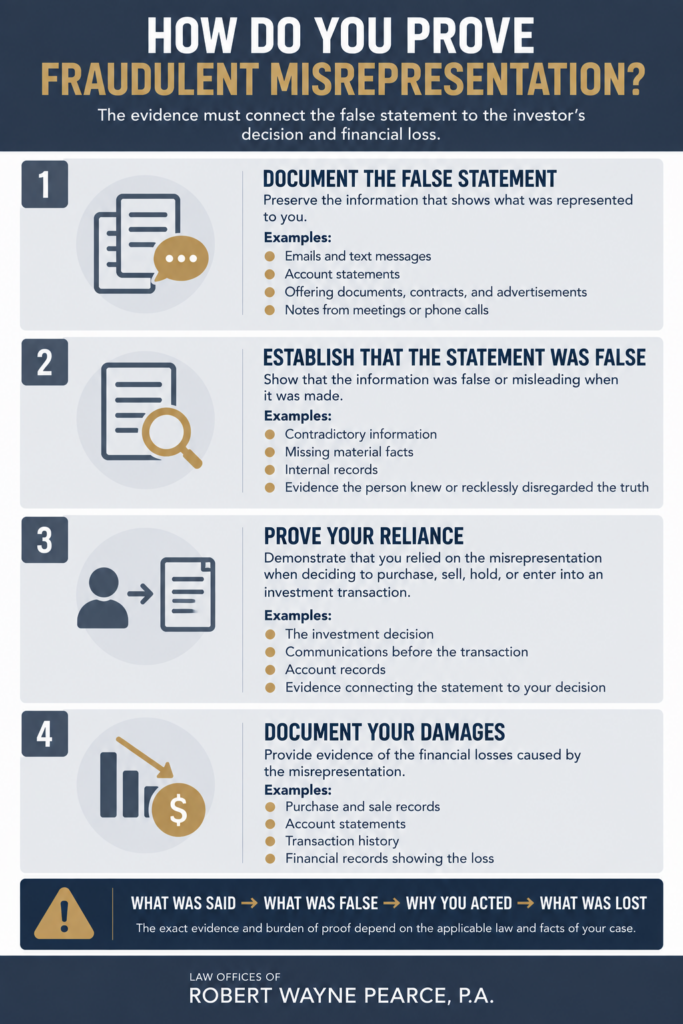
How Do You Prove Fraudulent Misrepresentation?
You prove fraudulent misrepresentation by presenting evidence that establishes each required element of the claim and connects the deception to your financial losses.
- Document the false statement: Preserve emails, text messages, contracts, advertisements, offering documents, account statements, and other records showing what was represented to you.
- Establish knowledge or recklessness: Show that the defendant knew the statement was false or made it recklessly without regard for whether it was true.
- Show intent: Emails, internal records, contradictory statements, concealed information, or patterns of similar conduct may help establish an intent to deceive.
- Prove your reliance: Demonstrate that you relied on the misrepresentation when deciding to enter a transaction, purchase an investment, or take another action.
- Document your damages: Financial records, transaction histories, and account statements can establish the losses caused by the misrepresentation.
The exact evidence and burden of proof depend on the applicable law and facts of your case.
How Can an Investment Fraud Attorney Help?
An investment fraud attorney can evaluate what happened, determine whether you have a valid case, and help you pursue and claim damages for losses caused by fraudulent misrepresentation.
At the Law Offices of Robert Wayne Pearce, P.A., we can:
- Hear the facts of your case: We review what your broker or financial professional told you, what you invested in, and how you lost money.
- Determine whether misconduct occurred: We examine communications, account statements, offering documents, transaction records, and other evidence for misrepresentations, omissions, and securities law or FINRA rule violations.
- Calculate your damages: We assess your investment losses and determine what compensation you may be entitled to pursue.
- Pursue your claim: We represent investors in FINRA arbitration and other investment fraud proceedings and seek to recover damages from responsible brokers and brokerage firms.
If you believe a broker misrepresented an investment, contact us to discuss your case.
Contact the Investment Fraud Lawyers at the Law Offices of Robert Wayne Pearce, P.A., for a Free Consultation
If you have lost money because of fraudulent misrepresentation, broker misconduct, or other investment fraud, contact the Law Offices of Robert Wayne Pearce, P.A., for a free consultation.
Our investment fraud attorneys have more than 40 years of experience representing investors and have recovered more than $185 million in damages for our clients. We handle investment disputes nationwide, including cases in Florida, California, New York, Texas, and all other states.
We can listen to the facts of your case, review your investment and communications with your financial professional, determine whether you may have a claim, and explain your options for recovering your losses.
Contact us today for a free, confidential consultation with an experienced investment fraud attorney.