
LPL Financial is a legitimate, SEC-registered financial services company and one of the largest independent broker-dealers in the United States. It provides brokerage services, financial planning, and investment management through a nationwide network of financial advisors.
The company reported approximately $2.56 trillion in client assets and 32,475 advisors as of June 30, 2026.
However, LPL Financial reviews and customer complaints paint a mixed picture. Some investors appreciate the personalized advice and flexibility of its independent advisors. Others raise concerns about fees, customer service, investment recommendations, and broker misconduct.
LPL has also faced regulatory enforcement actions. In January 2025, the Securities and Exchange Commission (SEC) announced an $18 million settlement involving failures in the company’s anti-money-laundering program.
In this review, we’ll examine LPL Financial’s services, fees, advantages, customer complaints, and disciplinary history. We’ll also explain what investors can do if they believe an LPL advisor caused them financial losses.
What Is LPL Financial?
LPL Financial is a financial services company that provides investment brokerage, investment advisory services, and wealth management services through a large network of financial professionals.
The company traces its origins to the 1989 merger of Linsco and Private Ledger. Today, LPL Financial Holdings Inc. is publicly traded on Nasdaq under the ticker symbol LPLA.
LPL Financial supports advisors with brokerage services, investment research, technology, and operational resources. Some operate independent practices, while others work through LPL’s corporate advisory platform.
These advisors can use LPL’s brokerage platform, investment research, technology, and administrative resources while maintaining a degree of independence in how they manage their businesses.
LPL Financial operates as both a broker-dealer and an investment adviser. It is regulated by FINRA and the SEC, respectively, in those capacities.
Its size is substantial. According to the company’s second-quarter 2026 earnings announcement, LPL had approximately $2.56 trillion in client assets, including around $1.55 trillion in advisory assets.
How Does LPL Financial Work?
LPL Financial provides brokerage, investment advisory, technology, and compliance services to financial advisors who serve individual investors and institutions.
Some advisors operate independent practices, while others work through LPL’s corporate advisory platform. These arrangements give advisors access to LPL’s brokerage services, investment products, trading platform, and operational support.
Advisors help clients make investment decisions or manage portfolios based on their registration and the services they offer. LPL provides the technology and infrastructure that support these activities.
The services, investment options, and fees available to investors vary by advisor and account type. Before opening an account, review LPL’s disclosures and the background of the advisor who will manage your investments.
What Services Does LPL Financial Offer?
LPL Financial offers brokerage accounts, investment management services, retirement planning, and other wealth management services through its network of financial advisors.
The services available to individual customers depend on their advisor and account arrangement. Here are the most common offerings:
- Investment brokerage: Advisors can help customers purchase and sell securities such as stocks, bonds, mutual funds, and exchange-traded funds (ETFs).
- Wealth management: Eligible advisors develop investment strategies, recommend asset allocations, and help manage portfolios according to clients’ financial goals. Some may use “Optimum Market Portfolios” as part of their investment approach.
- Retirement planning: Advisors may help customers plan for retirement, review retirement accounts such as IRAs, and develop investment strategies for retirement savings.
- Financial planning: Some advisors offer broader guidance involving budgeting, investment goals, retirement income, estate planning considerations, and other financial decisions.
- Investment research: LPL provides investment research, analytical tools, and portfolio resources that advisors can use when making recommendations.
- Account management: Customers can access information about their client accounts, review investments, and monitor certain transactions through LPL’s online tools.
Investors should ask their advisor which services are available, what each service includes, and whether any additional fees apply. That way, they know what to expect before opening an account or agreeing to an investment plan.
What Are the Pros and Cons of LPL Financial?
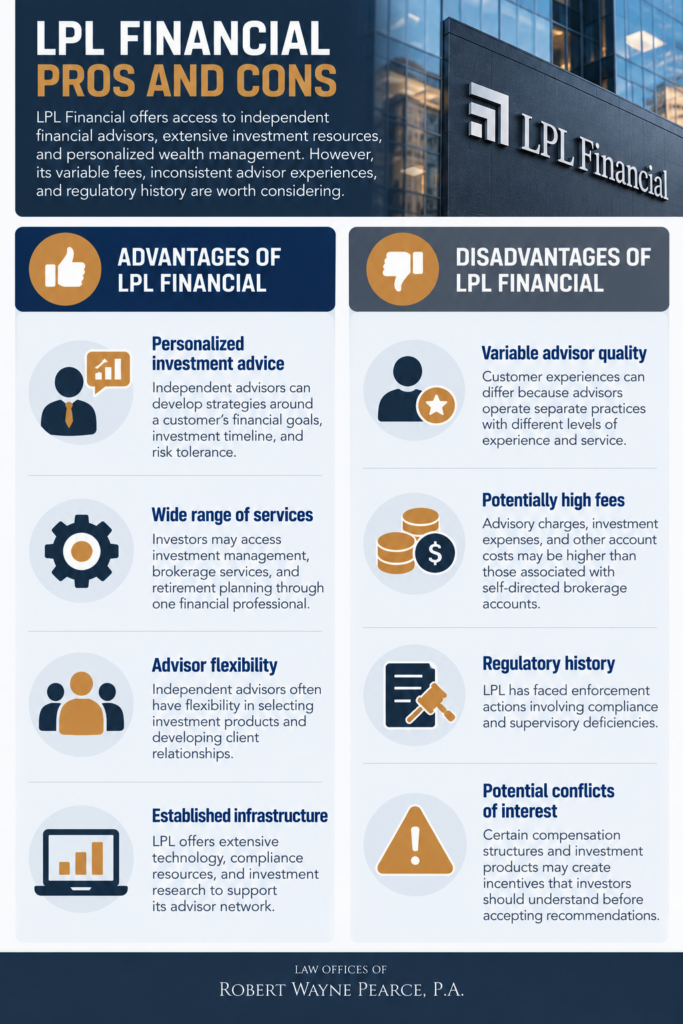
LPL Financial offers access to independent financial advisors, extensive investment resources, and personalized wealth management. However, its variable fees, inconsistent advisor experiences, and regulatory history are worth considering.
The following advantages and disadvantages can help investors evaluate the firm.
Advantages of LPL Financial
- Personalized investment advice: Independent advisors can develop strategies around a customer’s financial goals, investment timeline, and risk tolerance.
- Wide range of services: Investors may access investment management, brokerage services, and retirement planning through one financial professional.
- Advisor flexibility: Independent advisors often have flexibility in selecting investment products and developing client relationships.
- Established infrastructure: LPL offers extensive technology, compliance resources, and investment research to support its advisor network.
Disadvantages of LPL Financial
- Variable advisor quality: Customer experiences can differ because advisors operate separate practices with different levels of experience and service.
- Potentially high fees: Advisory charges, investment expenses, and other account costs may be higher than those associated with self-directed brokerage accounts.
- Regulatory history: LPL has faced enforcement actions involving compliance and supervisory deficiencies.
- Potential conflicts of interest: Certain compensation structures and investment products may create incentives that investors should understand before accepting recommendations.
These advantages and disadvantages don’t necessarily apply equally to every LPL customer.
The individual advisor, account type, and investment strategy can have a significant impact on the experience.
How Much Does LPL Financial Charge?
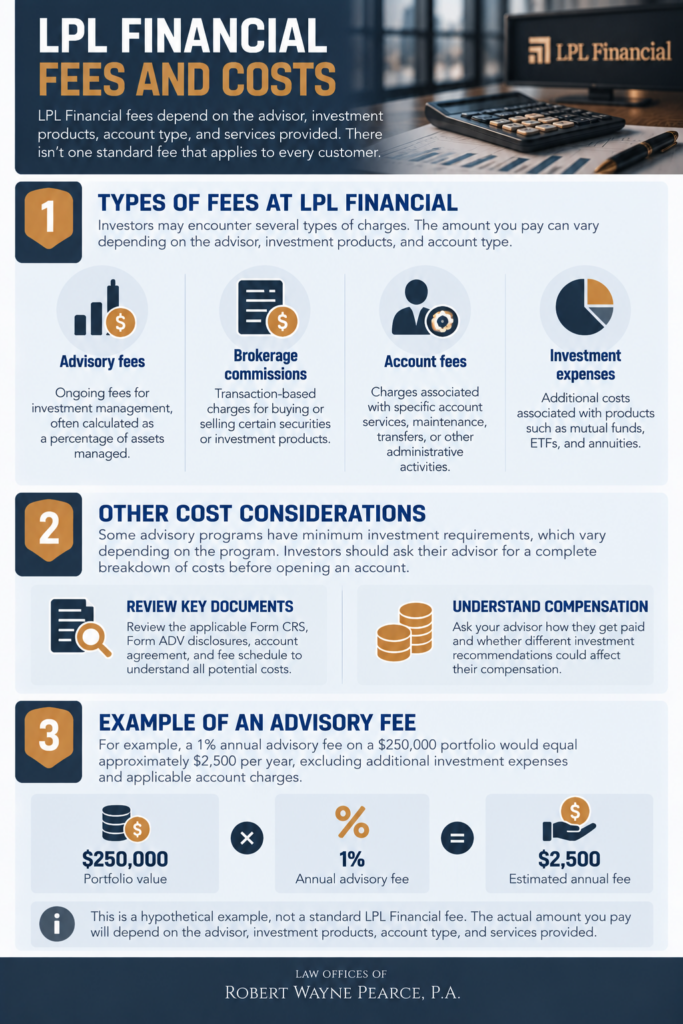
LPL Financial fees depend on the advisor, investment products, account type, and services provided. There isn’t one standard fee that applies to every customer.
Investors may encounter several types of charges:
- Advisory fees: Ongoing fees for investment management, often calculated as a percentage of assets managed.
- Brokerage commissions: Transaction-based charges for buying or selling certain securities or investment products.
- Account fees: Charges associated with specific account services, maintenance, transfers, or other administrative activities.
- Investment expenses: Additional costs associated with products such as mutual funds, ETFs, and annuities.
Some advisory programs have account minimums, which vary by program and advisor.
For example, a 1% annual advisory fee on a $250,000 portfolio would equal approximately $2,500 per year, excluding additional investment expenses and applicable account charges.
That’s a hypothetical example, not a standard LPL Financial fee.
Ask whether your account is subject to an LPL program fee, along with any advisory fees, investment expenses, or other account charges. Also, review the applicable Form CRS, Form ADV disclosures, account agreement, and fee schedule.
Is LPL Financial Legitimate and Safe?
Yes. LPL Financial is a legitimate, regulated brokerage and investment advisory firm. However, working with a registered financial institution doesn’t eliminate investment risk or guarantee protection from misconduct.
LPL Financial LLC is registered as a broker-dealer and investment adviser. Investors can verify its regulatory information through FINRA BrokerCheck.
Its FINRA registration number is CRD 6413.
SIPC protection may apply if a member brokerage fails and eligible customer securities or client funds are missing, subject to SIPC’s rules and limits. It generally covers up to $500,000 per eligible customer, including a $250,000 limit for cash claims.
However, SIPC doesn’t protect investors against ordinary market losses or guarantee that investments will perform as expected.
Nor does registration with FINRA or the SEC mean that every financial advisor associated with LPL has a clean disciplinary record.
Investors should independently check the background of the person managing their money.
What Do LPL Financial Customer Reviews Say?
LPL Financial customer reviews are mixed, and experiences can vary from one advisor to another. Some customers value the personal attention they receive from their financial advisor, particularly when planning for retirement or managing their investments.
Others prefer the flexibility of working with a local financial professional rather than relying solely on an online brokerage platform. The quality of that experience, however, depends on the advisor and the services provided.
Some customers also report problems with customer service, fees, account transfers, or their advisor’s recommendations.
LPL Financial complaints often involve customer service, fees, account transfers, or an advisor’s recommendations.
- Customer service: Some reviewers describe delays in communication, difficulty resolving account issues, or inconsistent responses.
- Fees and expenses: Customers sometimes question the cost of advisory services or complain about charges they didn’t fully understand.
- Account transfers: Investors have reported frustration with certain rollover, account transfer, or administrative processes.
- Advisor experiences: LPL Financial complaints may involve poor communication, disappointing investment recommendations, or dissatisfaction with individual advisors.
Online customer reviews should be treated as individual accounts rather than proof of widespread misconduct.
A positive review doesn’t establish that an advisor is qualified or trustworthy. Likewise, a negative review doesn’t necessarily mean a securities violation occurred.
For a more complete assessment, compare customer feedback with regulatory disclosures, fee documents, and the individual advisor’s professional history.
What Complaints and Regulatory Actions Has LPL Financial Faced?
LPL Financial has faced regulatory enforcement actions and customer complaints involving compliance failures and alleged advisor misconduct.
LPL’s regulatory actions and customer complaints involve different types of records. Regulatory actions document the outcome of a formal proceeding, while complaints describe allegations that may not be proven.
SEC Anti-Money-Laundering Settlement in 2025
On January 17, 2025, the SEC announced that LPL Financial agreed to pay an $18 million civil penalty to resolve charges involving failures in its anti-money-laundering (AML) program.
According to the SEC, LPL had longstanding deficiencies in its customer identification procedures between at least May 2019 and December 2023. The SEC identified failures involving customer identity verification and the handling of certain high-risk accounts.
LPL agreed to the settlement without admitting or denying the SEC’s findings. The resolution also included a censure, a cease-and-desist order, and compliance-related requirements.
Investor Complaints and Allegations
Investors have filed complaints involving alleged misconduct by financial advisors associated with LPL. Common allegations in securities disputes include:
- Unsuitable investment recommendations: Recommending investments that don’t align with a customer’s financial circumstances, investment objectives, or risk tolerance.
- Unauthorized trading: Executing transactions without the customer’s required consent or appropriate discretionary authority.
- Excessive trading: Conducting unnecessary or excessive transactions that may generate additional commissions and expenses.
- Misrepresentation: Providing inaccurate information or failing to disclose important investment risks.
- Supervisory failures: Allegations that a brokerage firm did not adequately monitor or respond to misconduct by its representatives.
These allegations do not establish that misconduct occurred. Investors can review LPL’s regulatory record and individual broker disclosures through FINRA BrokerCheck.
A customer complaint does not automatically establish wrongdoing. Some disputes are denied, withdrawn, settled, or resolved in favor of the brokerage firm.
Can Investors Recover Losses From LPL Financial?
Investors who suffered financial losses because of actionable misconduct involving an LPL Financial advisor may be able to pursue compensation through FINRA arbitration or other legal proceedings.
Recovering investment losses generally requires more than showing that an account declined in value.
Investors must establish grounds for a legal claim, such as unauthorized trading, misrepresentation, unsuitable recommendations, or a failure to supervise.
For example, suppose an advisor recommends a concentrated portfolio of high-risk products. to a retiree who has clearly expressed a need to preserve capital. If those recommendations violate applicable legal standards and cause losses, the investor may have grounds to investigate a claim.
If the recommendations violated applicable legal standards and caused losses, the investor may be able to recover damages.
Depending on the circumstances, recovery options may include:
- FINRA arbitration: A dispute resolution process commonly used for claims between investors and brokerage firms.
- Mediation or negotiated settlement: A process through which the parties may resolve a financial dispute without a final arbitration award.
- Civil litigation: An option in certain circumstances, subject to applicable laws and agreements.
If the recommendations violated applicable legal standards and caused losses, the investor may be able to recover damages.
Many brokerage customer agreements contain arbitration provisions, so investors should review their account documents.
Potential claims are subject to time limits. FINRA arbitration eligibility rules and applicable statutes of limitations may affect the options available.
If you believe an LPL advisor caused you financial harm, preserve your account statements, trade confirmations, investment recommendations, and communications. An attorney can review these documents to assess whether the advisor’s recommendations or trading activity violated an obligation to you and whether you have grounds to seek compensation.
Speak With Robert Wayne Pearce About LPL Financial Investment Losses
If you’ve suffered investment losses involving an LPL Financial advisor, you may have grounds to investigate a claim for broker misconduct, unsuitable recommendations, or failure to supervise.
At the Law Offices of Robert Wayne Pearce, P.A., our securities attorneys represent investors in disputes involving brokerage firms and financial professionals.
Our team can review your investments, evaluate potential misconduct, and explain your options for pursuing compensation through FINRA arbitration or other legal proceedings.
Contact the Law Offices of Robert Wayne Pearce, P.A. to discuss your LPL Financial investment losses and potential recovery options.