
A FINRA 407 letter was a written authorization that allowed securities industry employees to maintain certain personal investment accounts outside their employer’s brokerage firm. The letter was used to comply with New York Stock Exchange (NYSE) Rule 407, which required employees to obtain their employer’s written consent for these accounts.
The NYSE is a major U.S. stock exchange that historically maintained its own rules governing member brokerage firms. In 2007, the NYSE’s member regulation, enforcement, and arbitration operations were consolidated with those of the National Association of Securities Dealers (NASD) to form the Financial Industry Regulatory Authority (FINRA).
NYSE Rule 407 was retired on April 3, 2017, and replaced by FINRA Rule 3210, which continues to regulate outside brokerage accounts held by financial professionals.
Below, we’ll explain what a 407 letter was, how it worked, and what the current FINRA Rule 3210 requires.
What Is a FINRA 407 Letter?
A FINRA 407 letter was a written document used by securities industry employees to obtain their employer’s approval to open or maintain certain investment accounts at another brokerage firm or financial institution.
It was used to comply with NYSE Rule 407, which governed certain securities and commodities accounts held by employees and associated persons of member firms.
Suppose a stockbroker working at Firm A wanted to open a personal trading account at Firm B. Under NYSE Rule 407, the broker generally needed written permission from their employer before opening the account. This approval could be documented in a 407 compliance letter.
The purpose was to allow employers to monitor their employees’ outside investment activities and identify potential conflicts of interest.
Importantly, a 407 letter wasn’t a regulatory license or a separate FINRA rule. It was simply a document used to meet the written consent requirements of NYSE Rule 407.
What Did a 407 Letter Do?
A 407 letter documented an employer’s consent for an employee to maintain an outside investment account.
Under NYSE Rule 407, several related requirements helped employers monitor these accounts:
- Prior written consent: Employees generally had to obtain their employer’s written approval before opening or maintaining covered outside investment accounts.
- Account disclosure: The brokerage firm holding the account needed to know about the employee’s association with another financial institution.
- Duplicate trade confirmations: Covered transactions were subject to requirements for sending confirmations to the employee’s firm.
- Account statement monitoring: Employers could request duplicate account statements and trade confirmations from executing members in writing to monitor employees’ outside trading activity.
These requirements helped firms identify unauthorized trading, conflicts of interest, and other activities that might violate securities regulations.
Although 407 letters are no longer required under the retired rule, similar employer-consent and account-monitoring requirements continue under FINRA Rule 3210.
Why Was NYSE Rule 407 Retired?
NYSE Rule 407 was retired because FINRA consolidated several overlapping securities regulations into a single rule governing outside brokerage accounts.
Before Rule 3210, similar compliance requirements existed under different regulatory frameworks, including NYSE Rule 407 and NASD Rule 3050.
Following the consolidation of NASD and NYSE member-regulation operations under FINRA in 2007, FINRA worked to establish a unified rulebook.
Rule 3210 was part of that effort.
According to FINRA Regulatory Notice 16-22, the replacement consolidated and streamlined existing requirements to support effective supervision of personal investment accounts.
The rule took effect on April 3, 2017, replacing:
- NASD Rule 3050
- NYSE Rule 407
- NYSE Rule 407A
- NYSE Rule Interpretations 407/01 and 407/02
The change didn’t eliminate employers’ ability to monitor covered personal trading accounts.
Instead, it established a consolidated regulatory framework, with some changes to the previous requirements.
For example, Rule 3210 specifies when an executing member must transmit duplicate confirmations and account statements upon written request from the employer.
You can still consult the retired NYSE Rule 407 on FINRA’s website for historical reference, but FINRA Rule 3210 governs current compliance obligations for covered outside accounts.

What Is FINRA Rule 3210?
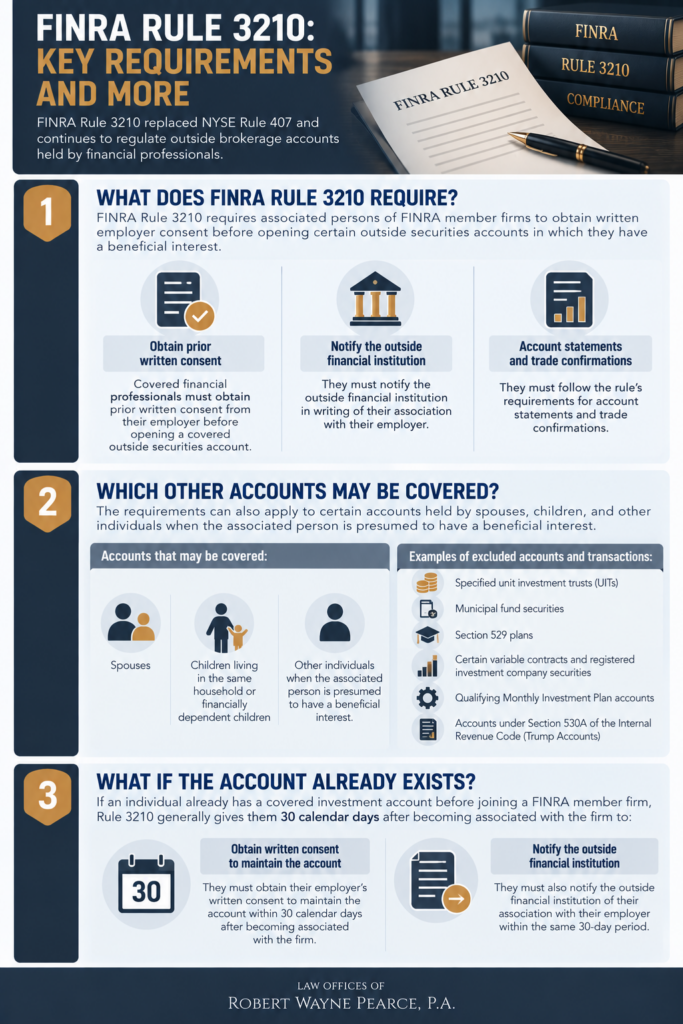
FINRA Rule 3210 is the regulation that replaced NYSE Rule 407. It requires associated persons of FINRA member firms to obtain written employer consent before opening certain outside securities accounts in which they have a beneficial interest.
The rule is officially titled Accounts at Other Broker-Dealers and Financial Institutions.
Under FINRA Rule 3210, covered financial professionals must generally:
- Obtain prior written consent from their employer before opening a covered outside securities account.
- Notify the outside financial institution in writing of their association with their employer.
- Follow the rule’s requirements for account statements and trade confirmations.
The requirements can also apply to certain accounts held by spouses, children who live in the same household or are financially dependent on the associated person, and other individuals when the associated person is presumed to have a beneficial interest.
However, Rule 3210 excludes certain transactions and accounts, including:
- specified unit investment trusts (UITs)
- municipal fund securities
- Section 529 plans,
- certain variable contracts and registered investment company securities
- qualifying Monthly Investment Plan accounts
- accounts under Section 530A of the Internal Revenue Code (Trump Accounts).
What if the account already exists?
If someone already has a covered investment account before joining a FINRA member firm, Rule 3210 generally gives them 30 calendar days after becoming associated with the firm to obtain written consent to maintain the account and notify the outside financial institution.
These requirements help brokerage firms supervise personal securities transactions and identify potential compliance issues.
Understanding FINRA’s Current Compliance Requirements
A 407 letter was a written authorization used to comply with the former NYSE Rule 407. Although the rule was retired in 2017, financial professionals must still comply with applicable outside-account requirements under FINRA Rule 3210.
These regulations help brokerage firms monitor employee trading activity, identify conflicts of interest, and maintain appropriate supervision.
At the Law Offices of Robert Wayne Pearce, P.A., our securities attorneys represent investors in cases involving broker misconduct, supervisory failures, and investment fraud.
If you believe a stockbroker’s or brokerage firm’s misconduct caused you financial losses, our team can evaluate your case and help you pursue compensation through FINRA arbitration or other available legal proceedings. Contact us to discuss your potential recovery options.