
Buying on margin, also known as margin trading, is when you borrow money from your brokerage firm to purchase securities, putting up part of the purchase price yourself and pledging the assets in your account as collateral for the rest.
Margin magnifies your losses just as readily as your gains, and it exposes you to margin calls and forced sales at prices you would never have chosen. Sometimes the real damage has less to do with the market and more to do with how the investment was handled in the first place.
Sometimes the real damage has less to do with the market and more to do with how the investment was handled in the first place.
Our experienced team of investment fraud lawyers will break down how all of this actually works. We will cover margin accounts and the agreements behind them, the rules that govern how much you can borrow, what triggers a margin call, what margin interest costs you, the risks worth taking seriously, and what record margin debt says about the market you are borrowing into right now.
What Is Buying on Margin?
Buying on margin means borrowing money from your brokerage firm to purchase securities, using the assets already sitting in your account as collateral for that loan.
If you have ever opened your account and noticed buying power well above what you actually deposited, you have already seen margin at work.
Margin trading works like this: You put up a portion of the purchase price and your broker lends you the rest, which means the position you control ends up larger than your own cash would allow on its own.
Margin buying requires a margin account. It’s a specific account type that differs from a regular cash account and obligates you to sign a margin agreement before any borrowing happens. That agreement grants your brokerage firm significant rights over the securities you purchase with borrowed funds.
The part investors most often overlook is that gains and losses are measured against the full position size rather than the money you personally contributed, which is exactly why margin trading amplifies results in both directions.
How a Margin Account Works
A margin account extends you a revolving loan against the market value of the securities you already hold, with those same securities pledged as security for the debt.
Opening one is not automatic. You submit an application, your brokerage firm reviews and approves you for margin borrowing, and you sign a margin agreement that spells out the firm’s authority over your holdings, including its right to sell them.
The borrowed amount then sits in your account as a margin loan balance, and margin interest accrues against that balance every single day it remains open. Unlike a mortgage or a car loan, there is no amortization schedule and no fixed payoff date, so the loan simply persists until you close the position or deposit cash to repay it.
You can use securities you already own as collateral for a margin loan, so you may not need to put up additional cash. The convenience it provides can make borrowing feel easy, but it can also make taking on more debt than you intended.
A Short History of Margin Trading
Margin trading looked very different before the federal government regulated it. Through the 1920s, brokerage firms routinely let customers buy stock by putting down as little as 10% of the purchase price and borrowing the remaining 90%, which handed ordinary investors ten to one exposure with no federal limit standing in the way. Brokers’ loans grew from roughly $3.5 billion in 1926 to more than $8.5 billion by the middle of 1929.
When prices turned in October 1929, that borrowed money did what borrowed money does. Investors received margin calls they could not meet, their shares were sold to satisfy the loans, the forced selling drove prices lower, and the lower prices triggered the next wave of calls.
Historians have identified low margin requirements as one of the direct contributors to the crash that preceded the Great Depression.
Congress responded through the Securities Exchange Act of 1934, which gave the Federal Reserve Board authority over margin requirements and produced Regulation T that October. The initial requirement was adjusted 22 times before settling at the 50% figure that has governed margin buying since 1974.
Margin Rules: Reg T, FINRA, and Your Brokerage Firm
Three separate layers of margin rules govern how much you can borrow and how much equity you have to keep in your account.
- Federal regulation: The Federal Reserve Board establishes the federal margin requirements that apply when you borrow to purchase securities.
- FINRA rules: FINRA, the Financial Industry Regulatory Authority, is the self-regulatory organization that oversees brokerage firms in the United States. Its rules add another layer of requirements for margin accounts.
- Brokerage firm rules: Your broker can also impose its own “house” requirements, and those can be stricter than the federal or FINRA rules. In practice, brokerage firms often set higher requirements for certain securities or accounts.
Understanding all three is what separates investors who know their exposure from investors who find out the hard way. The rules interact, and the strictest one always controls.
Initial Margin vs. Maintenance Margin
Initial margin is what you deposit at the moment of purchase, while maintenance margin is the equity percentage you have to hold continuously for as long as the position stays open.
Regulation T, known as Reg T, lets you borrow up to 50% of a marginable security’s purchase price. FINRA sets the maintenance margin floor at 25%, though most brokerage firms impose house requirements between 30% and 40% and can raise them without warning you first.
Minimum Margin and the $2,000 Floor
Minimum margin is the baseline deposit your brokerage firm requires before it will approve you for margin borrowing at all. FINRA sets that threshold at $2,000 or 100% of the purchase price, whichever amount is less. Certain securities also carry higher margin requirements than the standard 50%, which reduces how much you can borrow against those particular positions and shrinks your effective buying power.
Buying on Margin Example
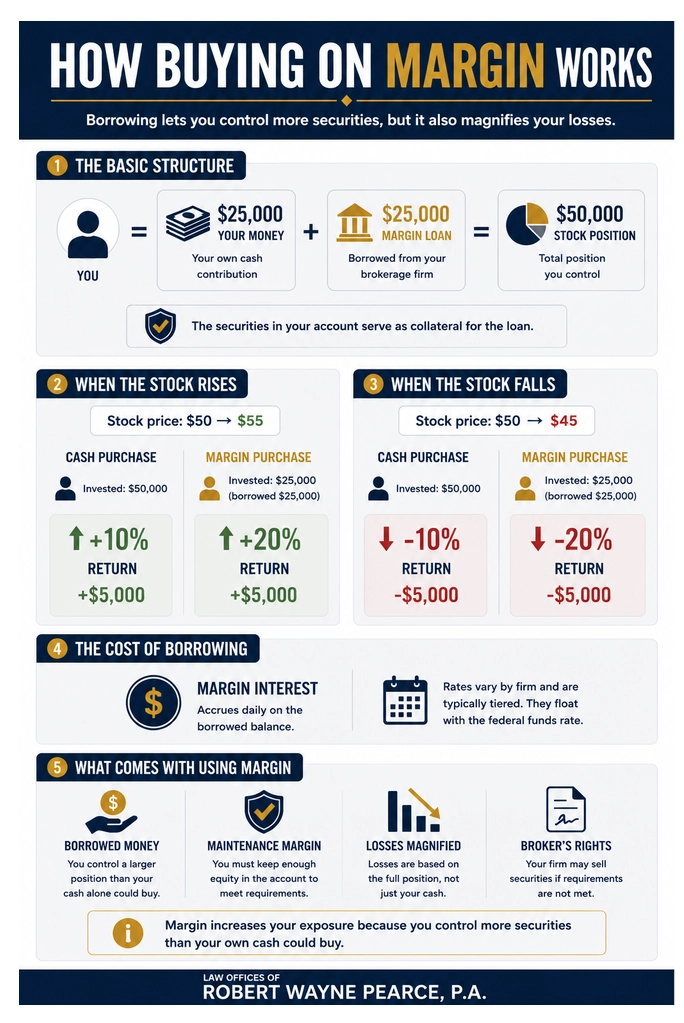
Consider an investor who wants 1,000 shares of a stock trading at $50 per share, a position worth $50,000 in total. Paying cash requires the full $50,000 up front. Through a margin trading account, that same investor puts up $25,000 of their own money and borrows the remaining $25,000 from the broker.
If the stock price climbs to $55 and the investor sells, the resulting $5,000 gain represents a 20% return on the $25,000 actually invested rather than the 10% a cash buyer would have earned. That is the arithmetic that makes margin attractive.
But this can also go in the opposite direction. If the stock falls to $45, the investor takes a 20% loss, twice what a cash buyer would lose. The $25,000 margin loan still has to be repaid, with additional interest added to the overall cost.
What Triggers a Margin Call
A margin call is triggered when falling stock prices reduce the equity in your account below the maintenance margin requirement your brokerage firm has set.
Equity is calculated by subtracting your margin loan balance from the total value of the account, then dividing that figure by the total value. When a $60,000 portfolio carrying a $30,000 loan drops to $40,000, your equity falls to $10,000 against a $40,000 position, which lands you at 25% and directly in margin call territory.
Once the call is issued, you must deposit more money or additional securities immediately, and if you do not, your brokerage firm can sell your positions without notifying you first. These margin call liquidations can happen before you have a chance to add money to the account.
We understand how disorienting that moment is. Many of the investors who come to us discovered their brokerage had already liquidated their holdings at the bottom of a selloff, with no phone call and no opportunity to add funds.
You are not entitled to an extension of time on a margin call, and forced sales tend to happen at exactly the prices you would never have chosen to sell at.

What Margin Interest Costs
Margin interest accrues daily against your borrowed balance whether the trade is working in your favor or against it, which makes it the one cost of margin trading that never pauses.
Rates vary considerably between brokerage firms, and they are typically tiered, so larger margin loan balances often carry lower margin interest rates than smaller ones.
Because margin interest rates float with the federal funds rate, the cost of a position you hold for eight months is not fixed at the moment you open it. Your carrying cost can rise while you are still holding.
Margin interest charges also create a hurdle your investment has to clear before borrowing produces any benefit at all. If your margin rate sits at 9% and the position returns 5%, the borrowed portion of that trade is losing money for you even though the stock itself went up.
Those borrowing costs can make a position that looks profitable on paper less profitable (or even unprofitable) once the interest is factored in.
How Buying Power Changes What You Can Purchase
Buying power is the total dollar value of securities you are able to purchase, and under the standard 50% initial margin, it comes out to roughly double your account equity. An account holding $10,000 in equity carries somewhere near $20,000 in total buying power on marginable securities.
Read that number carefully, because buying power is borrowing capacity rather than equity or cash, and every dollar of it you draw on becomes debt secured by your own portfolio.
Buying power also moves with the market value of what you hold, which produces an unpleasant feedback loop. A declining portfolio shrinks your available buying power at precisely the same moment it pushes your account toward a margin call, leaving you with less room to maneuver exactly when you need more.
What Record Margin Debt Says About the Market Right Now
Margin debt is the aggregate amount investors have borrowed against securities across every member brokerage firm, and FINRA publishes the figure monthly under Rule 4521. It is the cleanest available measure of how much borrowed money is riding on the stock market at any given moment.
Recent readings have set record after record, with the aggregate balance passing $1.5 trillion and growing far faster on a year-over-year basis than the S&P 500 itself. Analysts have pointed to the increase in margin debt as a sign of excess borrowing, and similar patterns appeared before the market peaks of 2000, 2007, and 2021.
Troughs in net credit balances have historically preceded S&P 500 peaks by roughly six months in 2000, four months in 2007 and 2018, two months in 2021, and zero months in 2025. The shortening lead time is worth sitting with, because it suggests the warning window has been closing rather than widening.
None of this is a timing signal. Treat elevated margin debt as context about the cycle you are borrowing into, and size your own position for the downside that context implies.
The Risks of Trading on Margin
The central risk of margin trading is that you can lose more than your initial investment, because the loan has to be repaid in full no matter what happens to the securities you bought with it.
Margin trading also comes with risks that can catch investors off guard, such as:
- Losses exceeding your deposit: When a margined position falls far enough, the loan balance can exceed what your remaining shares are worth, leaving you owing your brokerage firm money.
- Forced liquidation without notice: Your brokerage firm is permitted to sell securities bought on margin without contacting you and at a substantial loss to you, and many investors are stunned to learn this only after it happens.
- The SEC’s own warning: Federal regulators state plainly that margin accounts carry considerable risk and are not suitable for many individual investors, particularly those who cannot absorb a total loss.
- Interest that never stops: Margin interest accrues continuously, so a position that goes nowhere for a year still closes at a loss once carrying costs are counted.
- House requirements that change: Your firm can raise its maintenance margin requirement at any time without advance written notice, tightening your equity cushion overnight.
Keeping cash well above your maintenance margin requirement remains the most reliable protection available to you.
Margin Account vs. Regular Cash Account
A regular cash account limits you to the funds you have actually deposited, while a margin account adds borrowing capacity along with every obligation that comes attached to it. Cash accounts carry no margin call risk, no margin interest, and no possibility of forced liquidation, for the straightforward reason that there is no loan to secure.
Margin accounts are also required for short selling and for certain advanced options trading strategies, which is why some investors open one with no intention of ever borrowing against it.
Whether margin belongs in your investment strategy comes down to your risk tolerance and your holding period. Borrowed money rewards experienced investors who can withstand a drawdown without selling, and it punishes anyone who needs a position to work on a schedule.
Contact Our Investment Fraud Attorneys
If you believe a broker put you into margin you never should have been in, you may have a claim worth pursuing. Improper use of margin is something our firm has extensive experience litigating, including unsuitable recommendations, unauthorized margin trading, and failures to disclose what borrowing would actually expose you to.
We understand what it feels like to watch a brokerage firm liquidate holdings you spent years building. The Law Offices of Robert Wayne Pearce, P.A. has fought for investors for over 45 years and recovered more than $185 million for clients. We work on a contingency basis, so you pay nothing unless we recover for you. Call (866) 971-5340 today for a free consultation.