
A credit default swap is a private contract that transfers the risk of a borrower defaulting from one party to another. Retail investors effectively cannot buy credit default swaps directly, though the risk still reaches ordinary portfolios. It arrives inside structured notes, credit-linked notes, mutual funds, and synthetic CDOs sold as enhanced yield or principal protected investments.
The SEC and FINRA have brought enforcement actions involving structured-note recommendations and supervision in recent years, while the CFTC has separately pursued enforcement actions involving swaps and other derivatives. FINRA arbitration filings involving structured products rose 77 percent in 2024, although FINRA does not track CDS-related disputes separately.
If your broker put you into a CDS-linked note and called it safe income, you have every right to be angry. You may be entitled to recover what you lost. The investment fraud team at the Law Offices of Robert Wayne Pearce, P.A. has spent 45 years recovering more than $185 million for investors.
In this guide, we are going to walk you through what these instruments are and how the risk reaches retail accounts. We will also cover the enforcement actions regulators have brought, the broker conduct that creates claims, and what to do if you lost money.
What Is a Credit Default Swap?
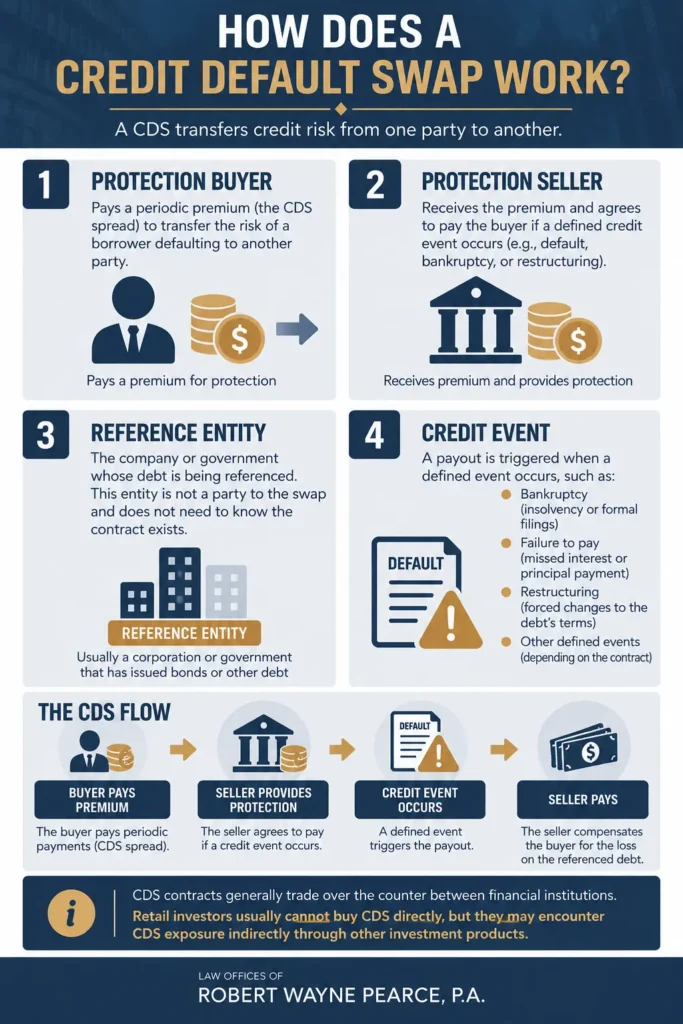
A credit default swap is a private contract that transfers the risk of a borrower defaulting from one party to another. One side, known as the CDS buyer, purchases protection against a specific debt going bad, and the other side sells that protection and agrees to pay out if a defined credit event occurs.
The borrower or issuer whose creditworthiness is being referenced is called the reference entity. It is usually a corporation or government that has issued bonds or taken on other debt.
The specific debt used to determine whether a credit event has occurred is called the reference obligation. The reference entity is not a party to the swap and does not need to know the contract exists. The protection buyer pays a periodic premium, quoted as the CDS spread, for as long as the contract remains in effect.
Credit default swaps trade over the counter between banks, hedge funds, insurers, and other financial institutions rather than on an exchange. Retail investors generally cannot enter into CDS contracts directly. As a result, investors may encounter CDS exposure indirectly through products such as credit-linked notes, certain structured products, or investment funds.
How Credit Default Swaps Work
A credit default swap works as an exchange of periodic payments for CDS protection against a defined credit loss. The protection buyer pays the seller a set number of basis points per year on the contract’s notional value, usually quarterly, until the contract matures or the borrower defaults. These CDS transactions allow investors to transfer credit risk without selling the underlying debt.
That annual rate is the CDS spread, which reflects the market’s view of the borrower’s credit risk exposure. A company seen as safe might cost 50 basis points a year to insure. One heading toward bankruptcy can cost several thousand.
If a credit event occurs, the seller pays the buyer the loss on the underlying debt and the premium payments stop. The payout is calculated from the notional value of the contract, not from anything the buyer originally invested. That is how a single defaulting bond can generate claims many times larger than the debt itself.
What Triggers a CDS Payout: Credit Events
A credit event is the defined failure that obliges the protection seller to pay. The contract names which events count before anyone signs it, so the payout does not depend on a judgment call made after the loss.
Two triggers appear in essentially every contract. Bankruptcy covers insolvency, administration, and the formal filings that follow a company’s collapse. Failure to pay covers a missed interest or principal payment above an agreed threshold. A third trigger, restructuring, covers a forced change to the debt’s terms, such as an extended maturity or a reduced coupon. The 2009 Big Bang Protocol removed restructuring from new North American corporate contracts, and it remains standard only in Europe.
Whether an event has occurred is decided by an industry determinations committee rather than by the two parties themselves. Contracts written on government debt add repudiation and moratorium, which cover a sovereign disowning its obligations or suspending payment on them.
How a CDS Differs From Insurance
A credit default swap is structured like insurance and regulated as a derivative, which strips out most of the safeguards an insurance policy carries. Both involve periodic premiums and a payout on a defined loss, and the resemblance ends there.
Insurance law requires an insurable interest, meaning you can only insure something you actually stand to lose. Credit default swaps carry no such requirement. A trader with no exposure to a company can buy protection on its debt purely to profit if it fails. That is what turns the instrument from a hedge into a speculative position.
State regulators also force insurers to hold capital reserves against expected claims. CDS sellers faced no equivalent obligation before Dodd-Frank, and AIG wrote hundreds of billions in protection it could not fund. For you as an investor, the practical consequence is that a CDS-linked product’s promise is only as good as the seller’s balance sheet.
Why Investors Buy and Sell CDS
Investors use credit default swaps for several reasons, with hedging being one of the most common. A bondholder or lender can buy protection to offset some of the loss it could face if the borrower stops paying. This allows the investor to keep the underlying position while reducing its credit exposure to the borrower.
CDS can also be used to speculate on a company’s creditworthiness. Because buyers do not have to own the underlying debt, a fund can buy protection simply because it expects the company’s financial position to deteriorate. A credit event can trigger a payout to the protection buyer, while the buyer continues paying the CDS premium as long as the contract remains in place. Michael Burry’s well-known bet against subprime mortgage bonds, later featured in The Big Short, used CDS to bet against mortgage-related securities rather than the debt of a single company.
Traders may also use CDS for arbitrage, looking for differences between the pricing of a company’s bonds and the cost of protection in the credit derivatives market. Banks can use CDS for another reason: buying protection on loans they have made can reduce the amount of regulatory capital they need to hold against those loans, subject to applicable capital rules.
How CDS Contracts Settle
A credit default swap settles in one of two ways once a credit event is confirmed. Under physical settlement, the protection buyer hands the defaulted bonds to the seller and receives their full face value. Under cash settlement, the buyer keeps the bonds and the seller pays what they have lost in value.
Cash settlement now accounts for most of the market. Contracts routinely outnumber the bonds available to deliver, because nothing stops multiple parties from writing protection on the same debt, which makes physical settlement impossible to complete.
The recovery price is fixed by an industry auction held shortly after the credit event, and every contract settles against that single number. For an investor holding a CDS-linked structured note, this machinery sits several layers away, and the terms of the note decide what actually reaches you.
How Retail Investors End Up Holding CDS Exposure Without Realizing It
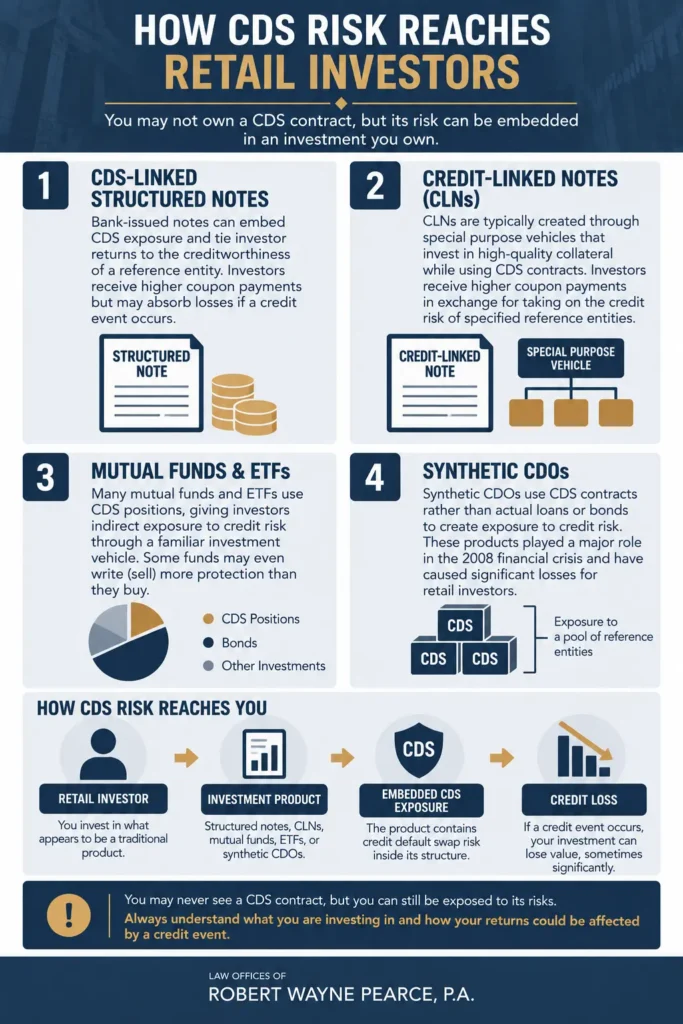
Retail investors rarely trade CDS directly. The Dodd-Frank Act effectively bars most individuals from entering swap contracts by requiring “eligible contract participant” status, generally reserved for institutions with $10 million or more in assets. Instead, CDS risk reaches retail portfolios through four main channels, each embedding derivative exposure inside familiar-looking investment wrappers.
CDS-Linked Structured Notes
For retail investors, CDS exposure can sometimes appear through structured notes rather than through a CDS contract itself. Issued as unsecured debt by major banks (JPMorgan, Morgan Stanley, Goldman Sachs, Barclays), these notes tie investor returns to the creditworthiness of a reference entity through an embedded CDS contract. The investor effectively sells credit protection to the issuer: in exchange for above-market coupon payments, the investor absorbs losses if the reference entity suffers a credit event like default or bankruptcy.
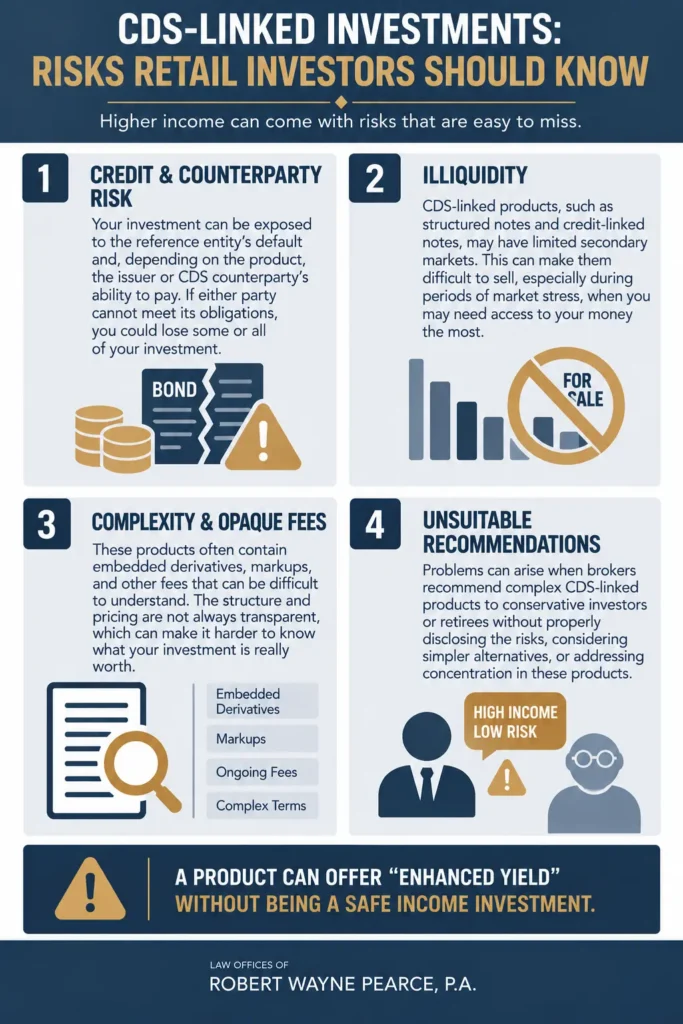
The SEC confirmed in a 2015 Investor Bulletin that financial institutions typically design and issue structured notes, which broker-dealers then sell to individual investors. In a single month (March 2015), approximately 870 structured note takedowns were filed with the SEC. These notes carry dual risk: both the credit risk of the reference entity and the counterparty risk of the issuing bank. If the issuer defaults, as Lehman Brothers did in 2008, all protections vanish regardless of the CDS performance.
Credit-Linked Notes (CLNs)
CLNs function similarly but are typically created through Special Purpose Vehicles that invest proceeds in high-quality collateral while entering CDS contracts with a dealer. Investors receive higher coupon payments in exchange for absorbing credit risk of reference entities. Academic research has found these products are generally overpriced in the primary market, with markups of 4–6% above fair value. The SEC Division of Corporation Finance historically refused to view CLNs as meeting registered offering disclosure requirements because payment information would not be available to investors through the life of the notes.
Mutual Funds and ETFs With CDS Positions
This represents a less visible but substantial channel. A Columbia Business School study analyzing CDS holdings of U.S. mutual funds from 2007–2011 found 309 mutual fund portfolios held 93,544 CDS positions, with total selling notional of $244 billion (exceeding buying notional by 65%). PIMCO, the largest fixed-income fund complex, sold twice as many CDS contracts as it purchased, meaning retail investors in PIMCO bond funds were unknowingly writing credit insurance.
ProShares now offers dedicated CDS ETFs (WYDE and TYTE) that invest at least 80% of assets in centrally cleared CDS. ProShares’ own SEC filing warns that an investor could potentially lose the full principal value of his or her investment within a single day.
Synthetic CDOs
These created the most devastating exposure channel historically. Unlike cash CDOs that hold actual loans, synthetic CDOs derive their value entirely from CDS contracts. Investors effectively sell insurance against default on pools of reference securities. Goldman Sachs alone packaged and sold $73 billion in synthetic CDOs from 2004–2007 containing 3,400+ mortgage securities. Retail investors were exposed through pension funds, structured investment vehicles, and bank portfolios that held CDO tranches.
Credit Default Swaps and the 2008 Financial Crisis
Credit default swaps turned the 2008 subprime collapse into a banking crisis by concentrating default risk in firms that could not absorb it. You have probably seen this story told through The Big Short, and the mechanics behind it are worth stating plainly.
Sellers wrote protection on mortgage-backed securities and synthetic CDOs while holding almost no capital against the possibility of paying out. AIG’s financial products unit alone had written $527 billion of super senior protection by the end of 2007. Of that, $78 billion referenced multi-sector CDOs, and roughly $61.4 billion carried exposure to US subprime mortgages.
Most of the remainder was European bank capital relief rather than mortgage risk. When the underlying mortgages failed, the collateral calls arrived faster than the firm could meet them. The Federal Reserve System and the U.S. Treasury ultimately provided a federal rescue that reached roughly $182 billion.
Two reforms followed. Dodd-Frank pushed standardized credit default swaps onto central clearinghouses and imposed margin, capital, and reporting obligations that had not existed before. What the reforms did not remove was the retail exposure, which moved into the structured notes, credit-linked notes and fund holdings described below.
Which CDS-Linked Products Have Caused the Most Retail Investor Harm?
The hierarchy of harm is clear: synthetic CDOs inflicted the greatest aggregate losses, while Lehman Brothers structured notes produced the most concentrated retail devastation. The Philadelphia Federal Reserve estimated total losses on subprime CDOs at approximately $420 billion, with 31% of collateral ($201 billion) in synthetic CDS form.
By the end of 2008, 91% of CDO securities had been downgraded. The landmark Goldman Sachs ABACUS case crystallized the problem: investors lost over $1 billion in a single synthetic CDO where hedge fund Paulson & Co. helped select the reference portfolio while secretly shorting it. Goldman paid a then-record $550 million SEC fine and acknowledged its marketing materials contained incomplete information.
Lehman Brothers structured notes devastated retail investors more directly. Over $8 billion in Lehman structured notes were outstanding at the September 2008 bankruptcy, with approximately $2.8 billion sold in the year of the collapse. Investors, most of retirement age seeking fixed income, received approximately 21 cents on the dollar. That left investors with a loss of about 80% of their principal.
Many notes had been marketed as “100% Principal Protected,” a claim rendered meaningless by Lehman’s insolvency because structured notes are unsecured debt obligations. The damage extended globally: over 43,700 Hong Kong investors lost HK$15.7 billion in Lehman-backed “guaranteed mini-bonds,” while approximately 10,000 Singapore investors lost over S$500 million in Lehman-linked structured products.
Recent Enforcement Actions Signal Intensifying Regulatory Scrutiny (2023–2025)
Recent enforcement demonstrates that regulators are actively policing CDS and CDS-linked products, with actions spanning the SEC, CFTC, and federal courts. If you believe your broker sold you unsuitable CDS-linked products, these actions confirm that regulators take this misconduct seriously, and that investors have legal recourse through FINRA arbitration.
SEC v. MUFG Securities EMEA plc (August 2025)
The SEC’s first-of-its-kind enforcement action against a security-based swap dealer over substituted compliance failures resulted in a $9.8 million civil penalty. MUFG, a UK subsidiary of Mitsubishi UFJ Financial Group, failed to comply with either U.S. or UK requirements from November 2021 through October 2024.
Violations included failure to compute net capital properly, failure to create required records, failure to make financial disclosures publicly available, and making untrue statements in its registration application. This signals heightened scrutiny of the post-Dodd-Frank framework that regulates CDS markets.
CFTC Enforcement Sprint Settlements (September 2025)
The CFTC simultaneously filed and settled compliance violations against 10 registrants, including multiple registered swap dealers, imposing total penalties of $8.325 million. UBS AG paid $5 million for failing to supervise trade surveillance systems covering credit products from 2015 through 2024. Santander, BNY Mellon, and SMBC Capital Markets each paid $500,000 for recordkeeping failures tied to employees using unapproved communication channels, while U.S. Bank paid a separate penalty for swap reporting failures.
CDS Antitrust Litigation and the $1.86 Billion Settlement
New Mexico State Investment Council’s antitrust class action alleged 10+ major banks conspired to rig CDS auction settlement prices. After surviving a motion to dismiss in 2023, the case hit a partial setback in January 2024, when the SDNY ruled that claims based on conduct before June 30, 2014 were barred by the release from the earlier $1.86 billion settlement in In re: Credit Default Swaps Antitrust Litigation, the largest CDS-related settlement in history.
Plaintiffs appealed, and in May 2025 the Second Circuit affirmed that ruling. The case then returned to New Mexico federal court, where litigation continues on claims tied to post-2014 conduct.
First Horizon Advisors Reg BI Violation (September 2024)
The SEC charged First Horizon with violating Regulation Best Interest’s Compliance Obligation related to structured note recommendations, imposing a $325,000 civil penalty. The firm lacked accurate customer information needed to evaluate structured note suitability and failed to enforce its own Reg BI policies for three years.
The SEC’s Complex Financial Instruments Unit chief stated that it is not enough to simply have written policies: firms must also enforce them. Additionally, SEC Rule 9j-1, effective August 29, 2023, now explicitly prohibits fraud, manipulation, and deception in connection with security-based swaps, including CDS, giving regulators a powerful new enforcement tool.
Seven Broker Misconduct Patterns That Generate CDS-Related Investor Losses
Broker misconduct with CDS-linked products follows predictable patterns, each violating specific FINRA rules and SEC regulations that create grounds for investor recovery. If any of these patterns sound familiar, contact a stockbroker fraud lawyer to discuss your legal options.
1. Suitability Violations
Brokers recommend CDS-linked structured notes to retirees, conservative investors, and unsophisticated individuals, characterizing them as “enhanced yield alternatives” to bonds or CDs. FINRA has documented cases where representatives recommended structured notes to customers who may not have had the sophistication to understand their features. These recommendations violate FINRA Rule 2111’s customer-specific suitability requirement and Reg BI’s Care Obligation, which requires brokers to consider reasonably available alternatives, including simpler fixed-income products.
2. Misrepresentation of Risks
This involves describing CDS-linked notes as “like bonds” or “safe income investments” while understating credit, counterparty, and liquidity risks. The “worst-of” feature common in CDS-linked products, where returns depend on the worst-performing reference entity, is frequently minimized. UBS paid $19.5 million in 2015 for misleading approximately 1,900 investors in structured notes, while Merrill Lynch paid $10 million in 2016 for concealing an “execution factor” in structured notes that cost investors 1.5% per quarter.
3. Failure to Disclose Counterparty Risk
Investors are not told that their principal protection depends entirely on the issuer’s solvency. As FINRA has warned, principal protection guarantees are only as good as the financial strength of the company making that promise. With CDS products specifically, investors face dual counterparty risk: both the structured note issuer and the underlying CDS counterparty.
4. Overconcentration
This occurs when brokers place excessive portions of a portfolio in CDS-linked products, violating diversification requirements. In one FINRA enforcement action, a broker-dealer allowed structured product concentrations of 25%+ in eight customers’ accounts with no exception reports or review mechanisms. A major FINRA arbitration awarded over $26.5 million in compensatory damages plus $80 million in punitive damages for overconcentrating customer accounts in structured notes.
5. Failure to Supervise
Under FINRA Rule 3110, firms must maintain written supervisory procedures specific to complex products. Failure to supervise manifests when firms lack procedures for CDS-linked products, fail to train supervisors on CDS risks, or maintain no exception reports to flag unsuitable sales. FINRA documented a firm that failed to supervise a broker who recommended that numerous customers liquidate their retirement accounts and invest the proceeds in structured notes and other speculative and illiquid securities.
6. Excessive Fees and Markups
These exploit the opacity of CDS-linked structured notes. Two former brokers were charged by the SEC with overcharging customers approximately $36 million through hidden markups on structured note transactions, altering term sheets to conceal the markups. As discussed below, embedded fees of 2–7% mean investors lose money from the moment of purchase.
7. Churning
This involves recommending premature sales of CDS-linked notes before maturity, then reinvesting in new structured notes to generate repeated commissions. Wells Fargo settled SEC charges in 2017 specifically for encouraging retail customers to trade structured products prior to their maturity and replace them with similar securities.
The Regulatory Framework Creates Multiple Grounds for Investor Claims
CDS-linked products sit at the intersection of overlapping regulatory regimes, creating multiple independent legal theories for recovery through FINRA arbitration or litigation. FINRA Regulatory Notice 12-03 (January 2012) established the foundational framework for complex product supervision, explicitly covering structured notes with embedded derivative features.
The notice requires firms to implement pre-approval processes for complex product sales, conduct heightened suitability analysis, consider whether less complex products could achieve the same objective, and provide comprehensive training for representatives and supervisors.
FINRA’s follow-up Regulatory Notice 22-08 (March 2022) reminded firms of their existing obligations when recommending complex products under FINRA rules and Regulation Best Interest and sought comment on possible additional measures to strengthen investor protections for complex products.
Regulation Best Interest (effective June 30, 2020) imposes four core obligations when brokers recommend CDS-linked products to retail customers: a Disclosure Obligation requiring written disclosure of all material fees, costs, and conflicts; a Care Obligation requiring reasonable diligence, care, and skill, including consideration of reasonably available alternatives; a Conflict of Interest Obligation requiring policies to identify, mitigate, and eliminate conflicts; and a Compliance Obligation requiring enforcement of written Reg BI policies.
The SEC’s 2025 and 2026 examination priorities specifically target recommended products that are complex, illiquid, or present higher risk to investors, including structured products. Dodd-Frank Title VII created the jurisdictional framework for CDS regulation: the CFTC oversees broad-based CDS (like CDX indices), while the SEC regulates security-based swaps, including single-name CDS. Critically, the Eligible Contract Participant requirement means retail investors generally cannot trade CDS directly, but they can be exposed through CDS-linked structured notes, ETFs, and mutual funds regulated under securities law, where full FINRA suitability and Reg BI protections apply.
Why CDS-Linked Products Are Unsuitable for Retirement and Conservative Accounts
CDS-linked products present a constellation of risks that make them fundamentally inappropriate for retirement accounts and conservative investors, a position supported by FINRA’s own regulatory guidance and a frequent basis for elder financial abuse claims. Liquidity risk is paramount. Structured notes and CLNs are illiquid instruments with no guaranteed secondary market.
The SEC has warned that an investor’s ability to trade or sell structured notes in a secondary market is often very limited. Retirees who need to access funds may face forced sales at deep discounts to par value. Counterparty risk makes these products particularly dangerous for retirement savings: principal protection depends entirely on issuer solvency, and the Lehman Brothers collapse proved that “100% Principal Protected” was meaningless in bankruptcy.
Complexity undermines informed consent: if the SEC’s own Division of Corporation Finance considered CDS-linked notes insufficiently transparent for registered offerings, they are clearly inappropriate for typical retail investors. Asymmetric risk means investors receive small premium payments in exchange for potential catastrophic loss, the opposite of what retirement portfolios need.
FINRA Regulatory Notice 07-43 specifically addresses senior investor protections, emphasizing that products that have withdrawal penalties or otherwise lack liquidity warrant special scrutiny and that age and life stage, whether pre-retired, semi-retired, or retired, can be important factors. The SEC’s 2025 and 2026 examination priorities explicitly focus on recommendations made to older investors and those saving for retirement, placing CDS-linked product sales to seniors squarely in the regulatory crosshairs.
FINRA Arbitration Claims for Structured Products Surged 77% in 2024
FINRA does not track CDS-specific arbitration claims as a standalone category. CDS-related disputes fall under the broader “Structured Products” classification in FINRA’s annual Dispute Resolution Statistics. However, the trend is striking:
| Year | Structured Products Cases | Change |
| 2020 | 35 | n/a |
| 2021 | 33 | -6% |
| 2022 | 38 | +15% |
| 2023 | 47 | +24% |
| 2024 | 83 | +77% |
Structured product cases have more than doubled since 2020, with the sharpest increase occurring in 2024. Overall, FINRA resolved cases in an average of 12.5 months in 2024 (improved from 14.6 months in 2023), with 84% of customer cases closed through settlement or awarded damages and an 87% mediation settlement rate. The growth trajectory signals increasing investor awareness and willingness to pursue recovery, and favorable conditions for claimants.
The CDS Market Is at Record Levels, Amplifying Retail Risk
The global CDS market is experiencing its fastest growth in nearly two decades. According to Bank for International Settlements data, credit derivatives notional outstanding reached approximately $11.1 trillion at mid-2025, representing 23% year-over-year growth, the fastest of all OTC derivative categories. CDS gross market value surged to $251.8 billion (+46.9% year-over-year), while single-name CDS market value jumped 61.9%. Trading volumes set all-time records in 2025.
The CDX North American Investment Grade index traded $16.8 trillion in notional, CDX North American High Yield reached $4.0 trillion, and iTraxx Europe hit $12.5 trillion, all record highs. The U.S. structured notes market is simultaneously booming, with issuance reaching $149–194 billion in 2024 (up approximately 46% year-over-year). One-third of independent financial advisors now use structured notes, and 25% plan to expand allocations.
While the overwhelming growth is in equity-linked products, the expanding market infrastructure and advisor adoption create channels through which credit-linked products, including CDS-linked notes, reach more retail portfolios. With the CDS market at record levels and structured note issuance booming, the pipeline of future investor harm remains substantial.
Protect Your Rights: What to Do If You Lost Money on CDS-Linked Investments
CDS-linked products represent one of the most dangerous categories of investments sold to retail investors, combining extreme complexity, opaque fee structures, dual counterparty risk, and severe illiquidity in a package that is fundamentally unsuitable for conservative and retirement accounts. The regulatory environment has never been more favorable for investors seeking recovery.
The SEC has addressed complex product sales through its examination priorities and Regulation Best Interest enforcement. SEC Rule 9j-1 also prohibits fraud, manipulation, and deception in connection with security-based swaps, including credit default swaps.
Broker misconduct with these products follows well-documented patterns: suitability violations, risk misrepresentation, hidden fees, overconcentration, and supervisory failures, each creating independent grounds for arbitration claims under FINRA rules, Reg BI, and securities anti-fraud provisions.
If you or a loved one lost money on CDS-linked structured notes, credit-linked notes, synthetic CDOs, or other derivative-based products recommended by a financial advisor, the Law Offices of Robert Wayne Pearce, P.A. can help. With over $185 million recovered for investors and a track record of more than 200 cases tried with only 4 losses, Attorney Pearce has the experience and resources to fight for your recovery. Contact us today for a free consultation to discuss your legal options!