
An equity-linked certificate of deposit (or equity-linked CD) is a bank CD whose interest depends on a stock index, so it can hand back your principal and nothing more. Brokers often pitch it as safe, yet caps and a years-long lock-up can cost you real growth.
If a broker sold you one that didn’t fit your needs, you may be able to recover your losses through FINRA arbitration, depending on the facts. Act soon, because FINRA’s six-year eligibility limit can prevent you from pursuing a claim through arbitration. Other legal deadlines may apply, too.
Robert Wayne Pearce and our investment fraud lawyer team have recovered over $185 million for investors across 45 years. There’s no fee unless we recover for you, so start with a free consultation.
In this guide, we’ll cover how equity-linked CDs work, how participation rates, interest caps, and averaging affect your returns, and what a hypothetical investment could earn. We’ll also explain the Federal Deposit Insurance Corporation (FDIC) insurance limits, the risks and tax implications, whether these CDs are a good investment, and when you may be able to recover losses through FINRA arbitration.
What Is an Equity-Linked Certificate of Deposit?
An equity-linked certificate of deposit is a bank CD that pays interest based on how a market index performs, often reflecting stock market movements, instead of paying a fixed rate.
The SEC describes it as “an FDIC-insured certificate of deposit that ties the rate of return to the performance of a stock index such as the S&P 500,” and says the usual term is five years.
You’ll also hear it called a market-linked certificate of deposit, an index-linked CD or a market participation CD, and HelpWithMyBank.gov, run by the Office of the Comptroller of the Currency (OCC), treats all of those names as the same product. Banks issue them, but they’re sold through bank branches and brokers, both affiliated and unaffiliated, so the person who pitched yours may work for a brokerage firm rather than the bank.
The OCC also warns that these CDs “may have complicated payout structures and may not be appropriate for all investors.” That warning is the reason a product with “CD” in its name can still end up in a FINRA arbitration.
How Equity-Linked CDs Work
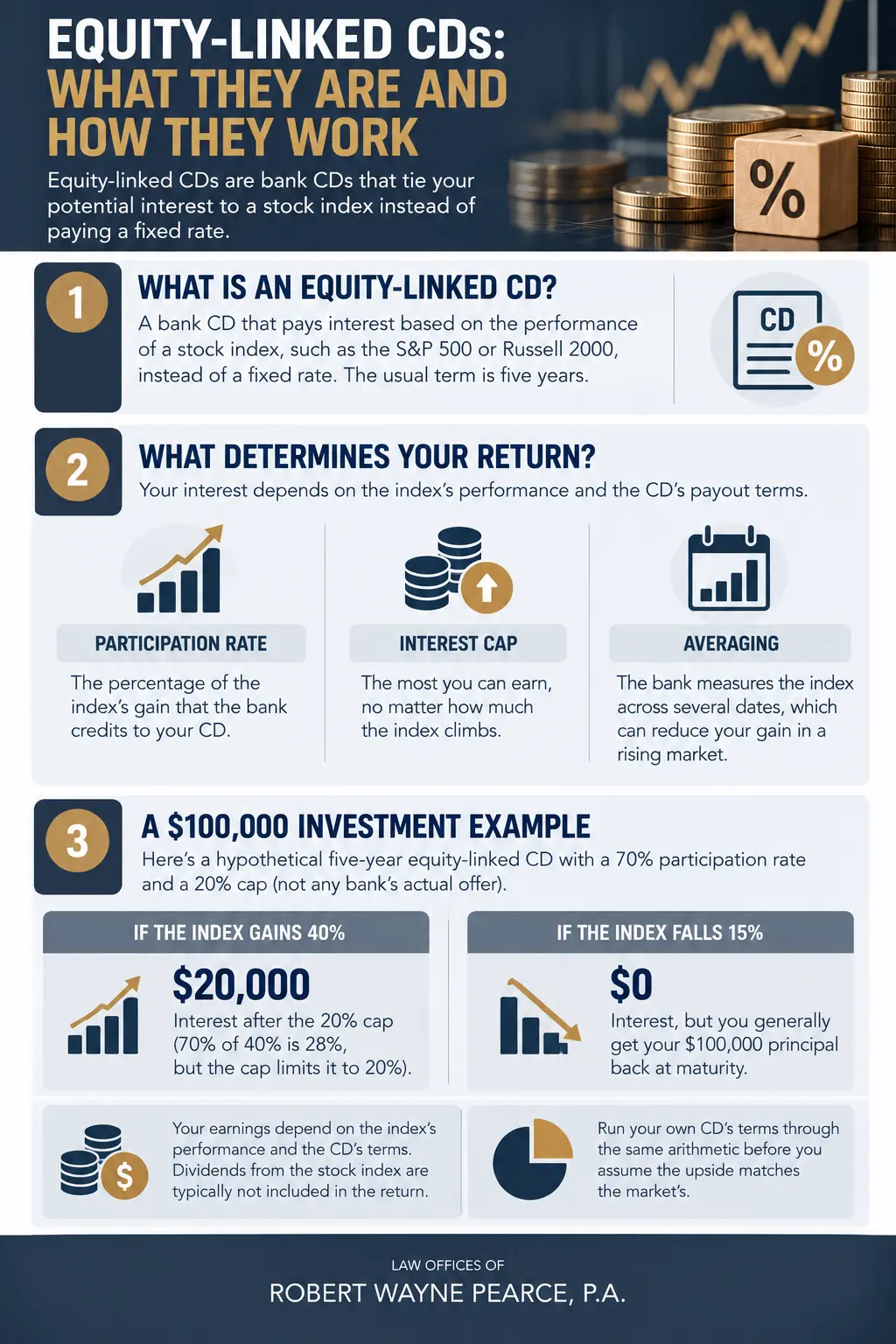
Equity-linked CDs tie your potential interest to a stock index, such as the S&P 500 or Russell 2000. You typically get your principal back at maturity, but your earnings depend on the index’s performance and the CD’s payout terms.
The product’s structure resembles a zero-coupon bond paired with a call option on the index, which serves as the underlying asset. Participation rates, interest caps, and averaging determine how much of the index’s gains you receive.
Participation Rate
The participation rate is the share of the index’s gain the bank credits to your CD. HelpWithMyBank.gov gives the example of an 80 percent participation rate on a 10 percent index gain, which pays you 8 percent, while the SEC notes that a 70 percent rate means you get only 70 percent of the gain.
Interest Cap
An interest cap is the most your CD can earn, however far the index climbs. In the OCC’s example, the S&P 500 rises 20 percent, and the participation rate is 70 percent, which would pay 14 percent, but a 10 percent cap holds you to 10 percent.
Averaging
Averaging means the bank measures the index across several dates instead of comparing its start and end values. The SEC says this can “lessen the impact of a declining market,” but it can also shrink your gain in a rising market, especially when market volatility causes index readings to fluctuate.
An Equity-Linked CD Example
Here’s a hypothetical equity-linked certificate of deposit example, using made-up terms (not any bank’s actual offer) so you can see how the math works. You put $100,000 into a five-year CD with a 70 percent participation rate and a 20 percent cap.
If the index gains 40 percent over the term, 70 percent of that gain is 28 percent, but the cap cuts your interest to 20 percent, or $20,000. If the index finishes 15 percent lower, you get your $100,000 back and nothing else after five years.
Meanwhile, a stock index fund holding the same stocks would have collected dividends along the way, and the SEC says dividend yields typically aren’t counted in a market-linked CD’s return. Run your own CD’s terms through the same arithmetic before you assume the upside matches the market’s.
Is an Equity-Linked CD FDIC Insured?
An equity-linked CD is FDIC-insured, but the SEC says coverage applies only to principal and guaranteed interest, subject to applicable FDIC insurance limits. The FDIC’s standard limit is “$250,000 per depositor, per FDIC-insured bank, for each account ownership category.”
So, the index-linked return isn’t guaranteed or covered by FDIC insurance. Because the coverage is limited to $250,000 per depositor, per insured bank, per ownership category, larger deposits may leave part of your principal or guaranteed interest unprotected.
The Risks of Equity-Linked CDs
Equity-linked CDs may protect your principal at maturity, but they still carry risks, including zero returns, limited liquidity, losses if you sell early, early redemption by the bank, and potentially unfavorable tax treatment.
Zero Return
Equity-linked CDs may pay no interest if the linked index fails to meet the CD’s payout conditions. You could receive only the principal amount at maturity, even after locking away your money for several years, while a traditional CD could have earned a fixed rate of interest income.
Liquidity Risk
Liquidity risk means you may not be able to get your money out early. The SEC notes that redemption before maturity is limited, and an early withdrawal can cost you a penalty and your interest, even inside an IRA or an education savings account.
Market Risk Before Maturity
Principal protection applies only at maturity. If you sell an equity-linked CD on the secondary market before then, the SEC warns it may be worth less than you paid, so a retiree who needs the cash in year three can take a real loss on a product sold as safe.
Call Risk
Some equity-linked CDs are callable, which means the bank can redeem them early. The SEC says a called CD may earn you less than holding it to maturity, and the bank decides when that happens, not you.
Tax Treatment
The SEC cautions that equity-linked CDs may be taxed differently from a traditional CD, and the tax treatment of interest income and capital gains can vary. Consult a tax advisor before investing to understand how taxes may affect your returns.

Are Equity-Linked CDs a Good Investment?
Equity-linked CDs may suit investors who can leave their money untouched until maturity and accept the possibility of earning no interest, but they aren’t ideal for everyone. For most people who were sold one as a safe place for savings, though, the trade-offs may outweigh the benefits.
Academic research points the same way, and you may find its conclusion surprising. A 2005 study in Financial Services Review, “Do equity-linked certificates of deposit have equity-like returns?” by Michelle Edwards and Steve Swidler, found that a typical ELCD may outperform a five-year Treasury note for some investors.
But it also found that “a synthetic ELCD consisting of a zero-coupon bond and stock index call option may be an even more appealing investment,” so you could often build the same exposure yourself (a bond plus an index option) for less.
When you compare market-linked CD rates, the OCC suggests reviewing each product’s Annual Percentage Yield (APY) disclosures. FINRA gives brokers a related instruction when they recommend complex products to you, since Regulatory Notice 12-03 says “registered representatives should consider whether less complex or costly products could achieve the same objectives for their customers.”
Can You Recover Losses on an Equity-Linked CD?
You may be able to recover losses if a broker recommended an equity-linked CD that didn’t fit your needs or misstated its risks. Regulation Best Interest requires brokers to act in your best interest when they recommend a product, and FINRA warns in Notice 12-03 that “the existence of the principal protection may not render the product a ‘conservative investment'” for an older investor who puts safety first.
A claim like this (usually one for unsuitability or misrepresentation) often turns on whether the broker called the CD “safe” or “guaranteed” without explaining the caps, the averaging, the call feature, or the lock-up. Our guide to market-linked CD risks covers the fees and conflicts involved in these sales in more depth, and our page on equity-linked notes explains the related product, which is a debt security rather than a bank deposit.
Most brokerage agreements send these disputes to FINRA arbitration. FINRA Rule 12206 says “No claim shall be eligible for submission to arbitration under the Code where six years have elapsed from the occurrence or event giving rise to the claim,” and state deadlines can be shorter, as our FINRA statute of limitations guide explains.
Talk to a FINRA Arbitration Lawyer
A FINRA arbitration lawyer can tell you whether your equity-linked CD sale gives you a claim worth bringing. Here at the Law Offices of Robert Wayne Pearce, P.A., we focus on structured product cases and fight to recover everything our clients are owed. Our team of FINRA arbitration lawyers has recovered over $185 million for investors in 45 years.
You won’t pay a fee unless we recover for you. Call us at (866) 860-7447 for a free consultation, and bring your CD’s term sheet, your account statements, your new account form, and any emails from your broker.