
FINRA Rule 2165 is a Self-Regulatory Organization (SRO) rule created and enforced by the Financial Industry Regulatory Authority (FINRA). It lets broker-dealers place a temporary hold on suspicious disbursements from a vulnerable adult’s account.
This FINRA rule applies to anyone 65 or older, or any adult whose mental or physical impairment prevents them from protecting their own financial interests.
When a broker has reasonable grounds to believe financial exploitation is happening or about to happen, the rule gives them a legal window to pause the transaction and escalate it before real damage is done.
While their broker may be trustworthy, your parents or other elderly loved ones may reach a point where they are no longer able to make sound investment decisions.
In such cases, it’s best to consult with an elder fraud attorney so they can help you get the justice you need. FINRA Rule 2165 is designed with folks like senior citizens in mind.
In the following guide, we will summarize FINRA 2165, what it allows, the time frame, and more.
FINRA 2165 Summary
La norma 2165 de la FINRA define la "explotación financiera" como una de las dos circunstancias. En primer lugar, la Regla 2165 identifica la explotación financiera como la toma o el uso indebido o no autorizado de los fondos o valores de un adulto específico.
Esta primera definición es muy amplia y puede abarcar muchos tipos de explotación financiera.
En segundo lugar, la norma 2165 define la explotación financiera como cualquier acción u omisión, incluso a través de un poder o una tutela, para hacer cualquiera de las siguientes cosas:
- “Obtain control over a specified adult’s money, assets, or property through deception, intimidation, or undue influence; or convert the specified adult’s money, assets, or property. “
La regla 2165 de la FINRA sólo protege a los "adultos especificados". Se trata de personas vulnerables que pueden no ser capaces de tomar sus propias decisiones financieras. La regla 2165 de la FINRA define a un "adulto especificado" como:
- Una persona de 65 años o más; o
- Una persona de 18 años o más que tiene una discapacidad mental o física que afecta a su capacidad para cuidar de sus propios intereses.
The financial exploitation definition under FINRA Rule 2165 relates only to actions taken against specified adults. If you do not fit into the category of “specified adult,” you still may have been the victim of securities fraud. If so, it’s important to reach out to an experienced securities fraud attorney as soon as possible.
What Does FINRA Rule 2165 Allow?
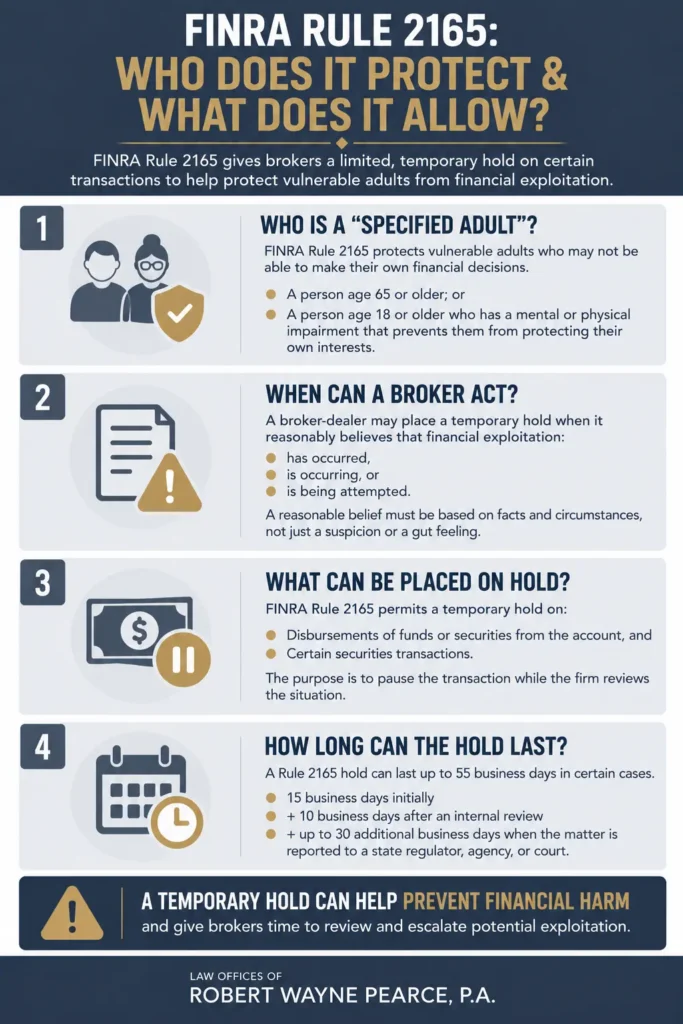
FINRA Rule 2165 permits a member firm to place a temporary hold on the disbursement of funds or securities, and on securities transactions, from the account of a specified adult when the firm reasonably believes financial exploitation has occurred, is occurring, or is being attempted.
A specified adult is any investor age 65 or older, or age 18 or older whom the firm reasonably believes has a mental or physical impairment that prevents protecting their own interests. The initial hold runs 15 business days, extendable by 10 more following internal review, and by an additional 30 when the matter is reported to a state regulator, agency, or court.
Cómo la norma 2165 de la FINRA protege a los adultos vulnerables de la explotación financiera
FINRA Rule 2165 and its sister rule, FINRA Rule 4512, are administered by the financial industry regulatory authority to help protect senior investors and vulnerable adults from financial exploitation.
These rules work together to protect vulnerable investors, including senior investors, by allowing a vulnerable person’s broker to temporarily hold disbursement of funds from an account suspected of financial exploitation.
These protections are part of broader investor safeguards across the securities industry. They also allow a broker to notify a vulnerable person’s important contacts when the broker suspects financial exploitation is taking place.
Impedir el desembolso de fondos cuando se sospecha de explotación financiera
Un corredor de bolsa puede retener temporalmente un desembolso de fondos o valores de la cuenta de corretaje de un adulto especificado si/cuando:
- A broker has a reasonable belief of financial exploitation based on facts and circumstances;
- A broker notifies all parties authorized to transact business in the account, as well as the account’s trusted contacts, about the temporary hold and the reason for it; and
- A broker initiates an internal review documenting the member’s reasonable belief and the circumstances observed.
The temporary hold is initially limited, but it can be extended for an additional 10 business days if the internal review justifies it.
La notificación a las personas autorizadas en la cuenta puede hacerse oralmente o por escrito (la comunicación electrónica es aceptable) en un plazo de dos días hábiles. Los corredores deben comunicar de forma clara y rápida la retención temporal y el motivo de la misma.
Brokers must make reasonable efforts to obtain and maintain the name and contact information of a trusted contact person for non-institutional customers, regardless of the customer’s age. This person must be a natural person and does not have to be a signatory on the account. But it can be someone the broker can share important account information with to address possible financial exploitation and help protect the customer’s assets.

FINRA Rule 2165 Hold Time
FINRA amended Rule 2165 on March 17, 2022, expanding it beyond disbursements alone, and a FINRA Rule 2165 hold can last up to 55 business days in certain cases because the rule allows an initial 15-business-day pause, a short extension after an internal review, and a longer extension when the situation is reported to a state authority.
Rule 2165 acts as a temporary hold tool. If someone thinks an older person is being tricked out of their money, it lets the broker freeze the account before the cash is gone for good.
At the Law Offices of Robert Wayne Pearce, P.A., our elder fraud attorneys have seen these holds used for more than wire requests, because the updated rule can also apply to a securities transaction as well as disbursements from the customer’s account or an adult customer’s account when a specified adult (customer age 65+ or an impaired adult) appears to be targeted.
“Reasonable belief” just means you have real reasons to be worried, not just a gut feeling. Red flags such as sudden account liquidations, unfamiliar payees, third-party pressure, or questionable power of attorney instructions may raise concerns about financial exploitation.
The updated rule applies where there is potential financial exploitation, a belief of financial exploitation, and signs the exploitation has been attempted or is ongoing. It also addresses the financial exploitation of specified adults, including a hold in a specified adult customer’s account.
Rule 2165 Amends Other Protections Against Elder Financial Abuse
The Securities and Exchange Commission (SEC) approved FINRA Rule 2165 in February 2017, and the rule became effective in February 2018. FINRA also amended Rule 4512 to require firms to make reasonable efforts to obtain and maintain the name and contact information of a trusted contact person for non-institutional customers.
These protections give investors and brokers additional tools to address potential financial exploitation:
- Trusted contacts can help brokers address concerns about unusual client behavior or possible diminished capacity.
- The framework can help when an individual is unable to protect his or her own interests.
- Early communication may help firms identify potential financial exploitation before losses worsen.
If you suspect your account or a loved one’s account has already been compromised, contact an investment fraud attorney as soon as possible. The sooner you act, the more options you have.
Los corredores son responsables del cumplimiento
FINRA member firms must consider whether a client is able to make financial decisions for themselves. That judgment can become more complicated when a broker has worked with the same client for many years.
Cognitive abilities can change over time, particularly for older adults and people with disabilities. Member firms must also recognize when a transaction may indicate financial exploitation rather than a legitimate financial decision. When exploitation is suspected, broker-dealers and other associated persons should escalate their concerns to supervisors, compliance, or legal.
Contact a Securities Fraud Attorney With Experience in Elder Financial Abuse
Si usted o un ser querido ha sido explotado económicamente, puede tener derecho a emprender acciones legales contra las partes responsables. La experiencia es clave en los litigios de este tipo de casos.
We at The Law Offices of Robert Wayne Pearce, P.A., are eager to help you understand your rights. Robert Pearce has many years of experience in the area of securities fraud and elder fraud. He has arbitrated and mediated hundreds of investment-related disputes in his career.
Our team of experienced investment loss litigators has recovered over $175 million dollars for well-qualified investors. We help investors nationwide and internationally pursue claims for a variety of investment losses and frauds. Contact us today about a free initial consultation on your case.