
Non-traded REITs are real estate investment trusts that own or finance income-producing real estate but, unlike publicly traded REITs, are not bought and sold on national stock exchanges. They give investors exposure to real estate and potential income without directly owning property, but they can also carry significant risks, including limited liquidity, high fees, and difficulty determining share value.
If you’ve landed on this non-traded REITs guide, you may have questions about how they work, their risks, or whether they’re appropriate for your portfolio. You may even have suffered losses after an unscrupulous broker made an unsuitable recommendation that didn’t fit your investor profile.
If so, contact the investment fraud lawyers at Robert Wayne Pearce. We represent investors in all 50 states and have recovered more than $185 million for clients over four-plus decades.
This guide explains what non-traded REITs are, their risks, pros and cons, why brokers recommend them, and whether they may be suitable for retirement accounts. But most importantly, it explains what you can do if a malicious broker has recommended an unsuitable investment and how you can get your money back!
What Are Non-Traded REITs?
A non-traded REIT is a real estate investment trust that is registered with the SEC but does not trade on any public stock exchange, and is typically sold by brokers and financial advisors to retail investors seeking income from commercial real estate.
Unlike publicly traded REITs, whose shares can be bought and sold on the NYSE or NASDAQ at transparent, market-determined prices, non-traded REITs are illiquid, opaque, and carry upfront costs. They also consume about 10%-15% of an investor’s capital before the remaining funds are used to invest in property.
Investors generally purchase shares through a public offering arranged by broker-dealer networks. The REIT’s sponsor, an external management company, uses the proceeds to acquire income-producing real estate such as office buildings, apartments, healthcare facilities, hotels, or retail centers. Investors receive periodic distributions, often marketed at yields of 5 to 8%, and are told to expect a liquidity event within seven to ten years.
Non-traded REITs usually follow two structures:
- Traditional lifecycle REITs: These REITs have a defined capital-raising period followed by an operational phase and, eventually, a potential liquidity event such as a listing or asset sale.
- NAV REITs: Newer NAV REITs, such as Blackstone’s BREIT and Starwood’s SREIT, offer periodic redemption windows based on net asset value rather than a fixed lifecycle. However, those redemptions are subject to limits, and both structures carry significant risks that brokers may understate.
How Do Non-Traded REITs Work?
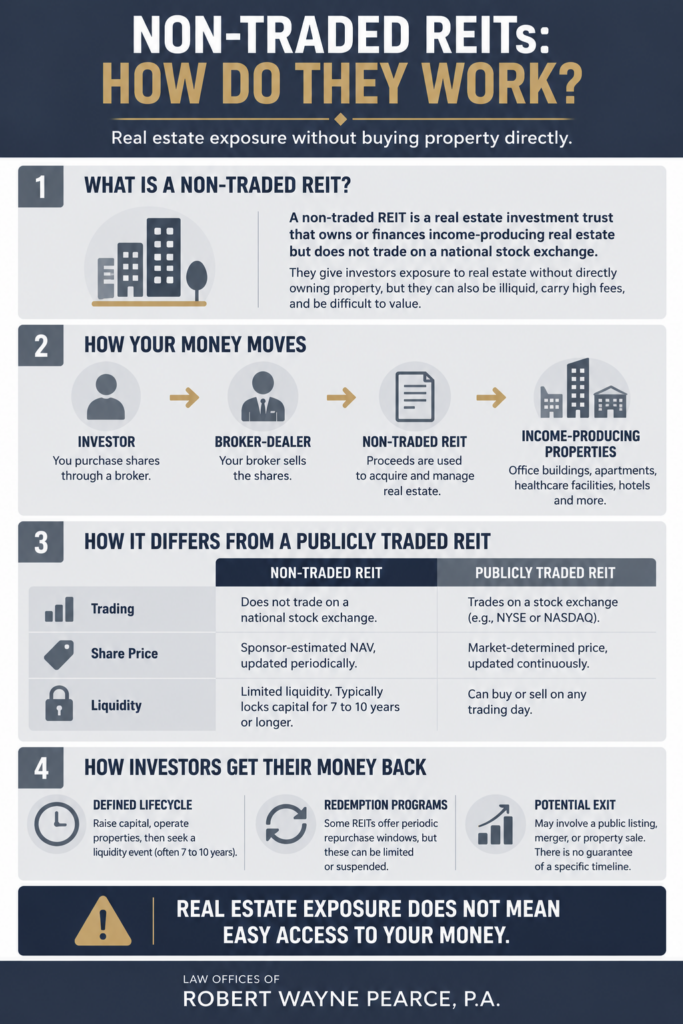
A non-traded REIT moves through three stages: a capital raise, an operational period, and an exit. Broker-dealers sell shares at a fixed price, usually $10.00, during an offering window that can stay open for years.
In many offerings, investors commit their money before the REIT has acquired any properties. With these blind pools, you have little say in how your capital is used, while the sponsor earns fees on acquisitions.
An external management company then handles leasing, operations, and property sales. Because the shares do not trade on a public exchange, investors do not have a daily market price to indicate the current value of their investment.
FINRA Rule 2231 requires brokerage firms to include an estimated per-share value for unlisted REIT securities on customer account statements. That figure may be based on the REIT’s reported net investment or an appraised valuation, so it is an estimate rather than a price established by actual buyers and sellers.
Your exit depends on a liquidity event: a public listing, a merger, or a portfolio sale. Sponsors project seven to ten years. Many have taken longer, and some ended in liquidation.
Non-Traded REITs vs. Publicly Traded REITs
The difference between a non-traded REIT and a publicly traded REIT is how investors buy, value, and sell their shares.
| Feature | Non-Traded REIT | Publicly Traded REIT |
| Liquidity | Capital locked for 7 to 10 years or longer | Sell on any trading day |
| Pricing | Sponsor-estimated NAV, updated periodically | Market-determined, updated continuously |
| Upfront fees | 9% to 15% of the offering price | Standard commission, often $0 |
| Ongoing costs | Management, acquisition, and disposition fees | Expense ratios often under 0.50% |
| Exit options | Capped redemptions, discounted secondary market, or a liquidity event | Sell on the exchange |
A publicly traded REIT tells you daily what your holding is worth. A non-traded REIT can carry a $10.00 statement value long after the properties behind it have fallen, which delays the moment you realize you were sold something unsuitable.
What Are the Benefits of Non-Traded REITs?
Non-traded REITs can offer several potential benefits, including access to commercial real estate, regular income distributions, and portfolio diversification:
- Access to commercial real estate: Non-traded REITs give investors access to properties such as office buildings, apartments, medical facilities, and warehouses without having to purchase or manage real estate directly.
- Potential income: Investors may receive regular distributions from rental income and other real estate operations. Non-traded REITs are often marketed with distribution rates of 5% to 8% (although payments are not guaranteed).
- Diversification: A single investment can provide exposure to multiple properties and real estate sectors that an individual investor may not be able to assemble alone.
What Are the Hidden Risks of Non-Traded REITs?
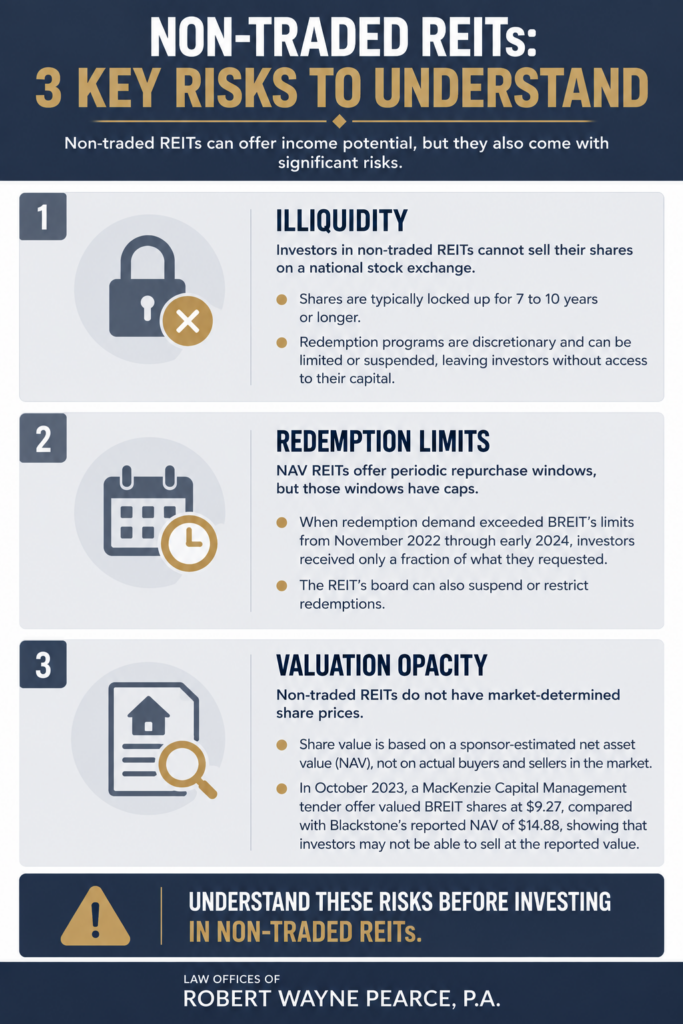
Despite the potential benefits, non-traded REITs also carry risks that investors should understand, such as illiquidity, valuation opacity, and redemption limits:
- Illiquidity: Investors in lifecycle non-traded REITs cannot sell their shares on an exchange, and redemption programs are discretionary. The REIT’s board can suspend or limit redemptions, leaving investors without access to their capital for years.
- Redemption limits: NAV REITs offer periodic repurchase windows, but those windows have caps. When redemption demand exceeded BREIT’s limits from November 2022 through early 2024, investors received only a fraction of what they requested.
- Valuation opacity: Non-traded REITs do not have market-determined share prices. In October 2023, a MacKenzie Capital Management tender offer valued BREIT shares at $9.27, compared with Blackstone’s reported NAV of $14.88, showing that investors may not be able to sell at the reported value.
How Are Non-Traded REIT Fees Hidden from Investors?
Non-traded REIT fees are embedded in the product’s offering structure and disclosed only in dense prospectus documents that most retail investors never read. The SEC has warned that upfront fees on non-traded REITs can reach 15% of the offering price, consuming a substantial portion of the investor’s capital on day one.
The fee layers typically include a selling commission of 6 to 7% paid to the broker and firm, a dealer manager fee of 1.5 to 3%, and additional offering and organizational expenses of 0.5 to 1.5%. On a $100,000 investment, these costs can total $9,000 to $15,000, money that never gets invested in real estate.
Ongoing fees deepen the cost drag. Non-traded REITs charge asset management fees, property acquisition fees, and disposition fees that reduce distributable income and erode NAV over time. The SEC has also cautioned that distributions may come from offering proceeds and borrowings rather than actual investment income, meaning investors may be receiving their own capital back while believing they are earning a return.
Why Do Brokers Recommend Non-Traded REITs Despite the Risks?
Brokers recommend non-traded REITs because the products generate commissions far exceeding what comparable investments pay. A 7% selling commission on a $100,000 non-traded REIT generates $7,000 for the broker and firm, compared to a fraction of that amount for a publicly traded REIT index fund with an expense ratio under 0.50%.
This compensation structure creates a direct conflict of interest. Under Regulation Best Interest (Reg BI), broker-dealers must consider reasonably available alternatives before recommending a product. A November 2024 report by the North American Securities Administrators Association (NASAA) found that many firms selling non-traded REITs had not updated their policies to comply with Reg BI’s requirement to evaluate lower-cost alternatives.
Revenue-sharing arrangements between REIT sponsors and broker-dealers add another layer of conflict. Sponsors pay marketing allowances and due diligence reimbursements that incentivize firms to promote preferred products over independent alternatives. When a firm’s compliance department does not adequately review these recommendations against customer profiles, unsuitable sales go unchecked.
Are Non-Traded REITs Suitable for Retirement Accounts?
Non-traded REITs are unsuitable for most retirement accounts because their illiquidity, high fees, and risk of principal loss conflict with the capital preservation retirees depend on.
Most states require purchasers to have a net worth of at least $250,000, or $70,000 in net worth plus $70,000 in annual income. FINRA Rule 2111 also required your broker to weigh your objectives, risk tolerance, time horizon, and liquidity needs, and Regulation Best Interest required them to consider whether a cheaper alternative would work just as well.
A retiree who puts $200,000 of an IRA into a REIT with a 10% load loses $20,000 on day one. If distributions stop, as they did at NorthStar Healthcare Income in 2019, that retiree cannot exit without a steep secondary-market discount. NASAA’s guidelines now cap non-accredited investors at 10% of liquid net worth per program.
If you suspect you’ve been defrauded through a non-traded REIT investment, it’s important to act quickly. The attorneys at the Law Offices of Robert Wayne Pearce, P.A. can help you understand your legal options and determine whether you may have a claim. Contact us today to schedule a consultation.
Recent Non-Traded REIT Fraud Cases and Enforcement Actions
Non-traded REITs have generated significant investor losses, FINRA arbitration filings, and regulatory scrutiny in recent years. The following cases illustrate the patterns of misconduct and loss that continue to affect retail investors.
- NorthStar Healthcare Income REIT, 70% Investor Losses (June 2025). NorthStar Healthcare Income, a non-traded REIT focused on senior housing, was acquired by Welltower Inc. for $3.03 per share in June 2025. Investors who purchased shares at the original offering price of $10.00 per share lost approximately 70% of their principal. NorthStar had suspended all distributions in 2019, and secondary-market shares traded as low as $1.01 before the merger. Our firm is actively investigating claims involving NorthStar Healthcare Income REIT.
- Moody National REIT II, Liquidation and Dissolution (2025). Shareholders of Moody National REIT II, a hospitality-focused non-traded REIT, voted in September 2025 to liquidate and dissolve the company. Distributions were suspended in 2020 and never resumed. Secondary-market shares traded between $3.50 and $4.75 against the original offering price of $25.00, a loss exceeding 80%. FINRA arbitration claims have been filed against firms including Centaurus Financial and Western International Securities.
- Inland Real Estate Income Trust, NAV Decline and Redemption Freeze (2025). Inland Real Estate Income Trust reported a new estimated NAV of $16.89 per share as of September 2025, an approximately 12% decline from its prior valuation. Between July and September 2024, only $107,036 of $2.4 million in redemption requests were fulfilled. Secondary-market shares traded at approximately $11.75, roughly 30% below the stated NAV.
- SEC and NASAA Heightened Regulatory Focus (2025 to 2026). The SEC’s FY 2026 Examination Priorities include continued scrutiny of retail investor protection and broker-dealer compliance with Regulation Best Interest. NASAA’s September 2025 amendments to its REIT Guidelines introduced a 10% concentration limit for non-accredited investors and added conduct standards for broker-dealers and investment advisers recommending non-traded REIT shares.
What Should You Do If You Lost Money on Non-Traded REITs?
Investors who suffered losses from non-traded REITs may have legal claims against the broker and firm that recommended the investment. Most brokerage account agreements contain mandatory arbitration clauses, meaning claims are filed through FINRA arbitration rather than court, but investors can and do recover substantial amounts through this process.
Common legal grounds for non-traded REIT claims include unsuitable recommendation, misrepresentation or omission of material risks, failure to supervise, breach of fiduciary duty, overconcentration, and negligence. The specific theory depends on whether the product matched the investor’s risk tolerance, whether fees and illiquidity were disclosed, and whether the firm maintained adequate compliance procedures.
FINRA’s eligibility rule requires claims to be filed within six years of the event giving rise to the dispute, and state statutes of limitation may impose shorter deadlines. If you believe your broker recommended a non-traded REIT that was unsuitable for your financial situation, you should consult a securities attorney promptly.
Talk to an Investment Fraud Attorney About Your Non-Traded REIT Losses
If you lost money on non-traded REITs due to a broker’s unsuitable recommendation, misrepresentation of risks, or failure to disclose material facts about fees, illiquidity, or conflicts of interest, you may have a viable claim to recover those losses.
Attorney Robert Wayne Pearce has over 45 years of experience representing investors in FINRA arbitration and securities litigation. Under his leadership, the Law Offices of Robert Wayne Pearce, P.A. has recovered more than $185 million for clients nationwide in cases involving investment fraud, stockbroker misconduct, and complex financial products including non-traded REITs and private placements.
Call (866) 859-5185 today for a free consultation. There is no cost to discuss your situation and determine whether you have a claim worth pursuing. The sooner you act, the stronger your position, and time limits on filing FINRA arbitration claims can work against investors who delay.
Frequently Asked Questions About Non-Traded REITs
Are Non-Traded REITs FDIC Insured?
No. Non-traded REITs are securities, not bank deposits. They are not insured by the FDIC, SIPC, or any government agency. If the REIT’s properties lose value or the REIT fails, investors can lose part or all of their principal.
What Is the Difference Between a Non-Traded REIT and a Publicly Traded REIT?
A publicly traded REIT’s shares are listed on a stock exchange, giving investors daily liquidity and transparent, market-determined pricing. A non-traded REIT’s shares do not trade on any exchange, forcing investors to rely on the sponsor’s estimated NAV for valuation and on limited redemption programs, or secondary markets, to exit. Non-traded REITs also carry substantially higher upfront fees, typically 9 to 15% of the investment.
What Is a NAV REIT, and Is It Safer Than a Traditional Non-Traded REIT?
A NAV REIT calculates net asset value on a regular basis and offers periodic repurchase windows instead of a fixed lifecycle. Major NAV REITs include Blackstone’s BREIT and Starwood’s SREIT. While NAV REITs provide more frequent valuation updates and redemption opportunities, repurchase programs are subject to caps and can be restricted when demand is high, as occurred with BREIT from November 2022 through early 2024.
How Long Do I Have to File a FINRA Claim for Non-Traded REIT Losses?
FINRA’s eligibility rule requires that arbitration claims be filed within six years of the event giving rise to the dispute. State statutes of limitation may impose shorter deadlines. The clock typically starts when the investor knew or should have known about the losses, and a triggering event could be a distribution suspension, a large NAV decline, or a liquidation announcement.
Can My Broker Be Held Liable for Overconcentrating My Portfolio in Non-Traded REITs?
Yes. FINRA suitability rules and Reg BI require that recommendations be appropriate in the context of the investor’s entire portfolio. Placing a disproportionate share of a portfolio in illiquid non-traded REITs, particularly for a retiree, may constitute a failure to diversify. NASAA’s updated REIT Guidelines now impose a 10% concentration limit for non-accredited investors.
What Evidence Do I Need to Prove My Broker Misrepresented a Non-Traded REIT?
Key evidence includes account statements showing the purchase, the REIT’s prospectus, marketing materials or correspondence from your broker, your customer account agreement documenting risk tolerance and objectives, and records of any verbal representations about the product’s safety or liquidity. A securities attorney can also obtain your broker’s regulatory history through FINRA’s BrokerCheck system.