
Unit investment trusts (UITs) are a type of investment product that Wall Street has marketed to many everyday investors, mostly for retirees and those saving for retirement through IRAs and 401(k) rollovers.
Most investors see a UIT as a simple, fixed basket of stocks or bonds with a set end date, made for easy diversification. But it actually is wrapped in layered fees and sales practices that have cost investors a huge sum and drawn repeated enforcement actions from FINRA and the SEC.
If you or someone you love has lost money in UITs, or if your broker has been repeatedly rolling your UIT proceeds into new trusts every 15 months (then charging you fresh sales commissions each time), you may have grounds to recover those losses.
The securities fraud attorneys at the Law Offices of Robert Wayne Pearce, P.A. have recovered more than $185 million for investors and have the experience to evaluate your situation at no cost.
In this guide, we’ll discuss:
- what UITs are and how they work
- the different types of UITs
- the complicated fee structure most investors never fully understand
- the risks UITs pose (especially to retirees)
- the rollover abuse pattern FINRA has specifically targeted
- how UITs compare to lower-cost ETFs
- real enforcement actions against firms like Stifel, Cetera, and Merrill Lynch
- and what to do if you believe your broker mishandled your UIT investments.
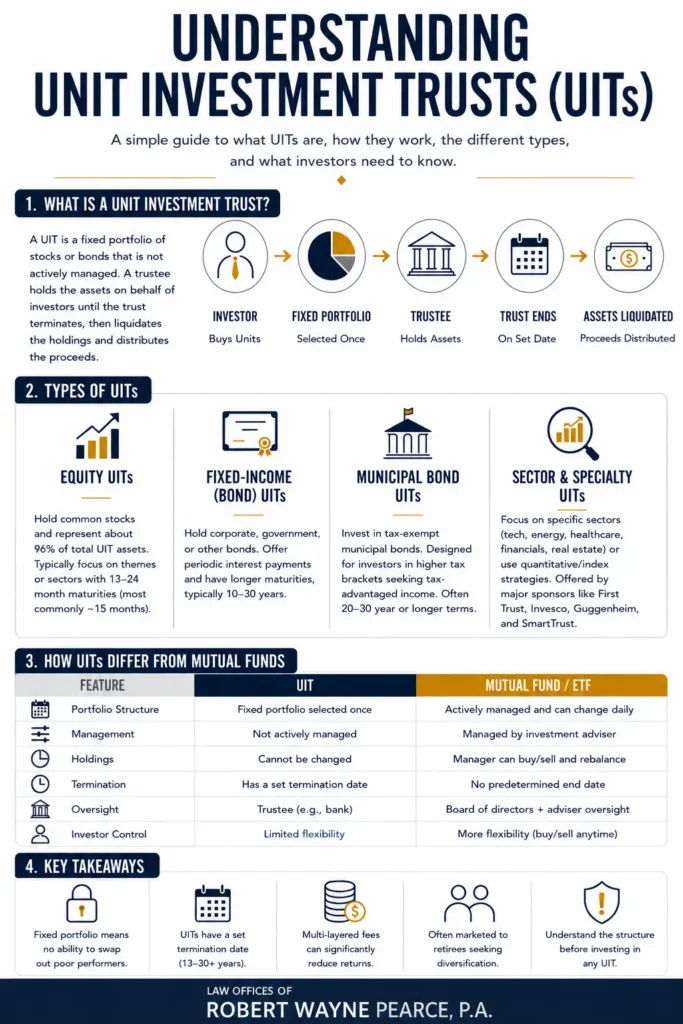
What Is a Unit Investment Trust (UIT)?
A unit investment trust is one of three types of investment companies recognized under the Investment Company Act of 1940, alongside mutual funds and closed-end funds.
When you buy “units” of a UIT, you are purchasing a proportional share of that fixed basket of underlying securities. A separate trustee (often a bank such as JPMorgan Chase or The Bank of New York) holds the assets on behalf of unit holders.
There’s no investment adviser managing the portfolio day-to-day, no board of directors overseeing investment decisions, and no ability to swap out poorly performing holdings for better ones. Once the portfolio is assembled, it is locked in place until the trust terminates.
Every UIT has a definite termination date, unlike mutual funds and ETFs that have no predetermined end date and can operate indefinitely. When that date arrives, the trust liquidates its holdings and distributes the net proceeds to unit holders.
Types of Unit Investment Trusts
The most common types of UITs include equity, fixed-income, municipal bond, and specialty UITs. Here’s more on each of these types of UIT in more detail:
Equity UITs
Equity UITs hold portfolios of common stocks, and they dominate the UIT market. As of year-end 2025, they made up about 96% of total UIT assets.
These trusts are typically organized around an investment theme or strategy, such as dividend-paying blue-chip stocks, a market sector (technology, healthcare, energy), or a specific stock-selection methodology.
Equity UITs generally have short maturities, most commonly 13 to 24 months, with many equity UITs having around 15-month terms.
Fixed-Income (Bond) UITs
Bond UITs hold portfolios of corporate bonds, government bonds, or other fixed-income securities.
They tend to have much longer maturities, typically 10 to 30 years, aligned with the maturity dates of the underlying bonds. Investors receive periodic interest payments from the bonds in the portfolio, and the principal is returned as bonds mature or the trust terminates.
Municipal Bond UITs
Municipal bond UITs are a subset of fixed-income UITs that hold portfolios of tax-exempt municipal bonds.
They are often marketed to investors in high tax brackets who seek income that is usually exempt from federal (and sometimes state) income taxes. Like other bond UITs, municipal UITs typically have long-term maturities and may extend 20 to 30 years or more.
Sector and Specialty UITs
Many equity UITs are designed around narrow sector themes like semiconductors, oil and gas, financials, and real estate, creating significant concentration risk.
Some specialty UITs use quantitative screening methods or track proprietary indexes. Major UIT sponsors such as First Trust Portfolios, Invesco, Guggenheim Investments, and SmartTrust each offer dozens of themed UIT series.
Red Flags That Your UIT Investment May Have Been Mishandled
You should consider consulting a securities attorney if any of the following apply to your situation:
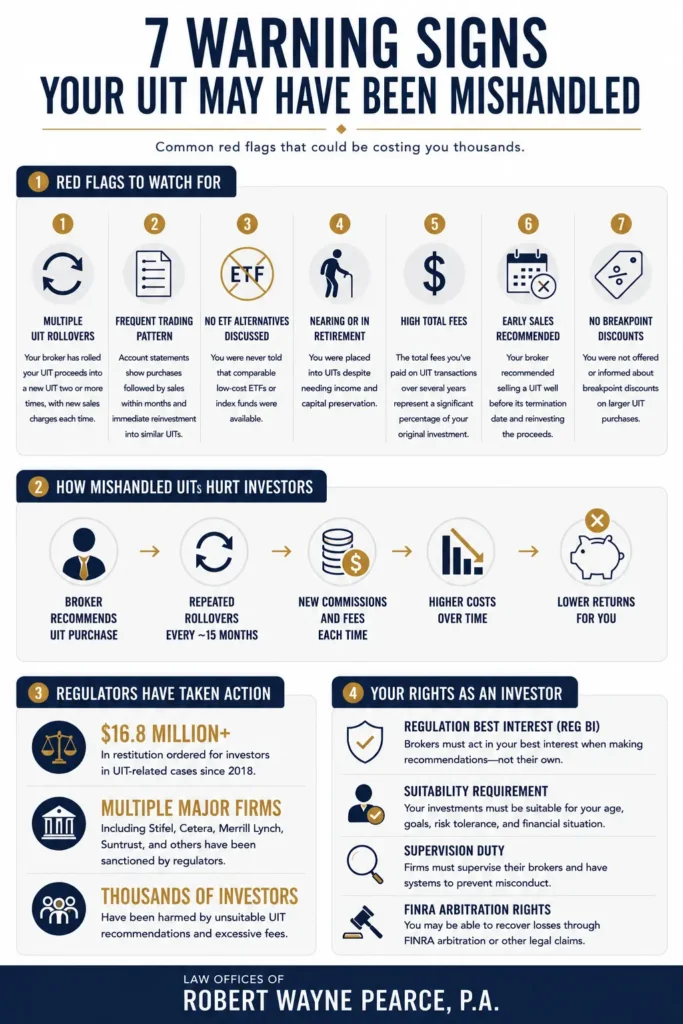
- Your broker has recommended rolling your UIT proceeds into a new UIT two or more times, with each rollover generating new sales charges.
- Your account statements show UIT purchases followed by sales within a few months, and then immediate reinvestment into similar UITs.
- You were never told that comparable low-cost ETFs or index funds were available. You are retired or nearing retirement and were placed into UITs despite needing income and capital preservation.
- The total fees you have paid on UIT transactions over several years represent a significant percentage of your original investment.
- Your broker recommended selling a UIT well before its termination date and reinvesting the proceeds.
- You were not offered or informed about breakpoint discounts on larger UIT purchases.
UIT Fee Structure
One of the most important things to understand about UITs is just how many fees you have to pay.
Although UITs have no ongoing management fees (because there is no active manager), investors pay a combination of charges that can be surprisingly costly, especially when UITs are repeatedly rolled over into new series.
| Fee Component | Typical Range | Descripción |
| Initial Sales Charge | 0–1.0% | Upfront charge at purchase during initial offering |
| Deferred Sales Charge | 1.35–2.5% | Deducted in installments over 12–18 months |
| Max Sales Charge (Combined) | 1.95–3.95% | Total of initial + deferred charges |
| Creation & Development Fee | ~0.50% | Compensates sponsor for assembling the trust |
| Organization Costs | Varies | One-time structuring costs; can exceed one-third of total expenses |
| Annual Operating Expenses | 0.20–0.30%/yr | Admin, trustee, evaluator, and bookkeeping fees |
| Dealer Concession (Broker Payout) | 1.25–2.0% | Commission paid to selling broker per transaction |
Breakpoint discounts may reduce sales charges for larger investments. For example, investments above $50,000 may qualify for a reduced maximum sales charge of 2.70% instead of 2.95%, and investments above $250,000 may be charged 2.20%.
However, as FINRA enforcement actions have shown, many firms have historically failed to apply these discounts properly, and some brokers have avoided aggregating client holdings to prevent their clients from reaching breakpoint thresholds.
Note: Actual fees, sales charges, and breakpoint schedules vary by UIT sponsor and trust series. Investors should consult the applicable prospectus for the specific terms that apply to their investment.
The Risks of Investing in UITs
Here are the risks of UITs broken down in plain English:
The Fixed Portfolio Problem
Because a UIT’s fixed portfolio of securities cannot be changed after creation, there’s no mechanism to respond to deteriorating market conditions, negative news about a company in the portfolio, or sector-wide downturns.
If one of the 25 stocks in an equity UIT drops 80% due to an accounting scandal, the trust must continue holding that stock until termination.
Unlike a mutual fund manager who could sell the position, a UIT trustee has no authority to act. This rigidity can be devastating for investors who assumed their money would be actively managed.
Concentration Risk
Most UITs focus on a single industry sector, a specific stock-selection screen, or a handful of high-dividend names. That makes a far less diversified investment portfolio.
Retirees with conservative risk profiles are often unsuitable candidates for that kind of concentrated exposure. For more on this issue, see our page on lack of diversification claims.
Illiquidity
UITs do not trade on an exchange the way stocks or ETFs do. While units are technically redeemable at net asset value, selling before the trust’s termination date typically triggers any remaining deferred sales charges.
Some sponsors maintain limited secondary markets, but liquidity is not guaranteed. For retirees who may need access to their funds for healthcare costs or other expenses, this lack of ready liquidity can create serious problems.
Suitability Concerns for Elderly and Retired Investors
FINRA has specifically flagged the sale of UITs to senior investors as a regulatory concern. FINRA Regulatory Notice 07-43 identifies products with “withdrawal penalties or otherwise lack liquidity” as potentially unsuitable for older investors.
The repeated cycle of 15-month rollovers each generating 2–4% in new sales charges creates a pattern of ongoing capital erosion that is particularly harmful to investors who are living on fixed incomes and cannot afford to lose 20–35% of their retirement savings to fees over a decade.
If you are an elderly investor, or the family member of one, who believes UITs were improperly sold, our elder financial abuse attorneys can help evaluate your claim.
| Have You Lost Money in Unit Investment Trusts? If your broker has been rolling your UIT investments into new trusts every 15 months, generating fresh commissions while your account balance shrinks, you may have a claim. Attorney Robert Wayne Pearce has recovered over $185 million for investors and offers free initial consultations. Call (561) 338-0037 or visit secatty.com to discuss your case. |
UIT Rollover Abuse
The single largest fraud pattern identified by FINRA in the UIT market is rollover abuse, also known as “switching.” It’s when a broker, as a UIT nears or hits its termination date, contacts the investor and recommends rolling the proceeds into a new UIT series.
Many investors assume this is just a natural continuation of their original investment strategy. What they often do not understand is that each rollover triggers an entirely new set of sales charges, typically 1.95% to 3.95% of the invested amount.
With a typical 15-month equity UIT, this cycle can repeat roughly eight times over a decade. At an average sales charge of 2.5% per cycle, that’s 20% of the investor’s capital consumed by sales charges alone before accounting for creation and development fees, organization costs, and annual operating expenses. The total 10-year cost can reach 22% to 35% of the originally invested amount.
FINRA has also found that the rollover discounts sponsors once offered are largely gone. As FINRA noted in its June 2021 guide, those discounts “are not commonly offered today.”

“Early Rollovers”: An Even More Harmful Pattern
An “early rollover” occurs when a broker recommends selling a UIT 100 or more days before its scheduled termination date and reinvesting the proceeds into a new trust.
The investor can end up paying deferred sales charges on the old UIT while paying new charges on the replacement at the same time. That’s what makes early rollovers more expensive.
FINRA launched a targeted examination of UIT early rollovers in September 2016, and the results led to enforcement actions against seven major brokerage firms.
Repeated, commission-generating transactions like this are analogous to churning and excessive trading, which are forms of securities fraud.
UITs vs. ETFs: Why Your Broker May Prefer to Sell You a UIT
One of the most revealing questions an investor can ask about UITs is: why would a broker recommend a UIT when a comparable exchange-traded fund (ETF) is available at a fraction of the cost? The answer, in many cases, comes down to compensation.
| Feature | Typical Equity UIT | Comparable Index ETF |
| Sales Commission | 1.95–3.95% per cycle | $0 (commission-free at most brokers) |
| Annual Expense Ratio | 0.20–0.30% | 0.03–0.10% |
| 10-Year Fee Cost on $100K (Illustrative) | $22,000–$35,000+ | $300–$1,000 |
| Portfolio Management | Fixed/unmanaged | Rebalanced to track index |
| Liquidity | Limited; redemption penalties | Trades on exchange throughout the day |
| Broker Payout | 1.25–2.0% per sale + volume bonuses | $0 in most cases |
Let’s say an investor places $100,000 into equity UITs and rolls over every 15 months for 10 years, earning 7% annually before fees.
After accounting for about 2.5% sales charges per rollover cycle plus annual operating expenses, the investor’s ending balance is roughly $153,000 to $163,000.
The same $100,000 invested in a Vanguard S&P 500 ETF (expense ratio 0.03%) would grow to approximately $196,000 over the same period. That’s $33,000 to $43,000 lost almost entirely to the UITs’ layered fee structure.
Brokerage firms and their representatives earn far more from UIT sales than from ETF purchases. UIT sponsors also pay broker-dealers volume-based bonuses (called “revenue sharing”) of 0.035% to 0.225% on total UIT sales. It gives brokers another reason to push UIT products.
As one major firm’s own disclosure states, this compensation arrangement “gives [the firm] and its Financial Advisors an incentive to recommend investment products based on the compensation received, rather than based on a client’s needs.”
Under Regulation Best Interest, brokers are required to consider “reasonably available alternatives” when recommending any security. A broker who recommends a UIT carrying 2.95% in sales charges when an equivalent low-cost ETF is available may be violating this obligation.
FINRA and SEC Enforcement Actions Involving UITs
UIT abuses have drawn significant regulatory scrutiny in recent years. Below are verified enforcement actions that illustrate the scope of the problem.
FINRA’s UIT Enforcement Sweep (2016–2021)
In September 2016, FINRA launched a targeted examination of UIT early rollovers that ultimately resulted in enforcement actions against seven major brokerage firms.
The sanctions totaled more than $16.8 million in restitution to nearly 10,000 harmed investors, plus millions in fines. These firms included some of the largest names on Wall Street:
| Firm | Year | Fine | Restitution | Total |
| Morgan Stanley Smith Barney | 2017 | $3.25M | $9.8M | ~$13M |
| Merrill Lynch | 2021 | $3.25M | $8.4M | $11.65M |
| Raymond James (SEC) | 2019 | $3M | $12M | $15M |
| Oppenheimer & Co. | 2019 | $800K | $3.87M | $4.67M |
| Stifel, Nicolaus & Co. | 2020 | $1.75M | $1.9M | $3.65M |
| Wells Fargo (2 entities) | 2021 | $650K | $2.46M | $3.1M |
| Cambridge Investment Research | 2020 | $150K | $150K |
Stifel, Nicolaus & Company: A Closer Look
The Stifel enforcement action is particularly instructive. According to FINRA’s findings, between January 2012 and December 2016, Stifel processed almost $10.9 billion in UIT transactions. Those transactions brought in $206.3 million in sales charges.
Of those transactions, $935.2 million involved early rollovers. Stifel also sent around 600 letters to customers that understated the cost of UIT switches by nearly 49%. For additional information about this firm, see our Stifel Nicolaus investigation page.
Cetera Financial Group: A Pattern of UIT Violations
Cetera Financial Group and its affiliated broker-dealers have been involved in multiple UIT-related enforcement actions:
- Investors Capital Corp (Cetera subsidiary), October 2016: FINRA imposed a $250,000 fine and ordered $841,532 in restitution for unsuitable short-term UIT trading in 74 customer accounts and failure to apply sales charge discounts on nearly 2,000 UIT purchases, overcharging customers approximately $472,876. In one case, a 68-year-old income-oriented client was sold 59 UITs with an average holding period of just three months, resulting in losses exceeding $32,000. Investors Capital subsequently withdrew its FINRA registration.
- Cetera Advisors LLC and Cetera Advisor Networks LLC, October 2015: Both entities were among 12 firms sanctioned by FINRA for failing to apply UIT sales charge discounts, with combined penalties of roughly $1 million. For more about this firm, see our Cetera Advisors investigation page.
Recent Actions (2023–2025)
Carter, Terry & Company: First Reg BI-Based UIT Action (2025)
In what appears to be the first Regulation Best Interest-based UIT enforcement action, FINRA sanctioned Carter, Terry & Company with a $75,000 fine and $176,590 in restitution.
The firm had executed more than $61 million in UIT transactions since June 2020 but had no written policies addressing UIT recommendations until April 2023.
A representative repeatedly recommended early UIT sales and reinvested proceeds into new trusts, causing customers to incur avoidable costs.
First Trust Portfolios: $10 Million Fine (November 2025)
FINRA fined First Trust Portfolios, the largest UIT sponsor in the country, $10 million for violations related to gifts and entertainment.
Between 2018 and February 2024, First Trust wholesalers routinely exceeded FINRA’s annual gift limits, providing more than $650,000 in improperly reported non-cash compensation and conditioning gifts on sales targets for First Trust products including UITs.
The case underscores the financial incentives that drive UIT sales throughout the distribution chain.
Centaurus Financial / Donnie Ingram (May 2023)
FINRA ordered Centaurus Financial and registered representative Donnie Ingram to pay $388,962 in joint restitution.
That’s after Ingram recommended 595 higher-cost “standard version” UITs across 81 customer accounts when lower-cost “fee-based” versions of the same products were available.
Ingram was on heightened supervision due to six prior suitability complaints, yet his supervisor never performed any suitability reviews of his 229 UIT purchases.
LPL Financial: $5.5 Million Fine (December 2023)
FINRA fined LPL Financial $5.5 million and ordered $651,374 in restitution for multiple violations. One was sending approximately 11,300 switch letters with inaccurate information about the charges customers incurred when switching securities, including UIT switch transactions.
The case demonstrated the pervasive nature of misleading disclosure practices around UIT costs.
Regulatory Rules That Protect UIT Investors
Multiple layers of federal securities regulation apply to the sale of UITs. Understanding these rules is important because they form the legal basis for claims that investors may bring when their brokers or firms fail to comply.
Regulation Best Interest (Reg BI)
Since June 30, 2020, broker-dealers have been subject to Regulation Best Interest (SEC Rule 15l-1), which requires them to act in the best interest of retail customers when making securities recommendations.
For UIT sales, Reg BI’s Care Obligation demands that brokers exercise reasonable diligence to understand the potential risks, rewards, and costs of any recommended transaction and to consider reasonably available alternatives, such as ETFs.
The December 2025 Carter, Terry & Company action shows that FINRA is now actively enforcing Reg BI in the UIT context.
FINRA Rule 2111 (Suitability)
FINRA’s suitability rule requires that any recommended transaction be suitable for the specific customer based on their investment profile, including age, financial situation, investment objectives, time horizon, liquidity needs, and risk tolerance.
The quantitative suitability prong is particularly relevant to UIT rollovers: even if each rollover appears suitable in isolation, the cumulative pattern of repeated early rollovers generating high costs may constitute a violation.
FINRA Rule 3110 (Supervision)
Brokerage firms are required to establish and maintain supervisory systems reasonably designed to detect and prevent violations.
In case after case, FINRA found that firms lacked automated exception reports to flag early UIT rollovers, failed to require supervisors to review the cost impact of switching, and had inadequate written supervisory procedures.
For more on this claim type, see our page on failure to supervise.
FINRA Regulatory Notice 21-07 and NASD NTM 04-26
FINRA has issued specific guidance on UIT sales practices. NASD Notice to Members 04-26 (2004) established requirements for firms to understand and correctly apply UIT breakpoints and volume discounts.
Regulatory Notice 21-07 (2021) reinforced these obligations and shared exam findings revealing widespread failures to apply sales charge discounts and rollover waivers.
Firms that overcharge customers by failing to apply available discounts may violate FINRA rules and other applicable securities laws discussed in these notices.
FINRA’s 2017 Targeted Examination Letter on UIT Rollovers
In September 2016, FINRA issued a targeted examination letter to firms doing substantial UIT business, defining an “early rollover” as the sale of a UIT 100 or more days before the portfolio ending date.
FINRA requested detailed data on each firm’s top representatives by early rollover revenue, written supervisory procedures, and exception reporting capabilities.
The examination led directly to the multi-firm enforcement sweep described above and signaled that FINRA considers UIT rollover abuse a high-priority issue.
Legal Claims Available to UIT Investors
If your broker or brokerage firm sold you UITs inappropriately, failed to disclose the true costs, or repeatedly rolled your UIT investments to generate commissions, you may have grounds for several types of legal claims:
- Unsuitability / Reg BI Violations: If UITs were not appropriate for your investment profile, especially if you are a retiree with income needs and limited risk tolerance, the recommendation itself may have been improper.
- Excessive Trading (Churning): Repeated early rollovers that serve the broker’s compensation interest rather than your investment needs may constitute churning.
- Failure to Supervise: If the firm lacked adequate supervisory systems to monitor UIT rollover activity, the firm itself bears responsibility for your losses under failure to supervise theories.
- Breach of Fiduciary Duty / Negligence: Brokers and firms owe duties of care to their clients. Recommending high-cost UITs when lower-cost alternatives were readily available, or failing to disclose the cumulative fee impact of rollovers, may constitute negligence or breach of fiduciary duty.
- Misrepresentation and Omission: If your broker understated UIT costs, failed to disclose their compensation conflict, or did not explain that cheaper alternatives were available, you may have a misrepresentation claim.
- Elder Financial Abuse: In many states, including Florida, there are specific statutory protections for elderly investors who have been exploited by financial professionals. Our elder financial abuse attorneys can evaluate whether these enhanced protections apply to your situation.
Unit Investment Trusts (UITs) and Taxation
UITs are taxed as pass-through vehicles, so the trust itself doesn’t pay anything.
Income, capital gains, and losses flow straight through to unit holders, so you owe tax on dividends and bond interest in the year you receive them. Municipal bond UITs are the exception, since that income may be exempt from federal tax.
Every termination is a sale, so any gains realized when the trust liquidates are taxable even if the proceeds never leave your account. Roll your UIT every fifteen months, and that amounts to about eight taxable events in a decade, stacked on eight rounds of sales charges.
How to Pursue a UIT Claim Through FINRA Arbitration
Most brokerage account agreements require disputes to be resolved through FINRA arbitration rather than in court.
FINRA arbitration puts your case in front of a panel of arbitrators who hear the evidence and hand down a binding decision. Claims must generally be filed within six years of the event giving rise to the dispute.
Some pieces of evidence that can be included in a UIT arbitration case are:
- brokerage account statements showing the rollover pattern
- sales charges assessed on each transaction
- confirmation slips
- the broker’s notes and communications
- a cost comparison against a lower-cost alternative
Expert testimony on industry standards and Reg BI compliance is also commonly presented.
Attorney Robert Wayne Pearce has tried more than 200 cases to verdict or award with only four losses in his entire career, and has recovered more than $185 million for investor clients. He offers free initial consultations to investors who believe they have been harmed by UIT sales practices.