
An AWC (Acceptance, Waiver, and Consent) is a formal settlement agreement used by the Financial Industry Regulatory Authority (FINRA) to resolve alleged securities rule violations without a disciplinary hearing.
A stockbroker, financial advisor, or brokerage firm that enters into an AWC agrees to FINRA’s findings and accepts specific disciplinary sanctions. These may include fines, suspensions, censures, restitution, or a permanent bar from associating with FINRA member firms.
However, signing an AWC doesn’t necessarily mean admitting wrongdoing. FINRA generally allows respondents to settle without admitting or denying its findings.
An AWC can also reveal important information about a broker’s disciplinary history. For investors who have lost money, these findings may provide valuable insight into potential misconduct.
In this guide, we’ll explain how FINRA AWCs work, what they mean for financial professionals, and how they may affect investors seeking to recover investment losses.
What Does Acceptance, Waiver, and Consent Mean?
Acceptance, Waiver, and Consent refers to the three commitments a financial professional or brokerage firm makes when settling a disciplinary matter with FINRA.
Each part of the agreement serves a specific purpose:
- Acceptance: The respondent accepts FINRA’s findings regarding the alleged violations. This doesn’t necessarily mean admitting wrongdoing, but the respondent agrees to the findings being entered as part of the settlement.
- Waiver: The respondent gives up the right to a FINRA disciplinary hearing and any right to appeal to the NAC, SEC, or courts, or otherwise challenge the AWC if accepted by FINRA.
- Consent: The respondent agrees to the sanctions outlined in the AWC letter, which may include fines, suspensions, or other disciplinary measures.
The AWC process is governed by FINRA Rule 9216.
For example, suppose FINRA investigates a stockbroker for making improper investment recommendations. Rather than contesting the allegations, the broker might agree to pay a fine and serve a temporary suspension.
If FINRA accepts the proposed AWC, the matter is resolved without a contested hearing. The disciplinary findings and penalties still become part of the broker’s regulatory record.
How Does the FINRA AWC Process Work?
The FINRA AWC process allows financial professionals and brokerage firms to settle alleged securities violations without going through a contested disciplinary hearing.
Although each case is different, the process mostly follows five steps:
- FINRA investigates a potential violation: FINRA may investigate suspected misconduct after receiving a customer complaint, identifying a compliance problem, or uncovering suspicious activity. Investigators can examine trading records, request documents, and interview relevant individuals.
- Settlement discussions begin: If FINRA believes a violation occurred, enforcement staff may negotiate a settlement with the respondent. The parties discuss the allegations, findings, and potential sanctions.
- An AWC letter is prepared: The agreement describes the conduct involved, identifies the applicable securities rules, and specifies the proposed disciplinary penalties.
- The respondent signs the agreement: The broker or firm accepts the findings, consents to the sanctions, and waives certain procedural rights. This typically includes the right to a disciplinary hearing and specified appeal rights.
- FINRA reviews the settlement: The proposed AWC goes through the required approval process. If FINRA accepts it, the agreement becomes a binding disciplinary resolution.
Once the respondent signs the AWC, the agreement still needs FINRA’s approval before it becomes final. If FINRA rejects the proposal, the matter may proceed through further negotiations or other disciplinary procedures.
The settlement process can save both parties considerable time and legal expenses. However, the consequences can be serious, especially for financial professionals facing lengthy suspensions or permanent industry bans.
What Violations Can Lead to a FINRA AWC?
FINRA can issue an AWC to resolve a wide range of securities violations, including unauthorized trading, improper investment recommendations, supervisory failures, and misleading statements to investors.
Common violations that may result in an AWC include:
- Unsuitable investment recommendations: A broker recommends investments that don’t match a customer’s financial situation, investment objectives, or risk tolerance, violating applicable suitability or best-interest standards.
- Unauthorized trading: A financial professional buys or sells securities without obtaining the customer’s required permission or having appropriate trading authority.
- Excessive trading (churning): A broker engages in excessive transactions in a customer’s account, potentially generating unnecessary commissions or fees.
- Failure to supervise: A brokerage firm fails to establish or enforce adequate procedures for monitoring its brokers and preventing regulatory violations.
- Misrepresentation or omissions: A broker provides misleading information about an investment or fails to disclose material facts that could influence an investor’s decision.
- Recordkeeping violations: A firm fails to maintain required records, submit accurate regulatory information, or comply with reporting requirements.
FINRA AWCs can address violations ranging from recordkeeping errors and compliance failures to misconduct that causes financial harm to investors.
The nature and severity of the violations vary from case to case, so investors should review the specific findings in an AWC to understand what occurred and whether it may have affected their investments.
What Penalties Can FINRA Impose Through an AWC?
FINRA can impose monetary fines, suspensions, censures, industry bars, restitution, and other disciplinary measures through an AWC settlement.
The penalties depend on the nature of the violations, their severity, and the circumstances surrounding the misconduct.
Common FINRA AWC sanctions include:
- Monetary fines: Financial penalties imposed on brokers or brokerage firms for violating securities regulations.
- Censures: Formal reprimands that become part of a respondent’s disciplinary record.
- Suspensions: Temporary restrictions that prevent a financial professional from working in certain securities industry capacities or prohibit firms from conducting specified activities.
- Industry bars: Sanctions that permanently prohibit an individual from associating with FINRA member firms in covered capacities.
- Restitution: Payments intended to compensate investors for certain financial losses or improper charges.
- Corrective measures: Requirements to improve compliance procedures, strengthen supervision, or address other regulatory deficiencies.
For example, a brokerage firm that fails to supervise its representatives might receive a fine and be required to improve its supervisory procedures.
If the violations caused customers to incur improper charges, FINRA might also order restitution.
Not every penalty involves compensation for investors. A fine paid as part of a disciplinary settlement doesn’t automatically mean that affected customers will receive money.
Investors should check the specific terms of the AWC to determine whether FINRA ordered restitution or other customer payments.

Does Signing an AWC Mean Admitting Guilt?
No. A financial professional who signs a FINRA AWC generally doesn’t have to admit or deny the allegations, even though they accept the disciplinary findings and penalties.
Most AWCs include a provision allowing respondents to settle without admitting or denying FINRA’s findings.
This means the settlement resolves the regulatory matter without a contested hearing or a formal determination following litigation.
However, that doesn’t mean the respondent can simply disregard the findings.
An accepted AWC is binding, and respondents usually waive their rights to appeal or challenge the validity of the agreement. The findings and sanctions become part of the respondent’s disciplinary record.
The settlement can also affect their registration status, professional reputation, and ability to continue working in the securities industry.
There is another distinction investors should understand.
An AWC is a regulatory settlement, not necessarily proof that a financial professional committed fraud against a particular customer.
For example, FINRA might find that a brokerage firm failed to supervise certain investment recommendations. An affected investor could potentially use those findings when investigating a claim.
However, the AWC alone doesn’t automatically establish the firm’s liability for that investor’s losses.
The investor must still establish the relevant facts and legal grounds for recovery.
Are FINRA AWCs Public Records?
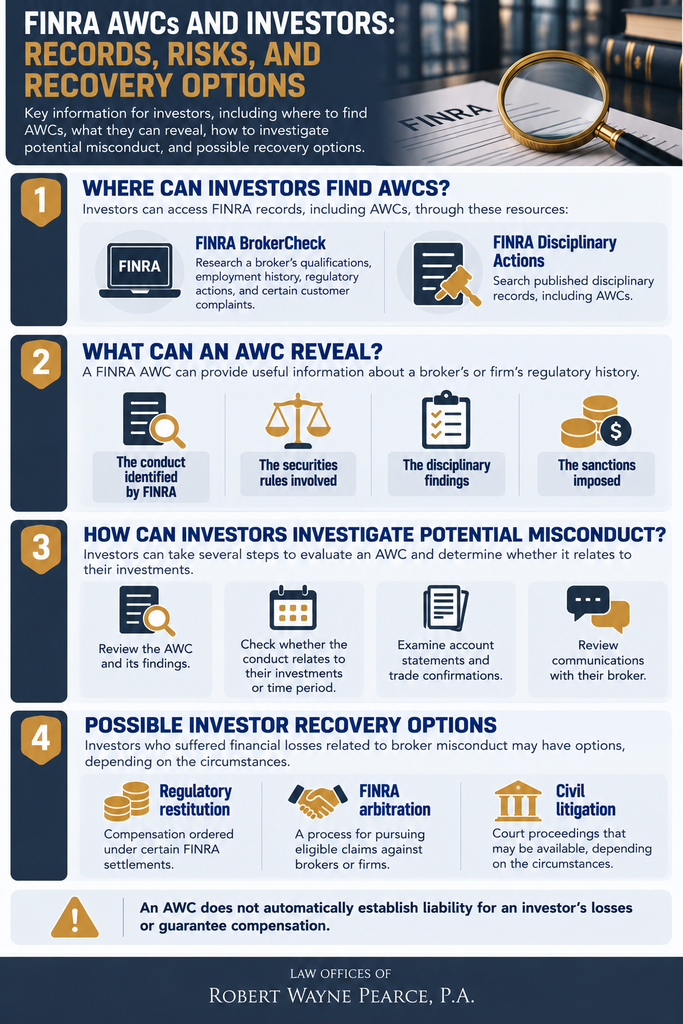
Yes. Accepted FINRA AWCs are generally public disciplinary records that investors can access through FINRA’s online databases.
These records can help investors research a broker’s background and identify previous regulatory problems.
There are two useful places to look.
FINRA BrokerCheck
FINRA BrokerCheck is a free tool that allows investors to research brokerage firms and individual financial professionals.
Depending on the broker’s history, you may find information about:
- Registration status and professional qualifications
- Employment history and previous brokerage firms
- Regulatory actions and disciplinary findings
- Certain customer complaints and arbitration proceedings
- Suspensions, industry bars, and other disclosures
FINRA Disciplinary Actions
FINRA also maintains a searchable database of disciplinary actions.
You can search for a broker, brokerage firm, or case number to locate published disciplinary records, including AWCs.
Reviewing the actual agreement can provide more context than simply reading a short disclosure summary.
For example, it may explain what the broker did, which rules were violated, and what sanctions FINRA imposed.
Keep in mind that a regulatory finding is different from an unresolved customer allegation. Review each disclosure carefully before drawing conclusions about a financial professional.
Can Investors Recover Losses Following an AWC?
Investors may be able to recover financial losses related to misconduct identified in a FINRA AWC. However, the existence of an AWC doesn’t automatically entitle investors to compensation.
An AWC may identify conduct that also gives rise to a private investment claim, particularly when the violations involve improper recommendations, unauthorized trading, or failures to supervise brokers.
Depending on the circumstances, investors may have several recovery options:
- Regulatory restitution: Some FINRA settlements require brokers or brokerage firms to compensate affected customers. The AWC may specify the amount owed and the process for distributing payments.
- FINRA arbitration: Investors can pursue eligible claims against brokerage firms or financial professionals through FINRA’s arbitration system. Arbitration may be required under a written agreement or requested by a customer when the dispute meets the requirements of FINRA Rule 12200.
- Civil litigation: Certain investment disputes can be pursued through the courts, depending on the applicable laws, arbitration agreements, and circumstances.
For example, an investor who loses $100,000 after a broker recommends high-risk investments may have grounds to investigate a claim if those recommendations were unsuitable.
If FINRA later issues an AWC finding that the brokerage firm failed to supervise the broker, those findings could provide additional insight into the firm’s conduct. The investor would still need to show that the misconduct caused their losses and establish legal grounds for holding the firm responsible.
While regulatory proceedings address violations of securities rules and can result in disciplinary sanctions, arbitration and civil litigation give investors a way to seek compensation for losses caused by broker misconduct.
An investor can also pursue a private claim without waiting for FINRA to issue an AWC. The absence of a disciplinary action does not prevent an investor from bringing a claim, provided there is evidence that the broker’s or firm’s actions contributed to their losses and grounds for seeking compensation.
What Should Investors Do if Their Broker Has an AWC?
If your broker has an AWC on their disciplinary record, reviewing the findings can help you understand the violations involved and how they may relate to your investments.
Here are some steps you can take:
- Review the AWC: Find the agreement through FINRA BrokerCheck or FINRA’s disciplinary database. Check the violations, dates, and conduct described in the settlement, particularly if they involve investments you held or periods when you experienced losses.
- Examine your investment records: Review your account statements, trade confirmations, and communications with your broker. Look for unauthorized transactions, excessive trading, unexpected fees, or recommendations that didn’t match your financial goals.
- Consult a securities attorney: If you suspect broker misconduct contributed to your losses, an attorney can review the AWC alongside your investment records, assess your potential claims, and explain your options for pursuing compensation through FINRA arbitration or other legal proceedings.
- Be aware of filing deadlines: Securities claims are subject to time limits that may affect your ability to recover losses. Under FINRA Rule 12206, claims generally become ineligible for arbitration six years after the event giving rise to the dispute. Separate statutes of limitations may also apply.
Keeping copies of the AWC and your investment records can also help if you decide to pursue a claim. These documents may provide useful evidence when discussing your situation with an attorney or preparing for arbitration.
Speak With Robert Wayne Pearce About Broker Misconduct
A FINRA AWC can reveal serious violations involving a stockbroker or brokerage firm. If you’ve suffered investment losses, the findings may help identify potential misconduct and grounds for pursuing compensation.
At the Law Offices of Robert Wayne Pearce, P.A., our securities attorneys represent investors in disputes involving broker misconduct, investment fraud, and brokerage firm supervisory failures.
We can review your investment losses, examine relevant disciplinary findings, and explain your options for pursuing recovery through FINRA arbitration or other legal proceedings.
Contact the Law Offices of Robert Wayne Pearce, P.A. to discuss your case and potential recovery options.