
A Delaware Statutory Trust (DST) allows investors to own fractional interests in investment real estate and can qualify as replacement property in a 1031 exchange. DSTs provide access to commercial real estate without the responsibilities of direct ownership, but they carry significant risks.
There are both pros and cons to this type of investment. There are several advantages, such as passive ownership, access to larger properties, and diversification.
However, DST investments are typically illiquid, involve upfront fees, provide no guaranteed income, and give investors little control over the property.
These limitations are tied to the IRS rules that allow certain DST interests to qualify for 1031 exchanges, including restrictions on the trustee’s powers.
If you were told a DST was a safe, guaranteed-income replacement for your real estate and incurred losses, consider having your investment reviewed. You may have been the victim of stockbroker misconduct.
The investment fraud lawyer team at the Law Offices of Robert Wayne Pearce, P.A. offers a free consultation to discuss your case.
In this guide, we cover what a DST is, what are the fees and risks, why brokers keep selling them, and how you can recover damages.
Let’s begin.
What Is a Delaware Statutory Trust?
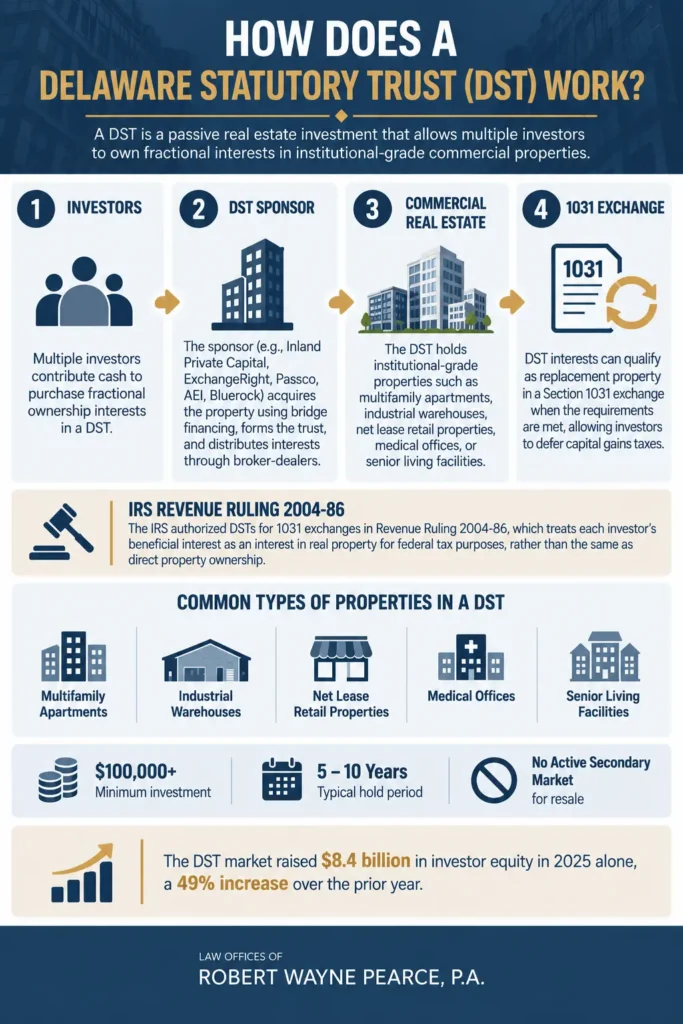
A Delaware Statutory Trust (DST) is a passive real estate investment vehicle structured as a Regulation D private placement that allows multiple investors to make a direct cash investment in fractional ownership interests in institutional-grade commercial real estate. DSTs are most commonly used as replacement properties in IRC Section 1031 tax-deferred exchanges, which can allow real estate investors to defer capital gains taxes when the exchange requirements are met.
The IRS authorized DSTs for 1031 exchanges in Revenue Ruling 2004-86, which treats each investor’s beneficial interest as an interest in real property for federal tax purposes, rather than the same as direct property ownership.
DST sponsors (companies like Inland Private Capital, ExchangeRight, Passco, AEI, and Bluerock) acquire properties using bridge financing, form the trust, and distribute interests through selling groups of broker-dealers.
Typical DST offerings involve multifamily apartments, industrial warehouses, net lease retail properties, medical offices, or senior living facilities valued at $30 million to over $100 million. Minimum investments start at $100,000, hold periods run 5–10 years, and there is no secondary market for resale. The DST market raised $8.4 billion in investor equity in 2025 alone, a 49% increase over the prior year.
What Are the Most Common Delaware Statutory Trust Complaints?
The most common Delaware Statutory Trust complaints involve high fees, lack of liquidity, unsuitable recommendations, misrepresentations, poor performance, lack of investor control, and unexpected tax complications. While DSTs can provide access to real estate and potential 1031 exchange benefits, investors should understand these risks before committing their money.
1. High Fees and Commissions
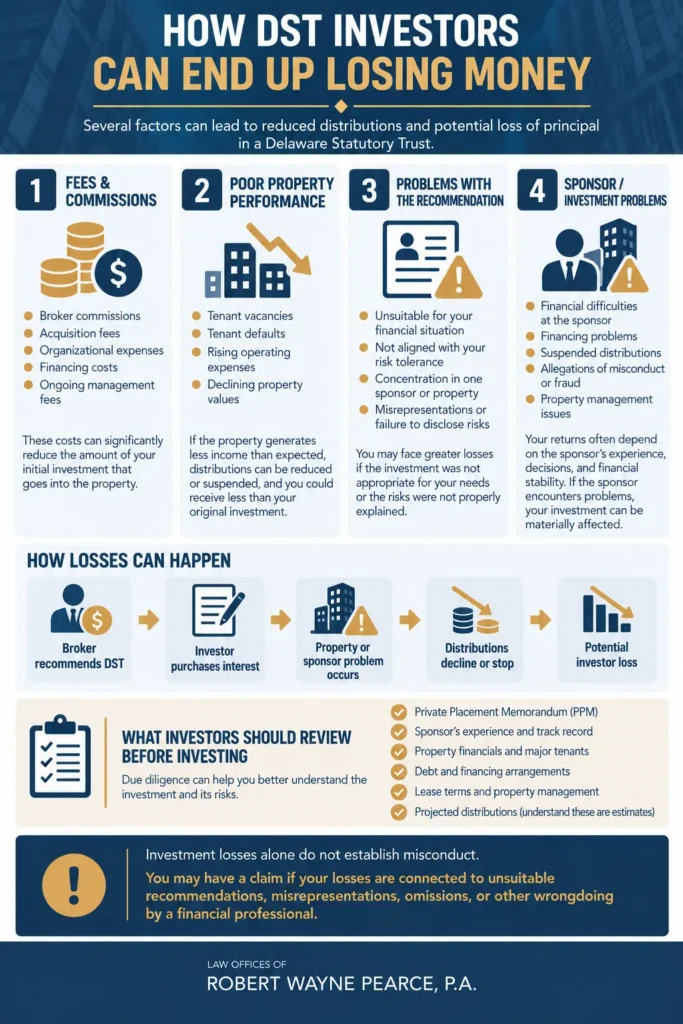
One of the most common Delaware Statutory Trust complaints involves the fees and commissions associated with these investments. DST offerings may include broker commissions, acquisition fees, financing expenses, sponsor fees, and ongoing management costs.
These expenses matter because they can reduce how much of an investor’s initial capital is actually invested in the underlying real estate. They can also make it harder for the investment to produce the returns an investor expected.
Problems may arise when a broker emphasizes projected distributions or tax benefits without clearly explaining the costs involved. Investors should understand both upfront and ongoing expenses before purchasing a DST.
High costs can become even more concerning because investors generally cannot simply sell their DST interest if they become unhappy with the investment.
2. Lack of Liquidity
DST investments are generally illiquid. Unlike publicly traded stocks or real estate investment trusts (REITs), DST interests do not trade on a major public exchange, and investors may have difficulty finding a buyer if they want to exit early.
In many cases, investors must wait until the underlying property is eventually sold. That could mean remaining invested for several years.
This can create serious problems for someone who unexpectedly needs access to their principal. Retirees may be particularly affected if they invest money they later need for living expenses, healthcare, or other financial obligations.
Because investors can become locked into a DST for years, financial professionals should consider whether the investment matches the investor’s liquidity needs before recommending it.
3. Unsuitable Investment Recommendations
Another common complaint involves brokers recommending DSTs to investors for whom the investment may not be appropriate. Broker-dealers and registered investment advisors recommending DSTs should take into account factors such as the investor’s financial circumstances, investment objectives, risk tolerance, and liquidity needs.
For example, an investor who may need access to their principal in the near future could face problems if a large percentage of their assets is placed in an illiquid DST.
Concentration can also increase risk. Investing too much money in one DST, sponsor, property, geographic market, or real estate sector can leave an investor heavily exposed if that investment performs poorly.
Even when a DST could potentially be appropriate, problems can still arise when the investment’s risks are not properly explained.
4. Misrepresentation and Failure to Disclose Risks
Some DST complaints involve allegations that a broker misrepresented the investment or failed to adequately disclose its material risks.
For example, an investor may have been told that a DST would provide predictable passive income or that the underlying real estate made the investment relatively safe. In reality, distributions can change, property values can decline, and investors can lose principal.
Other important risks may include tenant vacancies, tenant defaults, rising operating expenses, interest-rate changes, financing problems, and declining real estate markets.
Projected distributions and future property values should not be presented as guaranteed outcomes. When investors make decisions based on misleading or incomplete information, they may take on risks they never intended to accept.
5. Poor Performance and Loss of Investor Principal
DST investors can lose money when the underlying real estate performs worse than expected. Poor performance can result from falling property values, tenant defaults, vacancies, rising expenses, financing difficulties, or unfavorable economic conditions.
Cash distributions may be reduced or suspended if a property stops producing the anticipated rental income. These distributions are not guaranteed, even when marketing materials provide investors with projected income figures.
Investors may also suffer losses when the property is eventually sold. If a DST sponsor cannot sell the property at the projected price, investors could receive substantially less than expected and potentially less than their original investment.
Investment losses alone do not necessarily mean misconduct occurred. However, investors may have grounds for a claim when losses are connected to unsuitable recommendations, material misrepresentations, omissions, or other wrongdoing by a financial professional.
6. Lack of Investor Control
DST investors generally have very little control over the underlying property. Major decisions involving property management, leasing, financing, improvements, and the eventual sale are typically handled by the sponsor.
This means investors may have limited ability to intervene when they disagree with how the property is being managed. They generally cannot simply take over management or independently decide when to sell the underlying real estate.
The structure makes the sponsor’s experience, judgment, and financial stability especially important. Poor decisions by the sponsor can affect investment performance while investors have limited ability to change course.
This lack of control can become particularly problematic when the property or sponsor encounters financial difficulties.
7. Tax and 1031 Exchange Complications
Many real estate investors purchase DST interests as replacement property in a Section 1031 exchange. However, investors can make the mistake of assuming that purchasing a DST automatically guarantees favorable tax treatment.
1031 exchanges are subject to specific requirements, including rules governing eligible property and strict deadlines. Investors should understand how those requirements apply to their transaction before investing.
DSTs that hold properties across multiple states may also create additional state tax reporting obligations for investors.
These potential complications are another reason investors should evaluate the entire DST investment, including potential tax liabilities, rather than focusing solely on its potential tax benefits.
What Mistakes Do Investors Make When Purchasing Delaware Statutory Trusts?
Investors can make several mistakes when purchasing DSTs, including underestimating liquidity restrictions, overlooking fees, investing too much of their portfolio, failing to perform adequate due diligence, and focusing too heavily on projected returns or tax benefits.
1. Failing to Understand the DST’s Lack of Liquidity
One of the biggest mistakes investors make is purchasing a DST without understanding how difficult it may be to get their money back before the investment ends.
DST interests generally do not have the same liquidity as publicly traded investments. Investors should therefore consider their future financial needs before committing substantial investment capital.
Investors should therefore consider their future financial needs before committing substantial capital. Money that may be needed for retirement expenses, emergencies, healthcare, or other near-term costs may not be appropriate for a long-term, illiquid investment.
Liquidity is only one consideration. Investors should also understand exactly what they are paying to purchase and hold the DST.
2. Overlooking Fees and Commissions
Investors may focus on a DST’s projected income or potential tax advantages while paying less attention to its fees and expenses.
Depending on the offering, costs can include broker commissions, sponsor fees, acquisition expenses, financing costs, and ongoing property or asset management fees. These expenses can reduce the amount of capital effectively invested and affect overall returns.
Investors should review the offering documents carefully and understand where their money is going before investing. They should not rely solely on a broker’s description of the investment.
Understanding the costs is important, but even a DST with reasonable fees can be a poor choice if it exposes an investor to more risk than they can afford.
3. Investing Too Much of Their Portfolio in DSTs
Putting too much of a real estate portfolio into DSTs can create concentration risk. The problem can become even greater when a large amount is invested with one sponsor or in a single property, geographic market, or real estate sector.
For example, a DST heavily dependent on one major commercial tenant could experience significant financial problems if that tenant stops paying rent or leaves the property.
Investors should consider how a DST fits into their broader portfolio rather than evaluating the investment in isolation. Diversification cannot eliminate investment risk, but excessive concentration can magnify losses when something goes wrong.
Diversification is only part of the equation. Investors also need to investigate what they are actually buying.
4. Failing to Perform Adequate Due Diligence
Investors can make a serious mistake by relying entirely on a financial professional’s recommendation without investigating the DST themselves.
Due diligence can include reviewing the sponsor’s experience and track record, the underlying property’s financial condition, major tenants, lease terms, debt, financing arrangements, projected distributions, and assumptions about the eventual sale of the property.
Investors should also carefully review the private placement memorandum and other offering documents to understand the specific risks associated with the investment.
No amount of due diligence can predict exactly how a DST will perform. That makes it equally important to understand that financial projections are estimates rather than promises.
5. Relying Too Heavily on Projected Returns or Tax Benefits
Some investors become interested in DSTs because of projected distributions, potential real estate appreciation, or their possible use as replacement property in a Section 1031 exchange.
Those potential benefits should not overshadow the underlying investment risks.
Projected distributions, holding periods, appreciation, and future sale prices are estimates. Actual results can be substantially different if tenants leave, expenses increase, financing becomes more expensive, or property values decline.
The potential tax benefits of a DST should also be evaluated alongside fees, liquidity, risk, and the investor’s overall financial objectives. Investors should understand the investment itself rather than purchasing a DST primarily because of its projected returns or potential tax treatment.
What Are the Risks of Delaware Statutory Trusts?
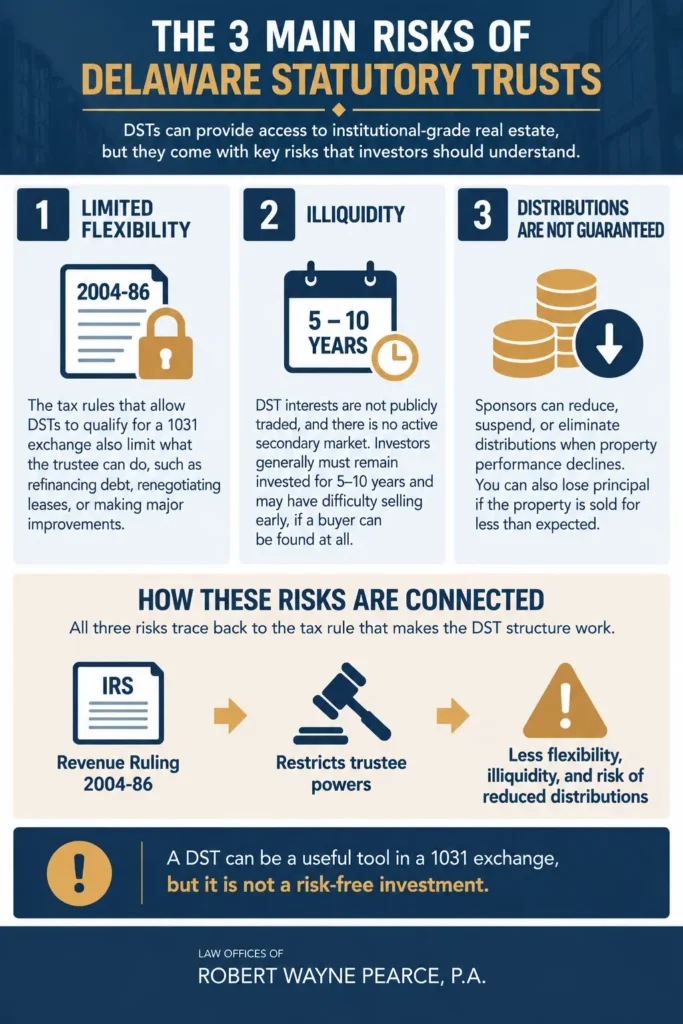
The risks that come with Delaware Statutory Trusts include limited flexibility, illiquidity, and the possibility of reduced or suspended distributions:
- Limited flexibility: The tax rules that make DSTs eligible for 1031 exchanges simultaneously prohibit the actions a prudent owner would take to protect the investment. If a tenant defaults, interest rates spike, or the property needs emergency repairs beyond reserves, the DST may have limited options for responding. Revenue Ruling 2004-86 restricts certain trustee powers, including refinancing debt, renegotiating leases, and making certain major capital improvements, subject to specific exceptions.
- Illiquidity: Illiquidity is a concern for retirees. DST interests are not publicly traded, and there is no active secondary market. Investors generally remain invested for the entire 5–10 year hold period. An investor who faces a medical emergency, long-term care expense, or any unexpected financial need may have difficulty accessing their funds. Early exit is theoretically possible but may require selling at a discount, if a buyer can be found at all.
- Distributions are not guaranteed: Sponsors can reduce, suspend, or eliminate monthly payments when property performance declines. During COVID-19, some student housing and senior living DSTs halted distributions for months or longer. When mortgage loan covenants trigger “cash traps,” investors may owe taxes on income they never received, a problem known as phantom income.
How Are DST Fees Hidden from Investors?
DST fees are layered across the offering structure rather than disclosed as a single, transparent cost.
- Front-end fees: The total front-end load, including selling commissions, sponsor acquisition fees, organizational expenses, and financing charges, can consume a substantial portion of investor equity before a single dollar is invested in real estate.
- Selling commissions and other upfront costs: On a $500,000 DST investment, approximately $75,000–$100,000 could be absorbed by fees in an offering with a 15–20% front-end load. Selling commissions alone typically range from 5–7% of equity, with some offerings documented as high as 12.5%. Sponsors may collect additional acquisition fees, organizational expenses, and financing coordination fees. These costs are disclosed in the Private Placement Memorandum but buried in dense offering documents that many investors never fully review.
- Ongoing fees: Ongoing fees can include asset management charges, property management fees, and disposition fees at sale. By comparison, a publicly traded REIT ETF can charge annual expenses as low as 0.08–0.12% and can be sold on any trading day.
Recent DST Fraud Cases and Enforcement Actions
Regulators and investors have pursued multiple actions involving DST fraud allegations, suitability violations, and sponsor misconduct in 2024–2026.
- Inspired Healthcare Capital: $1.2 Billion Bankruptcy (2025–2026). IHC raised over $1.2 billion from approximately 5,800 investors through DSTs, investment funds, and development investments. The SEC initiated a formal investigation in April 2025, and IHC filed Chapter 11 bankruptcy on February 2, 2026. Broker-dealers reportedly earned more than $100 million in commissions and fees.
- Crew Enterprises / Versity Investments: $56 Million Lawsuit (2024–Present). A lender filed a $56 million lawsuit in December 2024 alleging that Crew principals misappropriated DST syndication proceeds for personal use. In July 2025, Crew received a $47 million judgment for breaching lender obligations, and several DSTs suspended distributions.
- Nelson Partners / NP Skyloft DST: $76 Million Allegations (2021–2024). Investors alleged Nelson Partners diverted approximately $76 million from a student housing project in Austin, Texas. The affiliated Greeley Flats DST filed Chapter 11 bankruptcy in April 2024 after more than $10 million in loan defaults.
- Emerson Equity LLC: Broker-Dealer Involvement in DST Failures. Emerson Equity was the managing broker-dealer for 29 Inspired Healthcare DSTs and all of its investment funds. The firm has faced FINRA arbitration claims related to DST sales, including claims involving Inspired Healthcare and Versity/Crew.
What Should You Do If You Lost Money on a Delaware Statutory Trust?
Investors who suffered losses from DST investments may have legal claims against the broker-dealer and financial advisor who recommended the product. Most brokerage account agreements include mandatory arbitration clauses, meaning claims are filed through FINRA arbitration rather than court, but investors can and do recover substantial amounts through this process.
Common legal theories in DST cases include unsuitable recommendation, misrepresentation or omission of material risks, failure to supervise, breach of fiduciary duty, and negligence in recommending a private placement that did not match the investor’s risk tolerance, time horizon, or liquidity needs. The specific theory depends on whether the product was suitable, whether risks and fees were properly disclosed, and whether the firm conducted adequate due diligence on the sponsor.
You should also be aware of filing deadlines. FINRA’s eligibility rule generally requires claims to be filed within six years of the event giving rise to the dispute. State statutes of limitation may impose shorter deadlines. If you believe your broker recommended a DST that was unsuitable for your financial situation, you should consult a securities attorney promptly.
Talk to an Investment Fraud Attorney About Your DST Losses
If you lost money on a Delaware Statutory Trust due to a broker’s unsuitable recommendation, failure to disclose material risks, or inadequate due diligence on the DST sponsor, you may have a viable claim to recover those losses.
Attorney Robert Wayne Pearce has over 45 years of experience representing investors in FINRA arbitration and securities litigation. Under his leadership, the Law Offices of Robert Wayne Pearce, P.A. has recovered more than $175 million for clients nationwide in cases involving private placements, stockbroker fraud, and investment misconduct.
Call (866) 860-8078 today for a free consultation. There is no cost to discuss your situation and determine whether you have a claim worth pursuing. The sooner you act, the stronger your position. Time limits on filing FINRA arbitration claims can work against investors who delay.