

The risks of structured products are issuer credit risk, illiquidity, pricing you cannot verify, capped or conditional returns, embedded costs, missed dividends, and the potential loss of principal if a barrier is breached.
A structured product combines debt with a derivative, which means your outcome can depend on the performance of the underlying asset, the issuer’s ability to pay, and the specific terms of the note. FINRA announced a review of higher-risk structured products in May 2026 after identifying instances where firms and their representatives concentrated customer accounts in these products.
If a broker sold you a structured note as a safe, income-producing substitute for bonds and you are now looking at a loss, the recommendation may deserve closer scrutiny. You may be entitled to recover that money. The investment fraud team at the Law Offices of Robert Wayne Pearce, P.A. has spent 45 years representing investors in exactly these disputes, and the consultation is free.
In this guide, we are going to walk you through what these products are and how the payoff is built, the risks one at a time, who they actually fit, FINRA’s current scrutiny of worst-of notes, and the questions to ask before signing.
What Is a Structured Product?
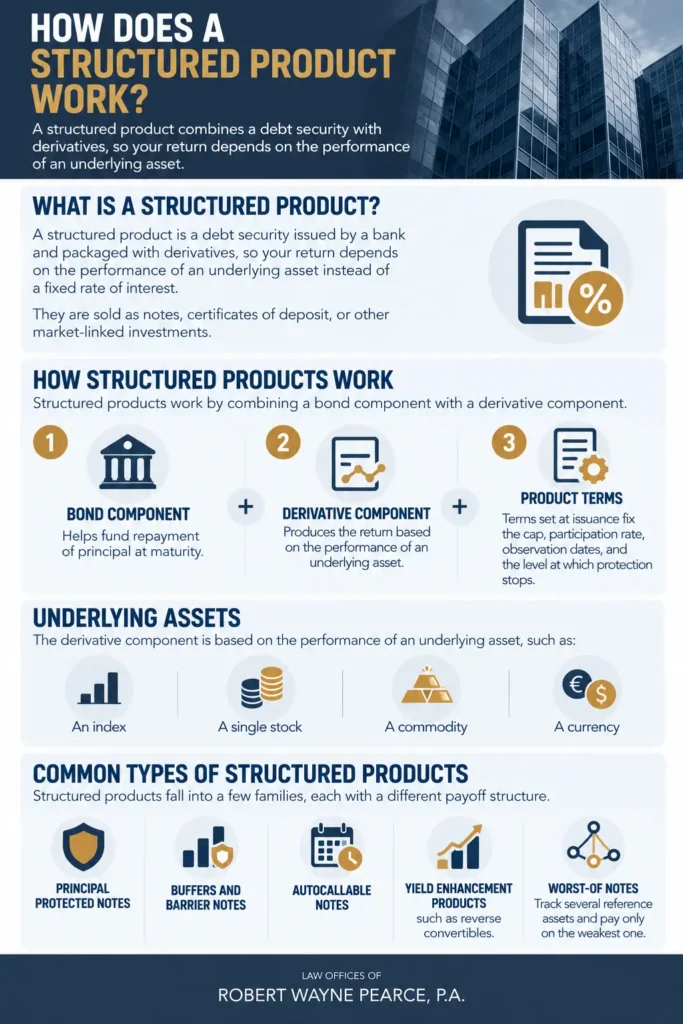
A structured product is a debt security issued by a bank and packaged with derivatives, so your return depends on the performance of an underlying asset instead of a fixed rate of interest.
Issuers, including investment banks, build these products by combining a bond component with options on an index, a single stock, a commodity, or a currency. FINRA describes structured products as securities derived from or based on a single security, a basket of securities, an index, a commodity, a debt issuance and/or a foreign currency.
They are sold as notes, certificates of deposit, or other market-linked investments, and the label on the term sheet rarely tells you how the payoff works. Our page on what structured notes are takes the definition apart in more detail.
How Structured Products Work
Structured products work by splitting your money in two: a bond component that funds repayment of principal at maturity, and a derivative component that produces whatever return you are credited. Terms set at issuance fix the cap, the participation rate, the observation dates, and the level at which protection stops.
The type of protection built into the note determines the level of capital protection and when you can start taking losses. A buffer absorbs losses up to a stated percentage, while a barrier provides protection only if the underlying asset stays above a specified level.
If the barrier level is breached, the investor may become exposed to principal loss, depending on the product’s terms. These terms are set when the note is issued, so understanding how the payoff works before you invest matters. We set them out step by step on our structured notes page.
The Different Types of Structured Products
Structured products fall into a few families: principal protected notes, buffers and barrier notes, autocallable notes, and yield enhancement products such as reverse convertibles. Family names signal where the risk actually sits inside the payoff formula.
Worst-of notes track several reference assets and pay only on the weakest one, which is the design FINRA singled out for review in May 2026. A strong year in three of the four assets does not save the payoff if the fourth one falls through its barrier. The full breakdown by underlying asset and payoff type sits on our structured notes page.
Risks to Consider When Investing in Structured Notes/Products
As an investor, you must be fully aware of the associated risks and whether structured notes fit within your investment parameters.
Robert Pearce, Attorney at the Law Offices of Robert Wayne Pearce, P.A., will explain these risks to you. He is a highly experienced investment fraud lawyer who has successfully handled many structured note cases and other complex securities and investment law matters.
Features of a particular structured product, dependent upon the type of products issued, that you as an investor should consider when determining its general suitability:
Credit Issues
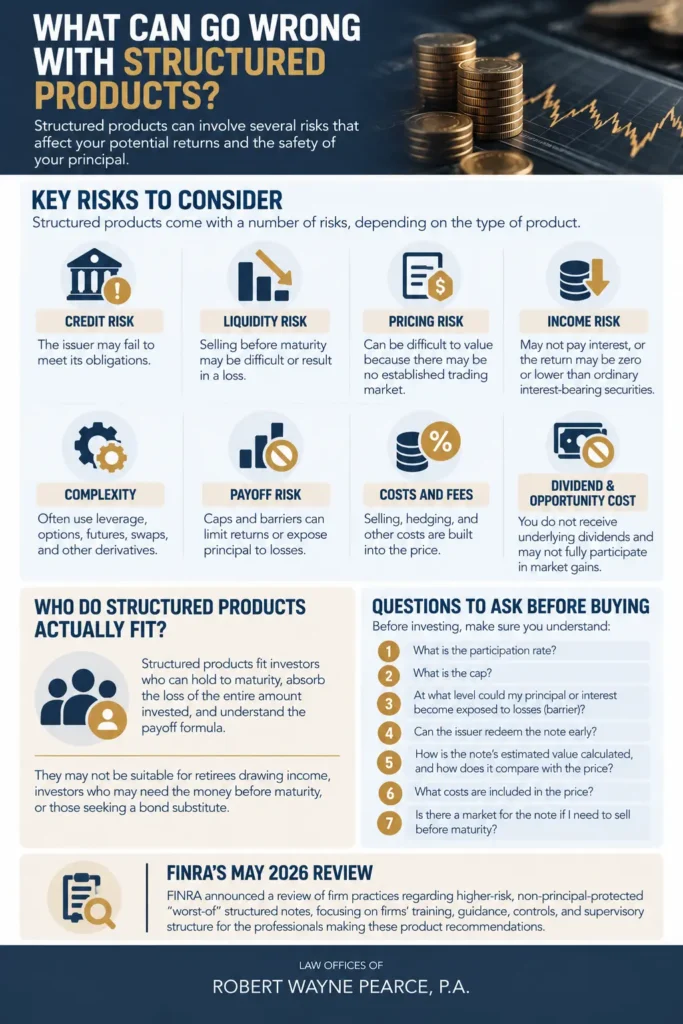
Structured products are unsecured debt obligations of the issuer. As a result, they are subject to the risk of default by the issuer. This creates counterparty risk, because investors depend on the issuer to meet its obligations. The creditworthiness of the issuer will affect its ability to pay interest and repay principal.
The financial condition and credit rating of the issuer are, therefore, important considerations. The credit rating, if any, pertains to the issuer and is not indicative of the market risk of the structured product or underlying asset.
If a structured issue provides principal protection or a minimum return, any such guarantee rests on the credit quality of the issuer. Those issued by banks in the form of CDs may also provide FDIC insurance with standard coverage limitations.
Liquidity
Structured products are generally not listed on an exchange or may be thinly traded. As a result, there may be a limited secondary market for these products, making it difficult for investors to sell them prior to maturity. Investors who need to sell structured products prior to maturity are likely to receive less than the amount they invested.
Therefore, structured products with longer maturities are subject to greater liquidity risk. The price that someone is willing to pay for structured products in a secondary sale will be influenced by market forces and other factors that are hard to predict. Sometimes, a broker-dealer affiliate of the issuer may make a market for the resale of structured products prior to maturity, but the price it is willing to pay will be adversely affected by the commissions paid by the issuer on the initial sale of the structured products and the issuer’s hedging costs.
Pricing Risks
Structured products can be difficult to price because their valuation is tied to an underlying asset or basket of assets, and there typically is no established trading market for structured products from which to determine a price.
Income Risks
Structured products may not pay interest (or may not pay interest in regular amounts or at regular intervals), so they are not appropriate for investors looking for current income. Because the return paid on structured products at maturity is tied to the performance of a basket of assets and will be variable, it is possible that the return may be zero or significantly less than what investors could have earned on an ordinary, interest-bearing debt security. The return on structured products, if any, is subject to market and other risks related to the underlying assets.
Complexity
Structured products typically use leverage, options, futures, swaps, and other derivatives, which involve special risks and additional complexity. The complexity is not decoration. It decides whether you are paid at all, because the same market move can produce a coupon, nothing, or a loss of principal depending on which observation date it lands on and which reference asset it touches.
FINRA’s Regulatory Notice 12-03 states that any product with multiple features that affect its investment returns differently under various scenarios is potentially complex, and that registered representatives who recommend complex products must understand the features and risks associated with those products. That notice expects a representative to be able to take a structured product apart into its component pieces, the bond and the derivative, before recommending it to anyone. If the person recommending the note cannot clearly explain its payoff structure and risks, ask for a fuller explanation before investing.
Pay-Out Structure
Some structured products impose limits, caps, and barriers that affect their return potential. With barriers, a structured product may not offer any return if a barrier is broken or breached during the term of the structured product. Conversely, some structured products may not offer any return unless certain thresholds are achieved.
Other structured products have capped returns. Even if the underlying assets generate a return greater than the stated limit or cap, investors do not realize that excess return. Structured products also have participation rates that describe an investor’s share in the return of the underlying assets.
Volatility
Past performance of an underlying asset class is not indicative of the profit and loss potential on any particular structured product. The value of the underlying assets can experience significant periods of fluctuation and prolonged periods of underperformance.
Costs and Fees
Costs and fees associated with the purchase of a structured product vary. What does not vary is where they sit, which is inside the price rather than on a statement line you can compare against another investment.
FINRA states that the initial estimated value of a note is generally less than the price of the note, meaning that you are investing an amount per note that exceeds its estimated value, and that these products typically have costs that can be relatively high and sometimes difficult to determine or understand. That gap covers the selling concession paid to the distributing firm, the issuer’s hedging costs, and the issuer’s own margin.
Dividends
Dividend risk is the income you never receive, because a structured product is the issuer’s debt and you do not own the shares in the index it tracks. The return credited to you is built from the movement in the reference asset, not from the dividends those underlying shares pay out along the way.
Issuers use that retained dividend stream to help fund the option package inside the note, which is part of why the terms looked generous on the term sheet. Over a note with a multi-year term, the income you forgo keeps compounding against you while the money stays locked up.
Opportunity Cost
Opportunity cost is the gap between what your structured product pays and what the same money would have earned in the underlying index, or in a plain bond of the same maturity. A capped note surrenders every point of index gain above the cap, so a strong year in the market reaches you only up to the stated ceiling.
Taxes
Structured products may be considered “contingent payment debt instruments” for federal income tax purposes. This means that investors will have to pay taxes each year on imputed annual income based on a comparable yield shown in the final term sheet or prospectus supplement. In addition, any gain recognized upon the sale or exchange, or at maturity, of these products will generally be treated as ordinary income. This especially pertains to principal protected issues. Please consult your tax advisor for guidance.
Who Structured Products Actually Fit
Structured products fit investors who can hold to maturity, absorb the loss of the entire amount invested, and read the payoff formula before they sign. That is a narrow group, and it is a great deal smaller than the group these products get sold to.
You were probably told the note suited your conservative, income-focused account. Reasonable basis suitability testing must happen before any representative or financial advisor recommends these to customers, and that expectation is not new: Notice to Members 05-59, published by FINRA’s predecessor, the NASD, warned that many investors, especially retail investors, may not understand the features of the product, and told firms to consider whether a customer meets the suitability requirements for options trading before selling a product that puts principal at risk.
Retirees drawing income from the account, investors who may need the money before maturity, and investors seeking a bond substitute may require particular scrutiny when considering whether a structured note is suitable.
What Questions Should You Ask Before Buying a Structured Product?
Before buying a structured product, focus on three things: how the payoff works, what you are paying for it, and how easily you can get out before maturity.
Start with the payoff mechanics:
- Participation rate: How much of the underlying asset’s gain do you actually receive?
- Cap: What is the maximum return you can earn?
- Barrier: At what level could your principal or interest become exposed to losses?
- Call risk: Can the issuer redeem the note before maturity? An issuer’s early redemption can prevent an investor from receiving future payments or potential upside that would otherwise have been available through maturity.
You also need to consider who issued the note. Because a structured note is a debt obligation of the issuer, its ability to meet its obligations can affect whether you receive your expected payments, even if the underlying asset performs as expected. Then look at pricing and liquidity:
- Estimated value: How does the issuer or dealer calculate the note’s estimated value, and how does it compare with what you are paying?
- Costs: What commissions, hedging costs, spreads, or other expenses are reflected in the price?
- Secondary market: Is there a market for the note if you need to sell before maturity, and who would be willing to buy it?
These questions can help you understand what you are actually buying, what you could receive, and what could happen if you need your money before the note matures. At the Law Offices of Robert Wayne Pearce, P.A., our structured product attorneys see that “structured note = issuer debt + derivative payoff,” which means the issuer’s credit risk can matter as much as the underlying index.
FINRA’s Scrutiny of Higher-Risk Structured Products
FINRA announced a review of firm practices regarding higher-risk structured products on May 19, 2026, and named the target: non-principal-protected “worst of” structured notes, products with payoffs that depend upon the worst-performing reference asset in a pre-specified group.
The review covers firms’ training, guidance, controls and supervisory structure for the professionals making these product recommendations to clients. FINRA said that firm representatives had concentrated their customers’ assets in structured products that increase complexity and risk, and that some investors have lost significant portions of their portfolios through such concentrated positions.
FINRA has said the review will only affect a subset of member firms, and has encouraged the rest of the industry to read the questions in the letter and evaluate their own practices against them. If your account holds a worst-case note that was described to you as protected, the regulator has already put a name to the practice you are dealing with.
Investment Losses? We Can Help
Discuss your legal options with an attorney at The Law Offices of Robert Wayne Pearce, P.A.
Get A Free Consultation or give us a ring at (800) 732-2889.
Contact the Law Office of Robert Wayne Pearce, P.A., for a Free Consultation on Stockbroker Fraud – See if You Have a Case!
Contact The Law Offices of Robert Wayne Pearce, P. A to discuss your structured note/products fraud or misrepresentation claim. We have over 40 years of experience litigating investment fraud and stockbroker fraud cases across the nation. Your first call is free.
The firm can be reached by phone at (800) 732-2889 or via e-mail.