
Embezzlement is a financial crime that occurs when someone intentionally misuses money or property entrusted to them. It commonly involves employees, business executives, financial advisors, and other individuals who have legitimate access to someone else’s assets.
The legal consequences depend on where the offense takes place and how the money or property was misused. In some cases, the conduct may also involve other crimes, such as securities fraud.
In this guide, we’ll explain what embezzlement is, how it works, and the different types and examples. We’ll also cover potential criminal penalties, warning signs, and legal options available to victims, including investors whose funds have been misappropriated by financial professionals.
What Is Embezzlement?
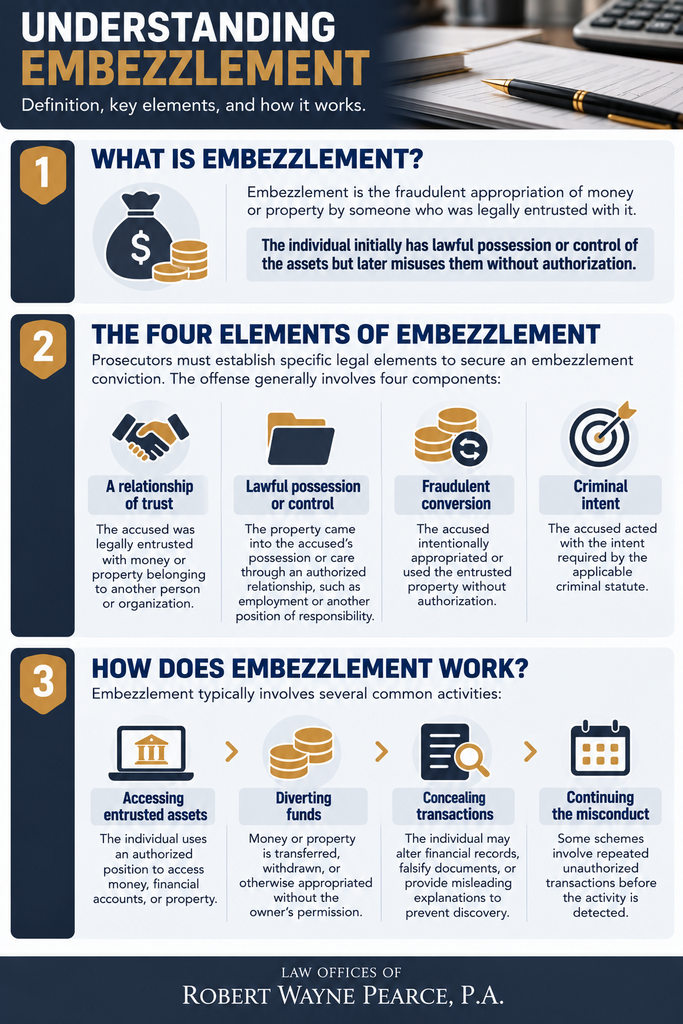
Embezzlement is the fraudulent appropriation of money or property by someone who was legally entrusted with it. It is generally considered a type of white-collar crime because it involves financial misconduct and an abuse of trust.
Unlike traditional theft, embezzlement involves property that someone initially had lawful possession or control of. The offense occurs when that person intentionally uses or takes the property without authorization.
Employees, accountants, corporate executives, trustees, and financial advisors may all have access to money or property belonging to another person or organization. However, having that access doesn’t mean they can use those assets for their own benefit.
Embezzlement can involve relatively small amounts of money or substantial financial losses. Depending on the circumstances, it may lead to criminal charges, civil lawsuits, and professional disciplinary action.
What Are the Elements of Embezzlement?
Prosecutors must prove that four key elements were present for an embezzlement conviction. These include a relationship of trust, lawful possession or control of the property, fraudulent conversion, and criminal intent.
- A relationship of trust: The accused was legally entrusted with money or property belonging to another person or organization.
- Lawful possession or control: The property came into the accused’s possession or care through an authorized relationship, such as employment or another position of responsibility.
- Fraudulent conversion: The accused intentionally appropriated or used the entrusted property without authorization.
- Criminal intent: The accused acted with the intent required by the applicable criminal statute.
Intent is particularly important when determining whether someone’s conduct constitutes embezzlement.
An accounting error, misunderstanding, or unauthorized transaction doesn’t automatically establish criminal guilt. Prosecutors generally need evidence that the accused intentionally misappropriated the property.
However, intending to repay the money doesn’t necessarily provide a defense.
The Department of Justice explains that, under certain federal embezzlement laws, prosecutors do not need to establish that the defendant intended to deprive the owner of the property permanently.
How Does Embezzlement Work?
Embezzlement starts when someone uses their legitimate access to money or property for a purpose they aren’t authorized to pursue.
For example, an employee may be allowed to manage financial accounts, process payments, approve expenses, or oversee business assets. They cross the line when they use that authority to divert money or property for personal gain or another unauthorized purpose.
The misconduct can take several forms. Common examples include:
- Accessing entrusted assets: The individual uses their position to access money, financial accounts, or property.
- Diverting funds: Money or property is transferred, withdrawn, or otherwise taken without the owner’s permission.
- Concealing transactions: The individual may alter financial records, falsify documents, or give misleading explanations to hide the activity.
- Repeating the misconduct: Some individuals continue making unauthorized transactions over time, allowing losses to accumulate before anyone notices.
The way these schemes unfold depends on the person’s access and the controls in place. Someone might manipulate payment records or transfer funds directly, while another person may take advantage of limited oversight to misuse assets over time.
What matters legally is whether the individual acted with the required criminal intent and unlawfully converted property entrusted to them.
What Are the Different Types of Embezzlement?
The different types of embezzlement include employee, corporate, payroll, government, investment, and trust or estate embezzlement. Each involves the misuse of money or property entrusted to someone, but the circumstances and people involved vary.
- Employee embezzlement: An employee misappropriates money or company property entrusted to them through their job.
- Corporate embezzlement: A company executive, officer, or other person in a position of authority diverts corporate assets for unauthorized purposes.
- Payroll embezzlement: Someone with access to payroll records or payment systems manipulates payments to divert company funds.
- Government embezzlement: A public employee or other person entrusted with government property unlawfully appropriates those assets.
- Investment embezzlement: A financial advisor, investment professional, or another person managing investor assets misuses client funds.
- Trust or estate embezzlement: A person entrusted with assets belonging to a trust or estate unlawfully diverts the property.
These categories describe the settings in which embezzlement occurs. They aren’t necessarily separate criminal offenses under every state’s laws.
What Are Some Examples of Embezzlement?
Embezzlement cases can involve ordinary business transactions, complex financial arrangements, or professionals entrusted with substantial client assets.
Here are two examples illustrating how embezzlement occurs.
Employee Payroll Embezzlement
An employee with access to payroll systems might deliberately create fictitious employee records and direct salary payments into a personal bank account.
The employee initially has legitimate access to the company’s payroll information and payment processes.
However, they misuse that authority to divert company funds for personal benefit.
This would generally constitute embezzlement if the required legal elements were established.
Financial Advisor Embezzlement: SEC Case Involving Gary Chang
A documented securities enforcement case involved financial advisor Chingyuan “Gary” Chang.
According to a December 26, 2023, Securities and Exchange Commission (SEC) order, Chang misappropriated approximately $58,560 from four brokerage customers and an advisory client between September 2021 and June 2022.
The SEC found that Chang initiated 40 unauthorized Automated Clearing House (ACH) transfers into personal accounts associated with online payment applications.
In some instances, he sold securities in customer accounts shortly before transferring the money.
The SEC also found that Chang took steps to conceal the misconduct.
Following an internal review by his employer, Chang repaid the misappropriated amounts.
Chang subsequently settled the SEC’s charges without admitting or denying its findings, except as specified in the settlement. He consented to a $58,560 civil penalty and industry bars.
The case demonstrates how financial professionals may exploit legitimate account access to misappropriate investor funds.
Embezzlement by Financial Advisors and Investment Brokers
Financial advisor embezzlement occurs when an investment professional unlawfully appropriates money or securities entrusted to them by a client.
Financial advisors and brokers may have authority to manage client investments, execute transactions, or transfer funds. However, they cannot use client assets for unauthorized personal purposes.
Depending on the circumstances, these actions may also violate securities laws, fiduciary duties, or brokerage supervision requirements.
At the Law Offices of Robert Wayne Pearce, P.A., our experience representing investors in misappropriation and broker misconduct disputes highlights the importance of examining both the financial professional’s actions and the brokerage firm’s potential responsibility.
Embezzlement vs. Theft, Fraud, and Misappropriation
Embezzlement shares similarities with theft, fraud, and misappropriation, but the legal definitions aren’t always identical.
The differences generally relate to how the property was obtained, the defendant’s conduct, and the elements required under the applicable law.
Embezzlement vs. Theft
Embezzlement commonly involves someone who initially possesses property lawfully because it was entrusted to them. Traditional larceny generally involves an unlawful taking from another person’s possession.
However, many states incorporate embezzlement into broader theft statutes.
Embezzlement vs. Fraud
Fraud typically involves intentional deception or misrepresentation used to obtain money, property, or another legally recognized benefit.
Embezzlement may involve deception, but its defining characteristic is the fraudulent conversion of entrusted property.
Embezzlement vs. Misappropriation
Misappropriation is a broader term describing the unauthorized or improper use of another person’s money, property, or assets.
The term also appears in securities law and civil litigation.
Embezzlement may qualify as misappropriation, but not every act described as misappropriation satisfies the elements of criminal embezzlement.
These offenses can overlap, and the same conduct may support multiple charges or legal claims.
State and Federal Embezzlement Laws
Embezzlement may be prosecuted under state or federal law depending on the property involved, the defendant’s position, and the applicable statute.
Its laws also differ from state to state. Some states treat it as a separate offense, while others address it under broader theft or larceny laws. Texas, for example, classifies embezzlement as theft. New York takes a similar approach by including conduct traditionally considered embezzlement under its larceny statute.
Federal law addresses embezzlement in several circumstances.
Relevant statutes include:
- 18 U.S.C. § 641: Addresses theft, embezzlement, and unlawful conversion of federal money or property.
- 18 U.S.C. § 656: Covers certain theft, embezzlement, and misapplication offenses involving officers, employees, and other covered persons connected to financial institutions.
- 18 U.S.C. § 666: Addresses theft, embezzlement, and related offenses involving qualifying organizations or governments receiving federal funds.
An important legal distinction is that federal jurisdiction doesn’t automatically arise because an embezzlement scheme involves a large amount of money.
The government must establish the requirements of the relevant federal statute.
For investors, this distinction has another consequence. Financial misconduct may create a potential securities law claim even when prosecutors do not pursue embezzlement charges.
Criminal liability and civil recovery are separate legal questions, with different requirements and available remedies.
What Are the Penalties for Embezzlement?
Embezzlement can result in fines, imprisonment, restitution, and professional disciplinary action. The penalties depend on the applicable law, the value of the property involved, and the circumstances of the offense.
The consequences can include:
- Misdemeanor charges: Certain lower-value offenses may carry shorter jail sentences and fines, depending on state law.
- Felony charges: More serious offenses may result in substantial fines and lengthy prison sentences.
- Restitution: Courts may require defendants to compensate victims for qualifying financial losses.
- Professional consequences: Financial professionals may face license restrictions, regulatory sanctions, or industry bars.
Under 18 U.S.C. § 641, embezzlement involving federal property can carry a maximum prison sentence of 10 years.
However, when the aggregate value specified by the statute does not exceed $1,000, the maximum prison sentence is one year.
Other federal laws carry different penalties. For instance, qualifying offenses under 18 U.S.C. § 656 can carry a maximum sentence of 30 years.
But these limits only represent the highest penalties allowed by law and not the actual sentence.
What Are the Warning Signs of Embezzlement?
Embezzlement can be difficult to identify because the individual involved often has legitimate access to financial accounts or business records.
However, certain irregularities may indicate that entrusted funds are being misused.
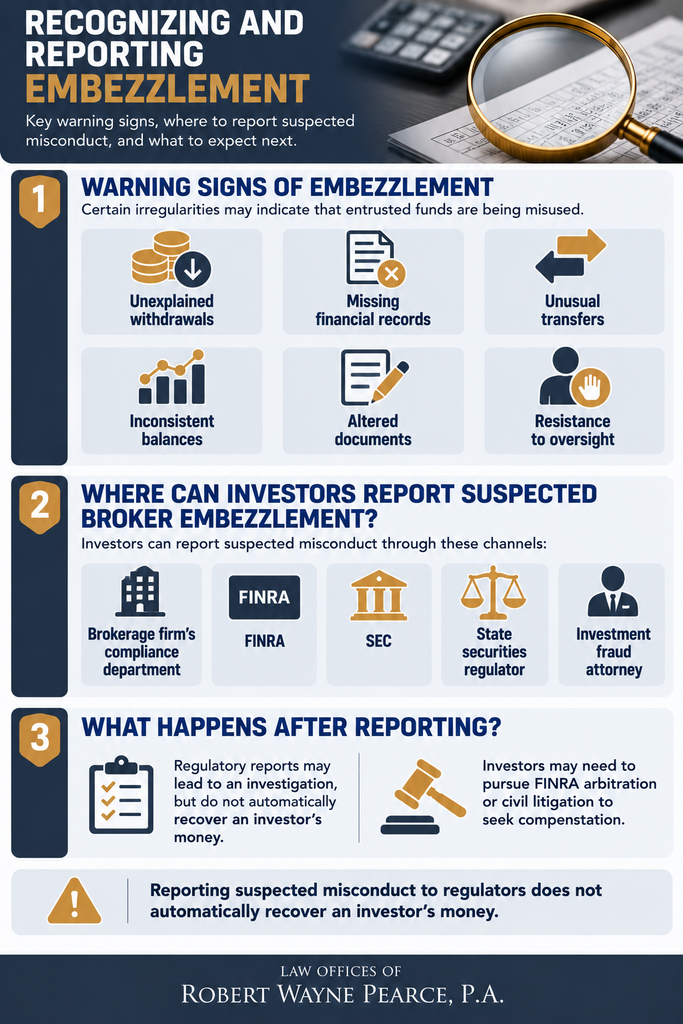
Common warning signs include:
- Unexplained withdrawals: Money leaves an account without a corresponding authorized transaction.
- Missing financial records: Statements, receipts, or transaction documentation cannot be located or contain unexplained gaps.
- Unusual transfers: Funds are repeatedly directed to unfamiliar accounts or recipients.
- Inconsistent balances: Financial statements do not match independently verified account balances or transaction histories.
- Altered documents: Financial records appear to have been changed without a legitimate explanation.
- Resistance to oversight: A person responsible for managing assets refuses reasonable requests for records or transaction details.
These issues can indicate financial misconduct, but they don’t necessarily prove embezzlement.
Errors, administrative problems, and legitimate transactions can produce similar irregularities.
The appropriate response is to investigate discrepancies and preserve relevant records before concluding.
How to Report Broker Embezzlement
If you suspect your stockbroker or financial advisor has embezzled your money, you can report the suspected misconduct to their brokerage firm, the Securities and Exchange Commission (SEC), or the Financial Industry Regulatory Authority (FINRA).
The appropriate reporting process depends on the circumstances, but investors can generally take the following steps:
- Contact the brokerage firm’s compliance department: Report the suspected embezzlement in writing and request a review of unauthorized transactions. Ask the firm about restricting further withdrawals or transfers if your account may be at risk.
- File a complaint with FINRA: FINRA accepts complaints and regulatory tips involving brokers and brokerage firms, including suspected misconduct and violations of securities industry rules.
- Report the misconduct to the SEC: You can submit suspected securities fraud or misappropriation through the SEC’s Tips, Complaints, and Referrals (TCR) system.
- Contact your state securities regulator: State regulators can investigate certain violations of state securities laws and may take enforcement action.
- Consult an investment fraud attorney: An attorney can assess whether you may have a claim against the broker, brokerage firm, or another responsible party.
Preserve your brokerage statements, transaction confirmations, emails, and other relevant documents throughout this process.
Reporting misconduct to regulators may lead to an investigation, but it doesn’t automatically recover your money. Investors may need to pursue FINRA arbitration or civil litigation to seek compensation.
Current Investment Fraud Cases We Are Litigating at the Law Offices of Robert Wayne Pearce, P.A.
The Law Offices of Robert Wayne Pearce, P.A. represents investors in securities disputes involving financial advisor misconduct, misappropriation of client funds, unsuitable investment recommendations, and other alleged violations of securities laws.
Our firm’s publicly reported work includes the following investment fraud and broker misconduct matters.
Financial Advisor Misappropriation Claims
Our firm has pursued FINRA arbitration claims involving financial advisors accused of misappropriating investor assets.
In one matter, we obtained a $615,000 settlement in September 2023 after an investor discovered that an advisor had misappropriated funds intended for investment and concealed the misconduct through fraudulent account statements.
Another misappropriation-related FINRA arbitration was settled in March 2024.
Current Broker Misconduct Investigations
Our firm also publishes ongoing investigations into suspected investment-related misconduct involving registered brokers and financial advisors.
These investigations cover allegations such as unauthorized transactions, misrepresentation, unsuitable investments, and other potential securities industry violations.
For the latest publicly reported matters, visit our Cases & Investigations page.
An investigation does not necessarily mean that a lawsuit or arbitration has been filed, or that the broker has been found liable.
Investors who have suffered losses involving any of these issues may contact our firm to discuss whether they have grounds for a legal claim.
Speak With an Investment Fraud Attorney
Embezzlement can leave investors facing significant financial losses, particularly when the misconduct involves a trusted financial advisor or investment professional.
The Law Offices of Robert Wayne Pearce, P.A. represents investors in disputes involving broker misconduct, investment fraud, and other securities-related wrongdoing.
Our firm can evaluate the circumstances surrounding suspected misappropriation, examine potential claims against responsible parties, and discuss available avenues for seeking financial recovery.
If you believe a financial advisor or broker misused your investment funds, contact the Law Offices of Robert Wayne Pearce, P.A. to discuss your situation and potential legal options.