
ETFs are generally considered relatively safe investments, but they are not risk-free. For ETF investors, how safe an ETF is depends largely on what the fund owns, how it is structured, and whether it matches your investment goals and risk tolerance.
Many ETFs spread your money across dozens, hundreds, or even thousands of securities. This diversification can reduce the damage caused by one company performing poorly. However, ETFs can still lose value when the overall market or the assets they track decline. Some specialized, leveraged, inverse, sector-specific, and thinly traded ETFs may carry substantially greater investment risk.
Problems can also arise when a financial professional recommends an ETF that is unsuitable for an investor or misrepresents its risks.
In this article, we focus on leveraged, inverse, and leveraged inverse ETFs, including how they work, why their daily-reset structure can create unexpected losses, and the risks investors should understand before buying or holding them.
If you lost money after a broker or financial advisor recommended a leveraged or inverse ETF, our investment fraud lawyers can review your investment, explain what may have gone wrong, determine whether your broker or financial advisor violated securities laws or industry rules, and discuss your options for recovering financial losses.
What Are Exchange-Traded Funds?
Exchange-traded funds (ETFs) are investment vehicles that trade on stock exchanges like individual shares, holding baskets of underlying investments such as stocks, bonds, or commodities. Standard index ETFs, products like the SPDR S&P 500 ETF (SPY) or Invesco QQQ, are among the most widely held investments in the world. They offer low costs, diversification, and transparency.
But some ETFs (like leveraged and inverse ETFs) use derivatives and other financial instruments as part of complex strategies to seek 2x or 3x the daily return of an index. Inverse ETFs seek the opposite of an index’s daily return.
These products are issued by firms such as ProShares, Direxion, and GraniteShares, and are sold through broker-dealers and online platforms to retail investors, including retirees and conservative savers who have no business owning them.

Are ETFs Safe to Invest in?
Market risk is the risk that an ETF loses value because the market it tracks declines, and no amount of diversification inside the fund removes it. You already know that stocks fall. What surprises most investors is how little the ETF wrapper changes about that.
Broad market ETFs can give investors instant diversification across many holdings, so a single bankruptcy or accounting scandal does not sink your position. Market risk works differently, because it moves every holding in the same direction at once.
During a broad decline, correlations between holdings rise, and the protection that worked in calm markets does much less for you. A fund tracking a falling index falls with it, on the same day, by close to the same percentage.
For that reason, ETF investments that track bonds will behave very differently from one that tracks small-cap stocks, especially when markets come under pressure.
What Are the Advantages and Disadvantages of ETFs?
ETF investing offers investors several advantages, including diversification, relatively low costs, and easy access to different markets. However, they still expose investors to losses and may carry additional risks depending on the assets and strategy involved.
Advantages of ETFs
- Diversification: A single ETF can hold hundreds or thousands of securities, reducing your exposure to the performance of any one company.
- Lower ETF costs: Many passive ETFs use passive management and have lower expense ratios than actively managed mutual funds.
- Easy to trade: ETFs trade on exchanges throughout the trading day, much like individual stocks.
- Wide range of investments: You can find ETFs covering stocks, bonds, gold, Bitcoin, commodities, specific industries, and international markets.
- Transparency: Many ETFs regularly disclose their holdings, making it easier to understand where your money is invested.
- Accessibility: ETFs make it possible to gain exposure to assets such as gold or Bitcoin without directly buying, storing, or managing the underlying asset.
Disadvantages of ETFs
- You can lose money: Diversification does not protect you from a broad market decline or a decline in the assets the ETF tracks.
- Some ETFs have more complicated structures: Leveraged, inverse, covered call, cryptocurrency, and other ETFs using complex strategies can behave very differently from a traditional index fund.
- Concentration risk: Sector, commodity, and single-stock ETFs may provide far less diversification than investors expect.
- Tracking differences: Fees, trading costs, derivatives, and fund structure can cause an ETF’s performance to differ from its benchmark.
- Trading risks: ETF prices can temporarily trade above or below their net asset value, particularly during volatile market conditions.
- Income can limit long-term growth: Strategies such as covered calls may produce attractive distributions while sacrificing some potential upside.
What Are the Different Types of ETFs?
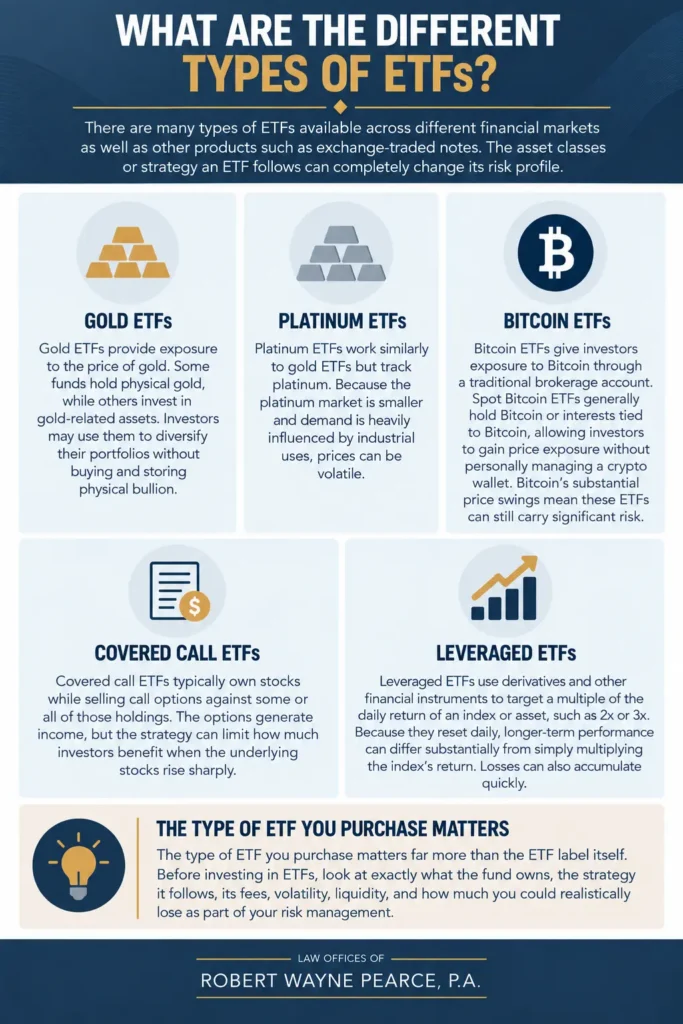
There are many types of ETFs available across different financial markets as well as other products such as exchange-traded notes. The asset classes or strategy an ETF follows can completely change its risk profile.
- Gold ETFs: Gold ETFs provide exposure to the price of gold. Some funds hold physical gold, while others invest in gold-related assets. Investors may use them to diversify their portfolios without buying and storing physical bullion.
- Platinum ETFs: Platinum ETFs work similarly to gold ETFs but track platinum. Because the platinum market is smaller and demand is heavily influenced by industrial uses, prices can be volatile.
- Bitcoin ETFs: Bitcoin ETFs give investors exposure to Bitcoin through a traditional brokerage account. Spot Bitcoin ETFs generally hold Bitcoin or interests tied to Bitcoin, allowing investors to gain price exposure without personally managing a crypto wallet. Bitcoin’s substantial price swings mean these ETFs can still carry significant risk.
- Covered Call ETFs: Covered call ETFs typically own stocks while selling call options against some or all of those holdings. The options generate income, but the strategy can limit how much investors benefit when the underlying stocks rise sharply.
- Leveraged ETFs: Leveraged ETFs use derivatives and other financial instruments to target a multiple of the daily return of an index or asset, such as 2x or 3x. Because they reset daily, longer-term performance can differ substantially from simply multiplying the index’s return. Losses can also accumulate quickly.
The type of ETF you purchase matters far more than the ETF label itself. Before investing in ETFs, look at exactly what the fund owns, the strategy it follows, its fees, volatility, liquidity, and how much you could realistically lose as part of your risk management.
What ETF Risks Should Investors Watch Out For?
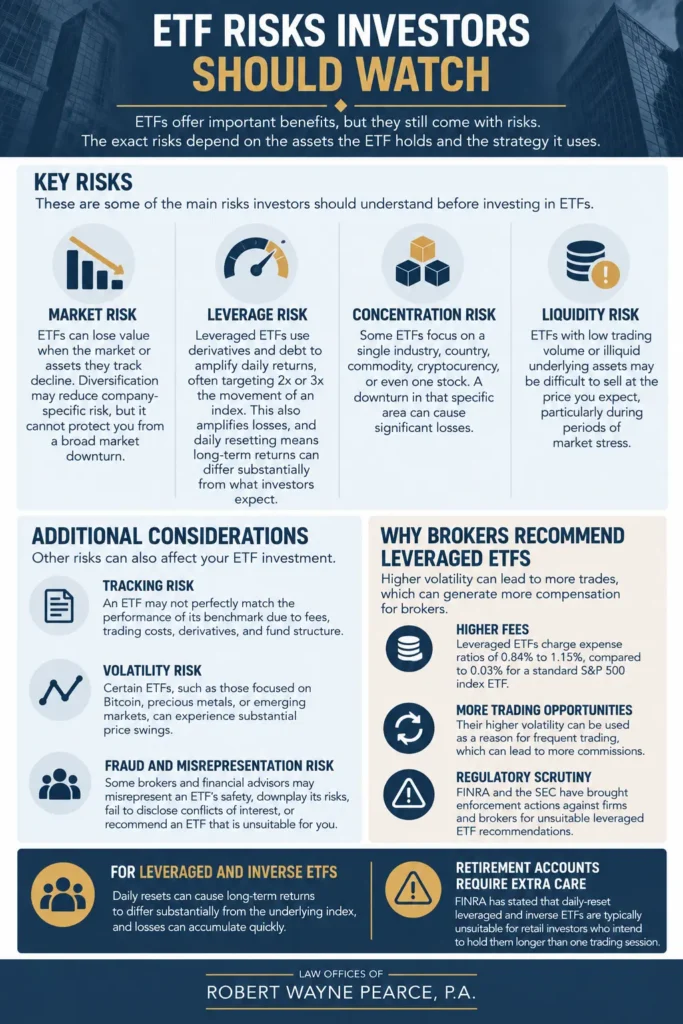
ETFs come with several potential risks that investors should understand before putting their money into a fund. The exact risks depend heavily on the assets the ETF holds and the strategy it uses.
- Market risk: ETFs can lose value when the market or assets they track decline. Diversification may reduce company-specific risk, but it cannot protect you from a broad market downturn.
- Leverage risk: Leveraged ETFs use derivatives and debt to amplify daily returns, often targeting 2x or 3x the movement of an index. This also amplifies losses, and daily resetting means long-term returns can differ substantially from what investors expect.
- Concentration risk: Some ETFs concentrate their holdings in a single industry, country, commodity, cryptocurrency, or even one stock. A downturn in that specific area can cause significant losses.
- Liquidity risk: ETFs with low trading volume or investments in illiquid underlying assets may be difficult to sell at the price you expect, particularly during periods of market stress.
- ETF shutdown risk: A fund provider can close funds that fail to attract enough assets or are no longer profitable to operate. A shutdown normally does not mean your entire investment disappears, but liquidation can force you out of the investment at an unfavorable time and potentially create a taxable event.
- Tax risk: Selling ETF shares at a profit can generate capital gains taxes, while some ETFs may also make capital gains distributions. Certain commodity, cryptocurrency, futures, and other specialized ETFs may also receive different tax treatment from traditional stock ETFs, making the tax consequences more complicated.
- Tracking error: An ETF may not perfectly reproduce the performance of its benchmark. Fees, trading expenses, derivatives, liquidity, and portfolio management can all create differences between the ETF’s return and the index it tracks.
- Volatility risk: Bitcoin, precious metals, emerging markets, leveraged products, and other investments can experience substantial price swings during periods of market volatility.
- Strategy risk: Covered call, inverse, leveraged, and other strategy-based ETFs introduce risks that may not be obvious to inexperienced investors. A strategy designed to increase income or amplify returns can also limit gains or increase losses.
- Fraud and misrepresentation risk: Brokers and financial advisors may misrepresent an ETF’s safety, downplay its risks, fail to disclose conflicts of interest, or recommend an ETF that is unsuitable for a particular investor.
Why Do Brokers Recommend Leveraged ETFs Despite the Risks?
Brokers recommend leveraged ETFs because the products’ higher volatility creates more trading opportunities, and more trades generate more compensation. Leveraged ETFs charge expense ratios of 0.84% to 1.15%, compared to 0.03% for a standard S&P 500 index ETF like VOO. The cost difference is substantial, but it understates the real problem.
Leveraged ETFs also carry hidden financing costs and counterparty risk from the total return swaps used to achieve their exposure. An ETF.com analysis found that one leveraged product lagged its underlying index by 0.04% per day, approximately 14.3% annualized, more than 13 percentage points above its stated expense ratio. These swap costs do not appear in the prospectus and are not disclosed on trade confirmations.
The higher volatility of leveraged ETFs also serves as a pretext for frequent trading. A broker can justify active management of a 3x ETF by pointing to its daily-reset design, generating churning commissions on each round trip. In FINRA’s complaint against Spartan Capital Securities, 39 registered representatives used this pattern to generate nearly $10 million in total trading costs across 114 accounts, with cost-to-equity ratios reaching 491%.
Are Leveraged ETFs Suitable for Retirement Accounts?
Leveraged and inverse ETFs can be a poor fit for a diversified portfolio intended for long-term retirement investing because they reset each day, and their performance can differ from the underlying index over longer periods.
FINRA stated in Regulatory Notice 09-31 that leveraged and inverse ETFs that reset daily are “typically unsuitable for retail investors who plan to hold them for longer than one trading session, particularly in volatile markets.” Under Regulation Best Interest (Reg BI), the SEC has specifically cautioned that leveraged or inverse ETFs “may not be in a retail customer’s best interest absent an identified, short-term, customer-specific trading objective.”
Despite these warnings, enforcement actions reveal a recurring pattern of leveraged ETFs placed in the accounts of elderly investors and retirees. In the E1 Asset Management arbitration, a 75-year-old retiree’s accounts were churned using triple-leveraged ETFs on margin, generating $1.6 million in commissions while destroying the client’s retirement savings. The SEC’s $35 million settlement with Wells Fargo involved inverse ETFs sold to senior citizens and retirees who held positions for months or years.
Recent Leveraged ETF Fraud Cases and Enforcement Actions
FINRA and the SEC have pursued significant actions against firms and brokers involved in leveraged and inverse ETF misconduct. These cases illustrate the regulatory consequences of recommending these products without adequate supervision or suitability analysis.
- FINRA v. Stifel Nicolaus: $2.3 Million Penalty (March 2024): FINRA ordered Stifel to pay $1 million in fines and $1.29 million in restitution for failing to supervise non-traditional ETP recommendations from 2014 through March 2018. This was a repeat offense. Stifel had been sanctioned in 2014 for the same conduct. After the first sanction, the firm deactivated a 30-day holding alert after it generated over 2,000 daily hits. Supervisors cleared alerts with comments like “same” or “no changes.” 381 accounts lost nearly $1.3 million.
- FINRA Arbitration: E1 Asset Management, $2.6 Million Award (April 2024): A FINRA arbitration panel awarded $2.6 million to a 75-year-old retiree whose accounts were churned using triple-leveraged ETFs on margin. The respondents executed more than $341 million in trades, producing an annual turnover rate of 13.2 and a cost-to-equity ratio of 12.4%. The panel found willful intent to defraud and breach of fiduciary duty.
- FINRA v. Arkadios Capital: $45,571 Fine and Restitution (February 2026): FINRA fined Arkadios $25,000 and ordered $20,571 in restitution for failing to establish supervisory systems compliant with Reg BI’s Care Obligation regarding leveraged and inverse ETF recommendations from September 2022 through March 2024. Thirty-six retail clients were affected, including senior investors. The firm ultimately prohibited representatives from recommending non-traditional ETF purchases.
- FINRA v. Spartan Capital Securities: Complaint Filed (December 2025): FINRA’s Department of Enforcement filed a complaint alleging Spartan Capital’s business model depended on widespread churning. From January 2018 through April 2022, 39 registered representatives excessively traded 114 customer accounts, generating nearly $10 million in trading costs and $8 million in investment losses. Cost-to-equity ratios reached as high as 491%. Fifty-three of the 114 accounts belonged to senior customers.
The SEC’s FY 2026 Examination Priorities, published in November 2025, explicitly reference funds with “novel strategies or leverage vulnerabilities” and “complex investments, such as exchange traded fund (ETF) wrapped products” as examination targets. FINRA’s 2026 Annual Regulatory Oversight Report reinforces the same emphasis on Reg BI compliance and complex product supervision.
Talk to an Investment Fraud Attorney About Your ETF Losses
If you lost money on leveraged or inverse ETFs due to a broker’s unsuitable recommendation, failure to disclose the risks of daily-reset decay, or overconcentration of your portfolio in these high-risk products, you may have a viable claim to recover those losses.
Attorney Robert Wayne Pearce has over 45 years of experience representing investors in FINRA arbitration and securities litigation. Under his leadership, the Law Offices of Robert Wayne Pearce, P.A. has recovered more than $185 million for clients nationwide in cases involving stockbroker fraud, unsuitable investment recommendations, and broker misconduct.
Call (866) 859-5185 today for a free consultation. There is no cost to discuss your situation and determine whether you have a claim worth pursuing. The sooner you act, the stronger your position. Time limits on filing FINRA arbitration claims can work against investors who delay.
Frequently Asked Questions About Leveraged and Inverse ETFs
What Is the Difference Between a Leveraged ETF and a Standard ETF?
A standard ETF tracks an index and aims to replicate its total return over any time period. A leveraged ETF uses derivatives to deliver a multiple (2x or 3x) of the index’s daily return only, and resets its exposure every trading day. This daily reset creates compounding effects that cause leveraged ETF returns to diverge from the expected multiple over periods longer than one day, often resulting in significant losses even when the underlying index is flat or rising.
Are ETFs Safe If the Market Crashes?
A standard index ETF is as safe as the stock market it tracks, which means it falls with the market in a crash but does not fail as a structure. The fund keeps working normally even while its share price falls sharply, and shareholders continue to own a proportional share of the underlying securities.
Two things do change in a crash. Bid-ask spreads widen, and an ETF’s market price can move away from the value of its holdings for a period, which penalizes anyone forced to sell into the panic. Leveraged and inverse products behave very differently during a sudden violent crash, because the daily reset can destroy most or all of the position’s value before any recovery arrives. A 3x fund tracking an index that falls sharply enough in a single session can be wiped out entirely.
Can I Lose More Than My Investment in a Leveraged ETF?
You cannot lose more than your investment if you purchase a leveraged ETF outright, because the fund structure limits losses to the amount invested. However, if your broker recommended leveraged ETFs on margin, which effectively compounds the already-embedded leverage, you can lose more than your initial capital and owe a margin balance to your broker. Buying a 3x ETF at 50% margin creates effective 6x leverage exposure.
What Regulatory Warnings Exist About Leveraged and Inverse ETFs?
FINRA issued Regulatory Notice 09-31 in June 2009 stating that daily-reset leveraged and inverse ETFs are “typically unsuitable” for retail investors who hold them longer than one trading session. The SEC and FINRA jointly issued an Investor Alert the same year. FINRA Regulatory Notice 22-08 (March 2022) expanded the discussion to all complex products, and the SEC’s Investor Bulletin (updated August 2023) warns that longer-term performance can differ significantly from stated daily objectives.
How Long Do I Have to File a FINRA Claim for Leveraged ETF Losses?
FINRA’s eligibility rule requires that arbitration claims be filed within six years of the event giving rise to the dispute. State statutes of limitation may impose shorter deadlines depending on the legal theory and jurisdiction. FINRA Rule 12206 generally makes a claim ineligible for arbitration after six years from the event that gave rise to the claim. State statutes of limitation may impose shorter deadlines, so speak with a securities attorney as soon as possible.
Why Do Some Brokerage Firms Prohibit Leveraged ETF Purchases?
Vanguard does not accept new purchases of leveraged or inverse ETFs. Arkadios Capital banned leveraged ETF recommendations in March 2024 after a FINRA enforcement action. These firms recognized that the regulatory and liability exposure from selling daily-reset products to retail investors outweighs the revenue those products generate. The fact that some firms have voluntarily prohibited these products strengthens the argument that other firms should not have recommended them to unsuitable investors.
What Evidence Do I Need to Prove My Broker Misrepresented Leveraged ETF Risks?
Key evidence includes account statements showing how long leveraged ETFs were held, trade confirmations documenting purchase and sale dates, your new account forms showing risk tolerance and investment objectives, and any communications (emails, texts, call notes) where your broker discussed the products. FINRA’s own regulatory notices, which state that these products are “typically unsuitable” for buy-and-hold investors, can serve as powerful evidence that a long-term recommendation was inappropriate.