
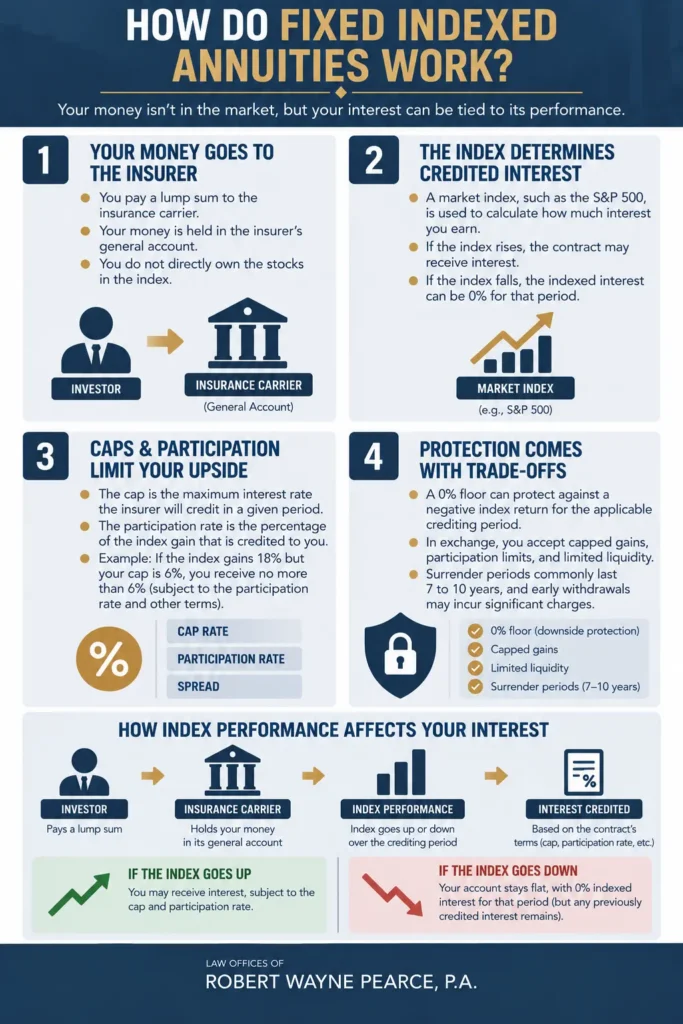
A fixed indexed annuity is an insurance contract that credits interest based on the performance of a market index like the S&P 500, but your money never enters the market. The insurance company holds it in its general account and uses the index only to calculate how much interest you earn each year. If the index goes up, you receive a portion of the gain. If the index drops, your account stays flat.
With a fixed indexed annuity, you are trading stock market upside for downside protection. The insurer caps your gains, controls the participation rate, and can reset both every year after the first.
Are fixed indexed annuities a good investment?
For someone within a decade of retirement who has maxed out other tax-advantaged accounts and wants to shield a portion of their savings from a market crash, the floor has genuine value. For elderly investors who need access to their money for medical bills, long-term care, or everyday expenses, the risks are severe. The problem is that many unscrupulous stockbrokers practice elder financial abuse or improperly recommend FIAs when they shouldn’t. When that happens, you deserve compensation.
In this guide, the stockbroker fraud lawyers at the Law Offices of Robert Wayne Pearce, P.A. cover how fixed indexed annuities work, the five risks that cost investors the most, the misleading sales tactics that target seniors, the legal and regulatory forums available when a sale goes wrong, and what a claim can recover. Robert Wayne Pearce and his team have spent over 45 years handling investment fraud cases and have recovered more than $185 million for investors.
What Are Fixed Indexed Annuities?
Indexed annuities are insurance contracts that tie the interest credited to your account to the performance of a market index, such as the S&P 500. You do not own the stocks in the index. Instead, the insurance company uses the index’s performance to determine how much interest to credit to your contract. You get the potential for interest tied to market performance without actually investing your money in stocks.
Fixed indexed annuities (FIAs) and registered index-linked annuities (RILAs) are the two types most relevant to investors. They may both use a market index to determine returns, but they handle losses differently. An FIA can protect you from a negative index return for the applicable crediting period, while a RILA can leave you responsible for some market losses in exchange for greater growth potential.
How Do Fixed Indexed Annuities Work?
Fixed indexed annuities work by handing a lump sum to an insurance carrier, and in return, the carrier credits interest to your account based on how a market index performs over a set period, usually one year. Your money is not invested in the underlying market index. It sits in the carrier’s general account, and the index determines how much interest you earn.
Each contract year, the carrier looks at where the index started and where it finished. If the index went up, you get a portion of that gain. How large a portion depends on three moving parts the carrier controls: the cap rate, the participation rate, and the spread.
If the index finishes flat or negative, the carrier credits no indexed interest for that period. Interest you earned in earlier periods remains part of your account value. Most contracts also provide a guaranteed minimum interest rate, often between 1% and 3%, applied to at least a portion of the premium.
Withdrawals depend on when you take the money out and the terms of your contract:
- During the 7- to 10-year surrender period, withdrawals may incur charges of around 8% to 10%. Many contracts allow about 10% in annual free withdrawals.
- After the surrender period, you can withdraw the contract value, take income, or exchange the annuity, subject to the contract and tax rules.
The insurance carrier profits on the spread between what their general account earns and what they credit to you. That spread funds the guarantees. It also means the carrier, not you, holds the investment risk.
What Are Caps in Fixed Indexed Annuities?
A cap is the maximum interest rate an insurance company will credit to your account in a given contract period, regardless of how well the index performs. If your contract has a 6% cap and the S&P 500 gains 18% that year, you earn 6%. The remaining 12% stays with the insurer.
Caps exist because the insurance company is the one bearing the downside risk. The 0% floor costs them money to maintain, and the cap is how they pay for it. The spread between what the index returns and what they credit to your account funds the guarantee, covers the company’s operating costs, and generates profit.
Are Fixed Indexed Annuities a Good Investment?
It depends on what you need the money to do. If you’re within 10 years of retirement, have maxed out other tax-advantaged accounts, and want to protect a chunk of your retirement income and savings from a market crash, a fixed indexed annuity does that job well. The floor matters when you can’t afford to wait five years for a recovery.
If you’re younger, have a longer time horizon, or need liquidity, the caps and surrender penalties cost you more than the protection is worth. A simple index fund will outperform over 20 years in nearly every scenario. The annuity trades upside for certainty. Whether that trade makes sense depends on your financial goals, when you need the money, and how much market volatility you can stomach.
Pros and Cons of Fixed Indexed Annuities
Fixed indexed annuities tie your returns to a market index like the S&P 500, but with a floor. You won’t lose principal from a negative index return during the applicable crediting period. That protection can be useful for people nearing retirement who have less time to recover from a market decline.
Your returns are still limited by the contract. Most contracts cap annual gains at somewhere between 4% and 10%, depending on the carrier and crediting method. If the index returns 20%, you may receive only a portion of that gain. Surrender periods also often last 7 to 10 years, and early withdrawals can trigger additional charges and taxes.
Pros
- Principal protection — your balance won’t drop when the index does
- Returns beat traditional fixed annuities in most years
- Tax-deferred growth until you withdraw
- Guaranteed minimum interest rate regardless of market performance
- No direct market exposure, so no sequence-of-returns risk near retirement
Cons
- Gain caps limit your upside, typically 4%-10% per year
- Surrender periods of 7-10 years with steep early withdrawal penalties
- Crediting methods (point-to-point, monthly averaging, spread) are complex and favor the carrier
- Participation rates mean you may only capture 50%-80% of the index gain even before the cap
- No dividends — most track price-return indexes, not total return
- Fees are baked into the cap and participation rate, making true cost hard to compare
- Riders for income or death benefits add layers of cost that erode net returns
Registered Index-Linked Annuities (RILAs)
RILAs, also called buffer annuities, are a newer product category that has exploded in popularity, reaching $65.6 billion in sales in 2024, a 38% year-over-year increase. Unlike FIAs, RILAs are SEC-registered securities, and they must be sold through Financial Industry Regulatory Authority (FINRA)-registered broker-dealers. RILAs offer higher potential returns than FIAs, but they come with genuine downside risk. A “buffer” absorbs the first 10–30% of index losses, but the investor bears all losses beyond that threshold. In a severe market downturn, a RILA investor can lose a significant portion of their principal.
As of September 2024, the SEC requires RILAs to register on Form N-4 and provide investors with a summary prospectus and Key Information Table. Because RILAs are securities, investors who receive unsuitable RILA recommendations from a broker-dealer generally have access to FINRA arbitration, a faster and more accessible forum than state court litigation.
Five Indexed Annuity Risks That Cost Investors the Most
None of these risks appear as a loss on your annual statement, which is what makes them easy to sell past. Each one can take real money out of a retirement account over the decade or more these contracts are built to run.
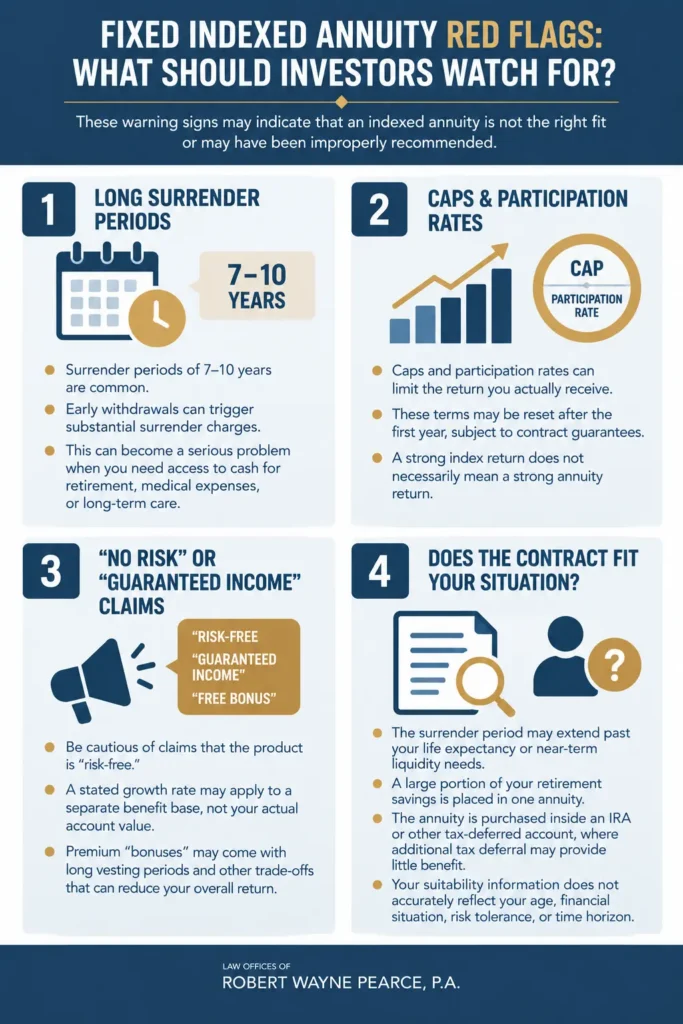
- Surrender charges: Surrender charges often start at 8% to 10% and decrease each year, with some schedules lasting a decade or more. Medical bills, assisted living, or a spouse’s death rarely arrive on the annuity’s timeline, and the penalty may apply regardless of the reason for the withdrawal.
- Caps and participation rates are not locked in: Most contracts allow the insurer to reset these crediting terms annually after the first year, subject to a minimum guarantee. A 7% cap, for example, could become a 3% cap in year four, leaving you to accept the lower rate or pay a surrender charge to leave.
- You never collect dividends: Indexed annuities typically credit interest based on an index’s price return rather than its total return, which includes dividends. This means the S&P 500’s full return shown in a sales presentation may be higher than the return used to calculate your interest.
- Your only guarantee is the insurance company: The 0% floor depends on the insurer’s financial strength, claims-paying ability, and indexed annuities do not have FDIC or SIPC protection. If the insurer becomes insolvent, recovery runs through your state’s guaranty association, subject to statutory limits that vary by state.
- Early withdrawals trigger stacked penalties: Taking money out before age 59½ may subject you to a 10% federal tax penalty, ordinary income tax, and any applicable surrender charge. A single early withdrawal can trigger all three costs at once.
Misleading FIA Marketing Tactics That Trap Seniors
The indexed annuity industry has a documented history of deceptive sales practices targeting elderly investors, drawing enforcement actions from the SEC, FINRA, state attorneys general, and insurance departments for over two decades. Common tactics include:
- Premium “bonuses” of 4-10%: Agents present these as free money, but they vest over 7-10 years and are offset by higher surrender charges, lower caps, and lower participation rates that erase the bonus entirely. The Allianz BonusMaxxx litigation ended in a $251 million settlement after allegations that the company sold ‘two-tiered’ bonus annuities to over 238,000 seniors using bonuses that were inaccessible for 10-15 years.
- “Guaranteed income” claims: Agents cite 6-8% annual growth, but that rate applies to a separate benefit base, not the actual account value. That benefit base can only be taken as lifetime income payments, cannot be withdrawn as a lump sum, does not pass to heirs, and can be permanently reduced by excess withdrawals.
- “No risk” framing: Sales materials emphasize the 0% floor without disclosing the real costs, including capped returns, surrender charges of 10% or more lasting 7-14 years, and the insurer’s ability to lower caps and participation rates annually after you are locked in. The California Department of Insurance found 97% of Allianz annuities sold to 84- and 85-year-old seniors were financially unsuitable.
- “Free lunch” seminars: A joint SEC, FINRA, and NASAA examination found 100% of the seminars reviewed were disguised sales pitches, with 50% containing exaggerated or misleading advertising claims.
Warning Signs Your Indexed Annuity Was Mis-Sold
The warning signs of a mis-sold indexed annuity are mismatches between what the contract actually does and what your own paperwork says you needed. You may already suspect this, because the account has not behaved the way the presentation said it would. The signs that show up most often in the cases we review are these:
- The surrender period runs past your life expectancy, or past the age at which you were always going to need the money.
- A large share of your liquid savings went into a single contract.
- The annuity sits inside an IRA or another tax-deferred account, where the tax deferral you were sold adds nothing.
- You were told the product was risk-free, or that the bonus was yours immediately.
- The suitability or best interest form in your file records income, net worth, risk tolerance, or a time horizon you never gave.
- The purchase replaced an annuity you already owned within the last few years.
- Nobody has given you a straight answer about the cap, the participation rate, or the surrender schedule.
- The person who sold it holds an insurance license and no securities registration, yet described the contract as an investment.
The suitability form deserves particular attention. It is the document the seller relied on to justify the recommendation, and it is the one investors most often find has been completed with a financial profile they do not recognize. When that form describes an investor with a fifteen year horizon and a moderate risk tolerance, and you were 79 years old and needed the money for care, the mismatch is documented in the file rather than left to memory.
Recent Enforcement Actions Confirm Ongoing Regulatory Scrutiny (2024–2026)
Regulators are not just looking at past abuses. Several significant enforcement actions in 2024–2026 demonstrate that the SEC and FINRA are actively pursuing indexed annuity violations under current rules, including Regulation Best Interest.
- SEC v. Cutter Financial Group (D. Mass., Feb. 2026): In a landmark case, the SEC charged investment adviser Jeffrey Cutter with recommending FIAs to advisory clients without disclosing his 7–8% upfront commissions while also charging advisory fees. The firm earned over $9 million in undisclosed commissions from FIA sales to approximately 430 retirement-age clients. A federal jury found the defendants liable, and the court entered final judgment in February 2026, imposing penalties and a five-year injunction. This case established that an adviser’s fiduciary duty extends to FIA recommendations, even though FIAs are insurance products, not securities, when made to advisory clients.
- FINRA v. AAG Capital (May 2025): In the first major FINRA enforcement action specifically targeting RILA compliance under Regulation Best Interest, FINRA found that AAG Capital recommended 479 RILA transactions totaling over $92 million without adequate policies. Of 41 exchanges from existing insurance or annuity contracts, 19 resulted in customers losing life or death benefits or paying surrender charges. Six customers exchanged life insurance policies for RILAs and forfeited death benefits valued at over $100,000 more than their policies’ surrender value. AAG was censured and fined $100,000 with $38,591 in restitution.
- Rosenau Family Research Foundation v. Principal Securities (FINRA Arbitration, June 2024): A Minnesota nonprofit established by Powerball lottery winners alleged that a Principal Securities broker invested 99% of the foundation’s $26 million in variable annuities and life insurance despite the foundation being tax-exempt, which rendered the tax-deferral benefits worthless. The arbitration panel awarded $7.34 million in compensatory damages, the largest annuity-related FINRA arbitration award in recent years.
Who Can Be Held Liable for Your Indexed Annuity Losses
Liability for an indexed annuity loss usually reaches past the individual who sold you the contract. The parties who profited from the sale are often the ones with both the responsibility and the assets to answer for it.
Liability for an indexed annuity loss can extend beyond the person who sold you the contract. Depending on the facts, the broker-dealer, investment adviser, or insurance company may also face liability.
Where a broker-dealer was involved, the firm may be held responsible for failing to properly supervise an annuity recommendation. FINRA Rule 3110 requires member firms to maintain a supervisory system reasonably designed to achieve compliance with applicable securities laws and FINRA rules.
If the dispute falls within FINRA’s arbitration rules, an investor may seek compensation from the broker-dealer or its associated person through FINRA arbitration. FINRA arbitration can provide a forum for recovering losses without having to pursue the dispute in court.
Other parties may also be liable depending on how the annuity was sold. Investment advisers owe fiduciary duties to their advisory clients, and the SEC recently obtained a judgment against an investment adviser and his firm over undisclosed financial incentives tied to fixed indexed annuity sales. Insurance companies may also face liability based on their role in designing, supervising, or distributing annuity products. The Negrete litigation against Allianz, for example, involved allegations concerning the company’s relationship with affiliated field marketing organizations and the sale of deferred annuities to seniors.
Protect Your Retirement: Contact an Experienced Stockbroker Fraud Attorney
At the Law Offices of Robert Wayne Pearce, P.A., we have more than 45 years of experience representing investors who have been harmed by unsuitable investment recommendations, broker misconduct, and elder financial abuse. Attorney Robert Wayne Pearce has served as lead counsel in more than 100 FINRA arbitration proceedings and has recovered over $185 million for investors nationwide.
If you or a family member purchased an indexed annuity and experienced any of the following, we want to hear from you:
- your broker recommended a long-term annuity despite your age or liquidity needs
- you were told the product was “risk-free” or that a bonus was immediately available
- you incurred steep surrender charges when you needed access to your funds
- your broker failed to explain participation rates, caps, or surrender schedules
- or a significant portion of your retirement savings was concentrated in annuity products.
Contact us today for a free, no-obligation consultation. Call (561) 338-0037 or use the contact form on our website to discuss your situation. Time limits apply to all investment claims, so prompt action is important.