
Leveraged ETF decay is the tendency for a leveraged ETF to lose value relative to the simple leveraged return of its underlying index over longer periods, especially when the market is volatile.
If a broker recommended a leveraged ETF as a long-term investment, you may have a claim depending on the circumstances. Don’t wait, since FINRA won’t hear most claims filed over six years after the event.
In 45 years of representing investors, Robert Wayne Pearce has recovered over $185 million. We charge nothing unless we recover for you. Book a free consultation with our ETF investment loss lawyers.
This guide shows how daily resets cause decay, with the flat-market math. It also covers what makes decay worse, whether a fund can go to zero, when a long hold is your broker’s fault, and how to recover.
What Is Leveraged ETF Decay?
Leveraged ETF decay is the loss a leveraged fund can experience when its index moves up and down, even if the index eventually ends up where it started.
You may also see this described as volatility decay or volatility drag. These terms refer to the effect of daily compounding, which can cause a leveraged ETF to lose value in a choppy market. Beta slippage is another related term. However, it’s used more broadly to describe the difference between a leveraged ETF’s actual performance and the return you might expect from simply multiplying the index’s overall return.
A leveraged ETF is an exchange-traded fund that uses swaps, futures, and other financial instruments to gain leveraged exposure to an underlying asset or index at a multiple such as 2x or 3x. But that multiple applies to a single day’s return. Over a week or a month, the fund’s result can come in well below three times what the index did.
An inverse exchange-traded fund works the same way in reverse (it aims for a negative multiple such as -1x or -3x of the daily move), so it decays too.
How Daily Rebalancing Causes Decay
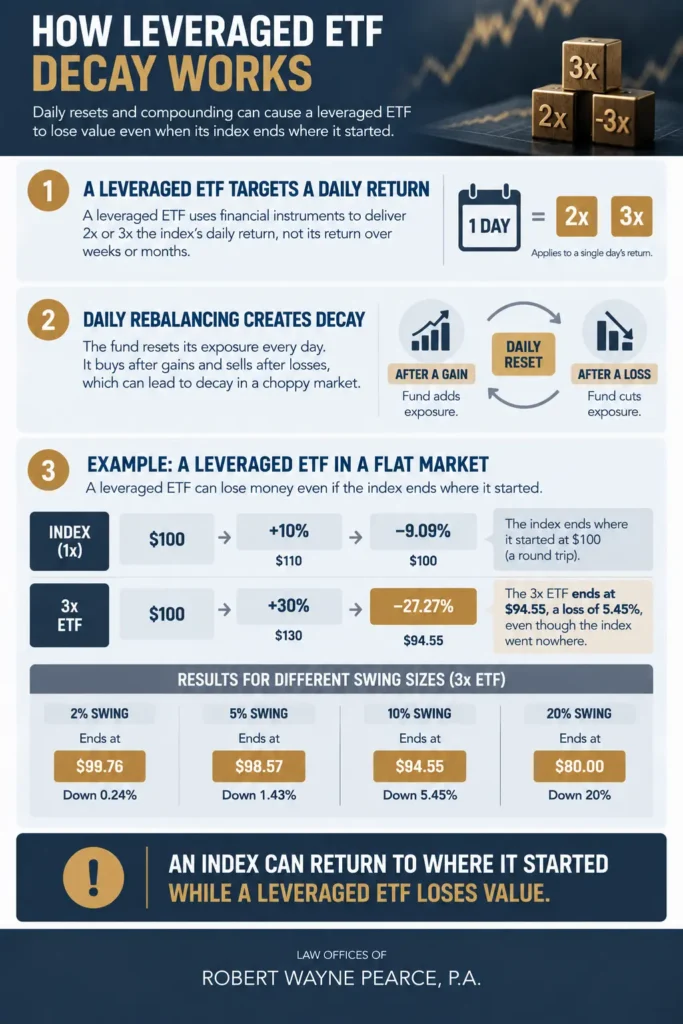
Daily rebalancing causes decay because the fund resets its exposure at the end of every trading day, so each day’s gain or loss compounds on a new starting value. FINRA said so directly in Regulatory Notice 09-31: “Most leveraged and inverse ETFs ‘reset’ daily, meaning that they are designed to achieve their stated objectives on a daily basis.”
After an up day, a 3x fund holds more assets, so it has to add exposure to keep it at three times. After a down day, it has to cut exposure. In other words, the fund buys after gains and sells after losses, and in a choppy market it keeps doing both.
Compounding then does the rest of the damage to your balance. A loss always needs a bigger gain to recover (a 50% drop needs a 100% gain just to get back to even), and leverage makes every loss bigger. So each down day digs a hole the next up day can’t quite fill.
That’s why the same notice warned that “due to the effect of compounding, their performance over longer periods of time can differ significantly” from the index they track. You don’t need a falling market to lose money this way.
A Leveraged ETF in a Flat Market
A leveraged ETF can lose money in a flat market because the index’s round trip doesn’t cancel out once it’s multiplied. Say you put $100 into a 3x fund while its index is at $100, and the index has one good day followed by one bad day.
A 10% rise takes the index to $110 and your fund to $130. Then the index drops 9.09% back to $100, while your fund drops three times that, 27.27%, and closes at $94.55, so you’re down 5.45% on an index that went nowhere.
We ran the same up-then-back-to-even round trip for a 3x leveraged ETF at four swing sizes, and here’s where a $100 stake ended:
- 2% swing: The fund ends at $99.76, a loss of 0.24%.
- 5% swing: The fund ends at $98.57, a loss of 1.43%.
- 10% swing: The fund ends at $94.55, a loss of 5.45%.
- 20% swing: The fund ends at $80.00, a loss of 20%.
You’ll find far worse results in real market history. FINRA’s notice pointed to an ETF built to deliver three times the daily return of the Russell 1000 Financial Services Index, which “fell 53 percent while the index actually gained around 8 percent” between December 1, 2008, and April 30, 2009.
What Makes Leveraged ETF Decay Worse
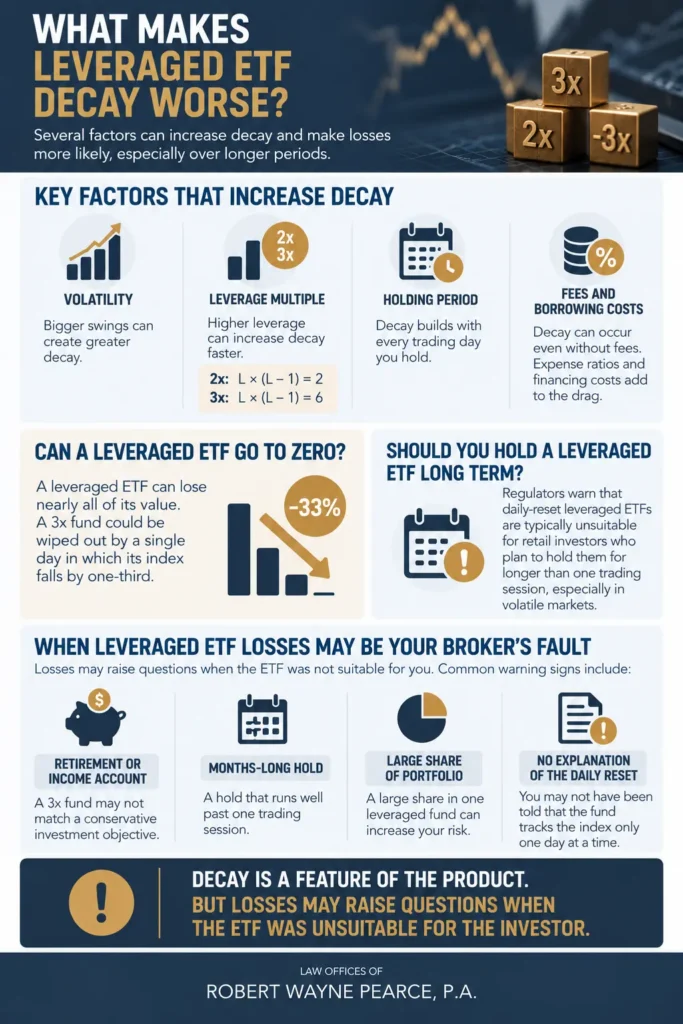
How much a leveraged ETF loses to decay depends on volatility, the leverage multiple, how long you hold it, and what the fund costs to run:
Volatility
Volatility drives decay more than anything else. A common approximation puts the drag at about half of L × (L − 1) × σ² × T, where L is the multiple and σ is the index’s daily volatility. T is the number of trading days you hold.
Because the formula squares volatility, bigger swings hurt far more than their size suggests. In our example, the 20% round trip cost the fund nearly four times what the 10% round trip did.
But decay isn’t guaranteed, and a steady trend can even work in your favor. If the index rises 3% a day for five straight days, it gains 15.93%, and a 3x fund compounding 9% a day gains 53.86%, which beats three times the index return of 47.8%. You get that bonus only in a smooth trend, and nobody can tell you in advance which kind of market you’re buying into.
The Leverage Multiple
The multiple raises decay faster than it raises exposure. In the formula, L × (L − 1) comes to 2 for a 2x leveraged ETF and 6 for a 3x fund, so the 3x fund decays about three times as fast in the same market.
On the same 10% swing, a 2x fund ends at $98.18, down 1.82%, while the 3x fund is down 5.45%, almost exactly three times as much.
Holding Period
Decay builds with every trading day you hold. If you buy and sell within one day, you get the stated multiple (before costs), since there’s no reset to compound.
GraniteShares (an issuer of leveraged ETFs) says investors “usually hold these funds for a day or two, sometimes up to 10-14 days on the longer side.” Your fund’s prospectus spells out its daily objective, so read it before you hold past a single session.
Fees and Borrowing Costs
You’d see decay even in a fund that charges nothing, because it’s arithmetic rather than a fee. On top of it, though, a leveraged fund pays an expense ratio plus the financing cost of the swaps and futures behind its exposure, and both come out of your return every day you hold.
Can a Leveraged ETF Go to Zero?
A leveraged ETF can lose nearly all of its value, and a 3x fund would in theory be wiped out by a single day in which its index fell a third. GraniteShares research on decay warns that “an investor could lose the full principal value of his/her investment within a single day.”
Decay also makes a slower slide toward zero more likely for you. Each choppy stretch shrinks the base the fund’s value compounds from, so it needs ever larger gains to recover, and a fund that has lost 80% needs a 400% gain to get back to where it started. If you’ve watched a 3x fund bleed value for months in a sideways market, that’s the pattern you’re looking at.
Should You Hold a Leveraged ETF Long Term?
Holding a leveraged ETF long term is what regulators warn against most, particularly during periods of high volatility. FINRA’s Regulatory Notice 09-31 says that “inverse and leveraged ETFs that are reset daily typically are unsuitable for retail investors who plan to hold them for longer than one trading session, particularly in volatile markets.”
A long hold only pays off in a steady trend with low volatility, and that’s a bet on the market’s path as well as its direction. If you bought a 3x fund as a long-term position because someone recommended it to you, you may want to look hard at that recommendation.
When Leveraged ETF Losses Are Your Broker’s Fault
Leveraged ETF losses can become a broker’s responsibility when the recommendation was wrong for you, especially if it exposed you to significant losses that were inconsistent with your circumstances and tolerance for market risk.
Under the SEC’s Regulation Best Interest, a broker-dealer “must act in the retail customer’s best interest and cannot place its own interests ahead of the customer’s interests” when recommending a security.
Reg BI’s Care Obligation also requires a broker to understand a product’s risks and costs before recommending it. A broker should also consider whether the investment fits the customer’s investment objectives, risk tolerance, financial situation, and other relevant circumstances.
FINRA Rule 2111 still covers recommendations Reg BI doesn’t reach, and it requires “a reasonable basis to believe that a recommended transaction or investment strategy involving a security or securities is suitable for the customer.”
Those concerns have also led to FINRA enforcement actions involving leveraged ETFs. On May 1, 2012, it sanctioned Citigroup, Morgan Stanley, UBS, and Wells Fargo a total of $9.1 million, including $7.3 million in fines and $1.8 million in restitution to investors.
FINRA found the firms “did not have a reasonable basis to recommend the ETFs to their retail customers,” and some of those customers “held them for extended periods when the markets were volatile.”
Your own statements often show whether you have a claim. Look for these warning signs in your leveraged ETF losses:
- A retirement or income account: A 3x fund may conflict with the conservative investment objectives recorded on your new account form.
- A months-long holding period: Your broker recommended holding the fund well beyond the one-day period highlighted in FINRA’s notice.
- A large share of your portfolio: Concentrating a significant portion of your assets in one leveraged fund can expose your savings to substantial losses.
- No explanation of the daily reset: Your broker may not have adequately explained that the fund targets a daily, rather than a long-term, multiple of the index’s return.
How to Recover Leveraged ETF Losses
If a broker’s recommendation caused your leveraged ETF losses, you may be able to seek compensation through FINRA arbitration, administered by FINRA Dispute Resolution Services. Whether the claim can proceed through FINRA depends on the circumstances and the applicable arbitration rules.
One thing to consider is whether the claim is still within FINRA’s time limit. FINRA Rule 12206 states that “no claim shall be eligible for submission to arbitration under the Code where six years have elapsed from the occurrence or event giving rise to the claim.”
State deadlines can run shorter than that, which we cover in our guide to the FINRA statute of limitations.
We recommend gathering your account statements, trade confirmations, new account forms, and any emails or notes from your broker before you speak with a lawyer. Those records show what you told the firm about your goals and what it bought for you anyway.
Talk to a Leveraged ETF Lawyer
Here at the Law Offices of Robert Wayne Pearce, P.A., we focus on leveraged ETF cases and fight to recover everything our clients are owed. Our FINRA arbitration lawyer team has 45 years of experience and has recovered over $185 million for investors.
You won’t pay a fee unless we recover for you. Call us at (866) 860-7447 for a free consultation, and we’ll go through your statements with you to see whether decay or your broker’s recommendation caused your losses.